While I hope that these little sections at the beginning of each
chapter are always useful, the note in this chapter is much more
important to read!
It would be far too ambitious of me to hope to write a single chapter
that will teach you how to write a proof. Entire books have been written
on this subject. Here are a couple that have been made freely available
online by their authors:
A classic book that should also be mentioned is How to Solve
It by George Pólya [85]. It is not a book about the method of
writing a proof, but will give you advice on how to come up with an idea
for it, which is maybe even more valuable.
Usually, when you learn proof-writing, you begin by proving
statements that are mathematically easy, so you don’t have to struggle
with two things at once. After you’ve done that, you might not yet be
comfortable with writing proofs on topics that challenge you
mathematically. If this is the level you’re at, then this chapter is for
you.
I will try to prepare you for the kind of proofs you will encounter
in this book by showing you how the general ideas of proof-writing
specialize to graph theory. A proof is a proof in every area of math,
but there are some ideas that show up in graph theory much more often
than in number theory or real analysis, for example. When you get used
to proofs in several areas of math, you will be an experienced
mathematician. You’ll be able to jump into a new topic much more
confidently.
So that you can benefit from this chapter early, I’ll limit myself to
examples from the first part of this book (Chapter 1 through Chapter 4), but I will mention chapters
later in the book where you’ll see more examples.
Conditional statements
In the moment when you first start trying to prove a theorem, you may
not yet know how the proof will go. However, just from the statement of
the theorem, you can have a rough overall idea of the strategy you need
to take. This is a good way to fight “blank page syndrome”, where you’re
staring at a problem and have no clue what to write!
So what do we look for in a statement? A big part of it is
conditional statements: statements that can be expressed in the form “If
\(P\), then \(Q\)”. If you’re trying to prove such a
statement, you can try:
A direct proof, where you assume that \(P\) is true, and try to prove that \(Q\) is true.
A proof by contrapositive, where you assume the
negation of \(Q\), and try to prove the
negation of \(P\). (This is a direct
proof of the contrapositive, “If not \(Q\), then not \(P\)”, which is an equivalent form of the
original conditional statement.)
A proof by contradiction, where you
simultaneously assume both \(P\) and
the negation of \(Q\), and try to prove
any statement you know is false.
A big reason why conditional statements are confusing to beginners is
that the informal meaning of “if \(P\),
then \(Q\)” in the English language is
under-specified. If you say a sentence like this in casual conversation,
only context can determine what you mean in the case that \(P\) is not true. Consider the following
examples:
“If you’ve lived in Paris your whole life (\(P\)), you’re French (\(Q\)).” Here, \(Q\) can still be true even if \(P\) is false: many French people have never
been to Paris.
“If you spend at least $50 (\(P\)), you will get free shipping (\(Q\)).” Here, the offer implies that you
will not get free shipping unless you spend at least $50: when \(P\) is false, \(Q\) is also false.
“If you’re hungry (\(P\)),
there’s pizza in the fridge (\(Q\)).”
Here, the condition is irrelevant, and \(Q\) is true regardless of the status of
\(P\).
In formal mathematics, an “if \(P\),
then \(Q\)” statement always goes
hand-in-hand with an implicit “and if not \(P\), then anything could be true”. It is an
assertion that \(Q\) is true, but
limited only to situations where \(P\)
is true, without making any claim about situations where \(P\) is false. When we want to talk about
both situations, and say that when \(P\) is false, \(Q\) must also be false, the standard
formulation is “\(Q\) if and only if
\(P\)”.1
Even mathematicians are not perfect at maintaining this distinction
in all circumstances. One place where you will often see the word “if”
misused, from a formal point of view, is in definitions. Though I have
avoided it in this book, it is common to see definitions phrased as, for
example, “A walk \((x_0, x_1, \dots,
x_l)\) is closed if \(x_0 =
x_l\).” All definitions should be read as if-and-only-if
statements: a walk is closed if \(x_0 =
x_l\), and not otherwise.
Finally, let me say a bit about necessary conditions and sufficient
conditions. This is another view of conditional statements. If the
statement “If \(P\), then \(Q\)” always holds, we say that \(P\) is a sufficient
condition for \(Q\): knowing
that \(P\) is true is enough to know
that \(Q\) is true. We call \(Q\) a necessary condition
for \(P\), in the sense that without
\(Q\) happening, \(P\) can’t happen either: this is a
paraphrase of the contrapositive, “If not \(Q\), then not \(P\)”. We don’t always use these terms,
though: we use them to emphasize specific ways of thinking about a
conditional statement.
We say that \(P\) is a sufficient
condition for \(Q\) to emphasize that
we’re in a scenario where \(Q\) is
normally a difficult statement to evaluate, but \(P\) is an easy-to-check test that can
sometimes tell us that \(Q\) is true.
For example, Corollary 4.7 is a
conditional statement where \(P\) is “A
graph \(G\) with \(n\) vertices has at least \(n\) edges” and \(Q\) is “\(G\) contains a cycle”. Often, counting
vertices and edges is much easier than investigating the graph’s
structure to see if it has a cycle or not. If we count the vertices and
edges and the hypothesis of Corollary 4.7 holds, then we
can skip that investigation! The condition we’ve checked is sufficient
to know that the graph has a cycle without looking for it.
We say that \(Q\) is a necessary
condition for \(P\) in the reverse
scenario: when \(P\) is difficult to
investigate, and \(Q\) is a simple
test. However, with necessary conditions, the test has a different
meaning: we learn nothing if we check \(Q\) and it is true, but if we check \(Q\) and it is false, we learn that \(P\) must also be false. For example,
Proposition 2.2
tells us that if \(G\) and \(H\) are isomorphic, then \(|V(G)| = |V(H)|\) and \(|E(G)| = |E(H)|\). Determining whether two
graphs are isomorphic is hard, but counting the vertices and edges is a
simple initial test we can do. If \(|V(G)| \ne
|V(H)|\), or if \(|E(G)| \ne
|E(H)|\), we can skip the hard work: the necessary condition
doesn’t hold, so \(G\) and \(H\) are definitely not isomorphic!
If we have an if-and-only-if relationship between \(P\) and \(Q\), then either statement is said to be a
necessary and sufficient condition for the other. If we
discover such a relationship, and one of the statements is a simple
test, then we can consider the other statement to be easy to check as
well. Knowing whether \(P\) is true or
false tells us all about \(Q\), and
vice versa.
Quantifiers
Whichever proof strategy you select, it will give you some goals to
work toward, and some initial assumptions to work with. Usually, those
goals and assumptions will contain quantifiers, which give you further
structure. Quantifiers come in two types: existential and universal.
An existential quantifier is fancy terminology for a
piece of a statement which says that some kind of object exists. The
notation “\(\exists x\in S, P(x)\)” is
shorthand for saying, “There exists an object \(x\) in the set \(S\) for which \(P(x)\) is true.”
Typically, we prove such a claim by constructing an example; in
simple cases, that just means writing down what it is. For example,
suppose you want to prove the following statement: “The circulant graph
\(\operatorname{Ci}_8(3)\) is
isomorphic to \(C_8\).” Two graphs
\(G\) and \(H\) are isomorphic if there exists an
isomorphism between them: a function \(\varphi
\colon V(G) \to V(H)\) with certain properties. Your proof might
begin by defining a function \(\varphi\), and then checking that it has
the properties that make it an isomorphism between \(\operatorname{Ci}_8(3)\) and \(C_8\).
I should also describe what happens when an existential statement is
part of your assumptions. In that case, you get to summon up an object
of the type being described, and start using it in your proof; this can
be incredibly helpful! For example, suppose you are giving a direct
proof of the following statement: “If a graph \(G\) has an \(x-y\) walk, then it has an \(x-y\) path.” The existence of an \(x-y\) walk is one of your assumptions: you
get to assume that such a walk exists.
It’s often a good idea to describe the object in detail, giving names
to its moving parts; you might begin by saying, “Let the sequence \((x_0, x_1, \dots, x_l)\) be an \(x-y\) walk, with \(x_0 = x\) and \(x_l = y\).” Later on in the proof, you will
get to manipulate the vertices \(x_0, x_1,
\dots, x_l\), and use facts about them that are based on the
definition of an \(x-y\) walk.
Moving on, a universal quantifier says that a
statement is always true: it is a universal rule. The notation “\(\forall x \in S, P(x)\)” is shorthand for
saying, “For all objects \(x\) in the
set \(S\), the statement \(P(x)\) is true.”
What if the set \(S\) is the empty set?
In that case, a statement about all
elements of \(S\) is automatically
true, because there’s nothing to check: we say it is vacuously
true.
We don’t generally make such statements on purpose, but we might get
them as a special case of a more general theorem.
To prove such a statement, we need an argument that applies to every
element of \(S\) at once. There is a
standard way to phrase such an argument: it is to choose an arbitrary
element \(x \in S\), assuming nothing
else about it. Then, your goal is to prove that \(P(x)\) is true. This can be easy or hard,
but look on the bright side: in this scenario, you both get to start
with an element \(x\in S\) to work
with, and get an idea of how you want your proof to end!
For example, suppose you want to prove the following statement: “For
all integers \(n\ge 3\), the cycle
graph \(C_n\) is connected.” You would
begin by taking an integer \(n\ge 3\),
and writing the rest of your proof for that value of \(n\). As long as you don’t accidentally
sneak in any further assumptions about \(n\), your argument will apply to every
integer you could have chosen.
The case I find most frustrating is the case of assuming a “for all”
statement, because you can’t do anything with it when you begin. For
example, suppose you have a graph \(G\)
for which you’ve made the assumption, “All cycles in \(G\) have an even length.” (See Chapter 13 to learn more about such
graphs.) You can’t do anything right away—it’s only once you encounter a
cycle in \(G\) that this assumption
“triggers” and tells you that the length of the cycle is even. It’s
possible that \(G\) has no cycles, in
which case you will never get to use the assumption.
When you get to assume it:
When you have to prove it:
\(\forall x \in S, P(x)\)
Nothing can be done right away.
When you encounter elements of \(S\), then you can assume that \(P\) is true for those elements.
Tells you how to begin and end.
Begin by defining an element \(x \in S\); you can't control anything else about \(x\). Your goal is to prove \(P(x)\).
\(\exists x \in S, P(x)\)
Tells you how to begin the proof.
Begin by defining an element \(x \in S\) and assuming that \(P(x)\) is true; you can't control anything else about \(x\).
Tells you how to end the proof.
You must somehow construct an element \(x \in S\) (you don't get to start with one) for which \(P(x)\) is true.
How to use quantifiers in a proof
To give you an overview of the situation at a glance, Figure A.1 describes what happens to
both types of quantifiers in both cases: when you assume them, and when
you prove them. Since some cases are easier to deal with than others,
you can try to change which case you have to deal with by changing your
approach.
You could try a different proof method that changes what you have
to do: for example, instead of proving a statement, you might assume its
negation.
You could use a theorem which gives an alternate characterization
of an object, with a different type of quantifier.
In more complicated statements, you will have to juggle both kinds of
quantifiers at once. An especially important combination to look at is
the combination \(\forall x, \exists
y\): “For every \(x\), there
exists a \(y\).” This is a very
demanding statement to prove, because you must present an example of
\(y\), which might have to depend on
\(x\); however, you can’t make any
assumptions about \(x\). Let me give
you some examples to compare:
“The circulant graph \(\operatorname{Ci}_8(3)\) is isomorphic to
\(C_8\)” is a concrete, purely
existential statement: no universal quantifiers at all. You can prove
that an isomorphism exists by writing down what it is and checking the
conditions.
“For all odd \(n\ge 3\), the
circulant graph \(\operatorname{Ci}_n(2)\) is isomorphic to
\(C_n\)” has a universal quantifier on
\(n\), but an existential quantifier
hidden inside the word “isomorphic”. You might still be able to write
down an isomorphism, but you will have to write it down as a formula in
terms of \(n\).
“Every connected \(n\)-vertex
graph \(G\) in which all vertices have
degree \(2\) is isomorphic to \(C_n\)” is even trickier: it has a universal
quantifier on a graph \(G\), which is a
much more complicated object than a number!
You will not be able to write down an isomorphism, not even with the
aid of formulas, because you can’t plug a graph \(G\) into a formula. In your proof, you
might describe a general strategy for finding an isomorphism, and check
that it always works.
This situation is part of the reason why algorithms play a big role
in graph theory: a common way to prove that something exists is to give
an algorithm for finding it. Theorem 8.3
and Theorem 8.4 are good examples of
this technique early in the book.
I should also warn you that often, universal quantifiers are omitted
in the statement of a theorem. If the statement of a theorem contains
variables that don’t have a quantifier attached, this usually means that
the theorem should be true for all possible values of those variables;
the scope should hopefully be clear from context.
I try to avoid doing this too much, but consider for example
Corollary 4.7, which I guess
I shouldn’t go back and edit because then I won’t be able to use it as
an example here. The full statement of the corollary is: “If \(G\) has \(n\) vertices and at least \(n\) edges, then \(G\) contains a cycle.” Neither \(G\) nor \(n\) is quantified, so we interpret both of
them as having hidden universal quantifiers on them. The statement
should be true for all graphs \(G\) and
for all integers \(n\ge 1\).
How do we know what kind of variables
\(G\) and \(n\) are?
Part of this is convention: \(G\) usually refers to a graph and \(n\) usually refers to an integer. Part of
this is context: \(G\) is mentioned as
having vertices and edges, so it should be a graph, and \(n\) is the number of vertices in \(G\), so it can only be a positive
integer.
Unpacking definitions
Quantifiers, implications, and many other parts of a statement can be
tucked away inside a definition where you can’t easily see them. For
example, it is not obvious from reading “\(G\) and \(H\) are isomorphic” that it’s existential
(\(\exists\)) statement: that there
exists a function \(\varphi \colon V(G) \to
V(H)\) which is an isomorphism. (Inside the definition of an
isomorphism, more quantifiers are tucked away!)
What are the quantifiers in “\(G\) is connected?”
It’s a \(\forall\exists\) statement: for every two
vertices \(x,y \in V(G)\), there exists
an \(x-y\) walk.
What are the quantifiers in “The maximum
degree of \(G\) is \(k\)?”
It has two parts: a \(\forall\) statement that every vertex has
degree at most \(k\), and an \(\exists\) statement that there exists a
vertex of degree \(k\). (More on such
statements later!)
This means that there’s an important first step you have to keep in
mind whenever you write a proof: you must unpack all the definitions
you’re working with to get at the moving parts inside them!
Let’s look at an example of this: the proof of Lemma 3.3. This lemma
claims that the relation \(\leftrightsquigarrow\) on the vertices of a
graph \(G\) is an equivalence relation,
where \(x \leftrightsquigarrow y\) is
defined to mean that there is an \(x-y\) walk in \(G\).
To begin with, we are proving that something is an equivalence
relation. By definition, an equivalence relation is a relation which is
reflexive, symmetric, and transitive. So right away, we know that our
proof will have three parts, one where we prove each part of the
definition.
Let’s look at just one of these: proving that \(\leftrightsquigarrow\) is symmetric. The
definition of this is that for all \(x\) and \(y\) (which, in this case, are vertices of
\(G\)), if \(x\leftrightsquigarrow y\), then \(y\leftrightsquigarrow x\).
Assuming that we choose to write a direct
proof (which there’s no reason not to do), which quadrant of Figure A.1 are we in?
The top right quadrant: we are proving a
universal statement about all pairs of vertices \(x,y \in V(G)\).
Therefore we begin by choosing arbitrary vertices \(x,y \in V(G)\). We assume that \(x\leftrightsquigarrow y\) is true, and set
ourselves a goal: to prove that \(y\leftrightsquigarrow x\) is true. At this
point, we must also unpack the definition of \(x\leftrightsquigarrow y\). We are assuming
that there is an \(x-y\) walk in \(G\); we are proving that there is a \(y-x\) walk in \(G\).
Which quadrants of Figure A.1 do these fall under?
The bottom two quadrants: both the
assumption we make about \(x\) and
\(y\) and the property we want to prove
are existential statements. We get to summon an \(x-y\) walk out of nowhere, but we will have
to construct a \(y-x\) walk.
It is not very helpful to use the existence assumption merely by
saying something like, “Let \(W\) be an
\(x-y\) walk in \(G\).” To get anything useful out of the
assumption, we should unpack the definition of an \(x-y\) walk. We say, “Let the sequence \((x_0, x_1, \dots, x_l)\) be an \(x-y\) walk, with \(x_0 = x\) and \(x_l = y\).”
Looking ahead, we see that we’ll want to define a new sequence of
vertices, which we will then prove is a \(y-x\) walk. It is only at this point that
we get to the problem-solving step of the proof! To figure out how to
get a \(y-x\) walk out of an \(x-y\) walk, we might look at some small
examples to get a feeling for the problem. With experience comes an
“intuition” for things to try, which is just a way to say that you’ve
seen similar problems before and have some guesses about what might
work.
To summarize, here is the “scaffolding” of a proof that \(\leftrightsquigarrow\) is symmetric; only
the sections with “…” are left for us to figure out. (Not every proof is
as heavy in definitions, and so you won’t always have as much unpacking
to do.)
Proof. Let \(x\) and \(y\) be two arbitrary vertices, and suppose
that \(x \leftrightsquigarrow y\): that
there is a \(x-y\) walk in \(G\). Our goal is to prove that there is
also a \(y-x\) walk in \(G\).
Let \((x_0, x_1, \dots, x_l)\) be an
\(x-y\) walk (with \(x_0 = x\) and \(x_l = y\)). Then define a new sequence of
vertices by …
This sequence of vertices starts at \(y\), ends at \(x\), and consecutive vertices in the
sequence are adjacent because …, proving that it is a \(y-x\) walk.
Since a \(y-x\) walk exists, we
conclude that \(y \leftrightsquigarrow
x\). Since this is true for all pairs of vertices \(x,y \in V(G)\), we conclude that that \(\leftrightsquigarrow\) is symmetric. ◻
I should also mention that there is a danger to unpacking too far. If
you unpack every definition you can, you are forced to write a
“low-level” proof that works with the fundamental notions of graph
theory. The alternative is a “high-level” proof, where you stop early to
apply a theorem you know to an object without unpacking it.
For example, in Chapter 4, we
gave Theorem 4.4 a
low-level proof: we proved that a cycle exists by listing out the
vertices of a walk representing it. Later, we gave Corollary 4.7 a more
high-level proof: we proved that a cycle exists by applying Theorem 4.4,
without interacting directly with the definition of a cycle.
Optimization problems
Many definitions in graph theory involve solving an optimization
problem: they are phrased in terms of the biggest or smallest thing of a
certain type. In the first part of the textbook, this includes:
The distance between two vertices \(x\) and \(y\): the length of the shortest \(x-y\) walk.
The minimum and maximum degree of a graph \(G\): the smallest and largest,
respectively, of the degrees of the vertices of \(G\).
When we say, “The distance between vertices \(x\) and \(y\) is \(5\),” we are making two separate claims.
First, we are saying that there is in fact an \(x-y\) walk of length \(5\). Second, we are saying that this is the
shortest walk: all \(x-y\) walks have
length at least \(5\). The first claim
is an existential (\(\exists\))
statement, and the second claim is a universal (\(\forall\)) statement.
What statement about the distance \(d(x,y)\) do we make if we only say that
there is an \(x-y\) walk of length
\(5\)?
This is equivalent to saying that \(d(x,y) \le 5\). The distance can’t be
longer than \(5\), because we’ve
already found walk of length \(5\), but
it might be shorter.
What statement about the distance \(d(x,y)\) do we make if we only say that
that all \(x-y\) walks have length at
least \(5\)?
This is equivalent to saying that \(d(x,y) \ge 5\). We can’t do better than
\(5\), but we don’t know if we can
actually achieve \(5\).
What we see for proofs about the distance between two vertices is
true in general. An upper bound on a minimization problem is an
existential statement: we can prove it by giving a single example of a
solution that achieves that bound. A lower bound on a minimization
problem is a universal statement: we can prove it by proving that no
solution can do better. For maximization problems, the situation is
reversed.
Let’s look at an example.
Proposition A.1. Let \(G\) be the graph with vertex set \(V(G) = \{1,2,\dots,100\}\) in which two
vertices \(x\) and \(y\) are adjacent if and only if \(|x-y|\) is the square of a positive
integer. (For example, vertices \(7\)
and \(71\) are adjacent, because \(|7 - 71| = 64 = 8^2\).)
Then \(G\) has maximum degree
\(\Delta(G)=14\).
Proof. First, we prove that a vertex of degree \(14\) exists, by example. The vertex \(50\) is adjacent to the \(14\) vertices \[1, 14, 25, 34, 41, 46, 49, 51, 54, 59, 66, 75,
86, 99.\] We don’t have to check them all by hand: these are the
vertices \(50-k^2\) for \(k=1,2,\dots,7\) and \(50+k^2\) for \(k=1,2,\dots,7\). All we have to do is to
check that the extreme values \(50 - 7^2 =
1\) and \(50 + 7^2 = 99\) still
fall within \(V(G)\).
This example proves that \(\Delta(G) \ge
14\); to prove that \(\Delta(G) \le
14\), we prove that all vertices have degree at most \(14\).
Let \(x\) be an arbitrary vertex.
From the example we looked at, we can see that to find the degree of
\(x\), we need to count how many values
of the form \(x - k^2\) or \(x + k^2\) fall with in the range \(\{1,2,\dots,100\}\). Let \(a\) be the largest integer such that \(x - a^2 \ge 1\), and let \(b\) be the largest integer such that \(x + b^2 \le 100\); then the neighbors of
\(x\) are \(x
- 1^2, x - 2^2, \dots, x - a^2\) and \(x + 1^2, x + 2^2, \dots, x + b^2\), and
\(x\) has degree \(a+b\).
What is the largest possible value of
\(a\)?
It is \(9\): even if \(x\) is as large as possible, that is if
\(x=100\), then \(x - 10^2\) is still not in the range \(\{1,2,\dots,100\}\).
Similarly, we can prove that the largest possible value of \(b\) is \(9\), giving us an upper bound of \(9+9=18\) on the degree of \(x\), and on the maximum degree. But that’s
not good enough; we wanted \(\Delta(G) \le
14\), not \(\Delta(G) \le
18\).
What prevents us from making both \(a\) and \(b\) this large simultaneously?
To get \(a\) to reach \(9\), we need \(x\) to be close to the end of the range. To
get \(b\) to reach \(9\), we need \(x\) to be close to the start of the
range.
We know that having \(a=7\) and
\(b=7\) are possible when \(x=50\), so let’s rule out the remaining
possibilities. If \(a \in \{8,9\}\),
then \(x - 8^2 \ge 1\), so \(x\) is at least \(1 + 8^2 = 65\); but now, since \(65 + 6^2 = 101\) is too big, we learn that
\(b \le 5\). Similarly, if \(b \in \{8,9\}\), then \(x + 8^2 \le 100\), so \(x\) is at most \(100 - 8^2 = 36\); but now, since \(36 - 6^2 = 0\) is too small, we learn that
\(a \le 5\). So in these cases, no
better solution than \(a+b = 9+5 = 14\)
or \(a+b=5+9=14\) is possible.
Is \((a,b) =
(9,5)\) or \((a,b)=(5,9)\)
actually achievable?
No: for example, \(a=9\) requires \(x \ge 82\), and \(b=5\) requires \(x \le 75\). This is fine for our proof: we
are done with the stage that proves existence, now we are only ruling
out options, and we don’t care about ruling out options that don’t
contradict the upper bound \(\Delta(G) \le
14\) we want.
When \(a \in \{8,9\}\) or \(b \in \{8,9\}\), we have \(\deg(x) = a + b \le 14\). But if \(a \le 7\) and \(b
\le 7\), we also have \(\deg(x) = a + b
\le 14\). Therefore \(\deg(x) \le
14\) no matter what \(x\) is.
This tells us that \(\Delta(G) \le
14\), which completes the overall proof. ◻
In Chapter 5, the diameter of a graph
\(G\) is introduced: the largest
distance between two vertices of \(G\).
The definition of diameter has one optimization problem nested inside
another! This means that both lower and upper bounds on the diameter of
a graph unpack to statements with multiple quantifiers.
For example, suppose we want to prove that the diameter of \(G\) is at most \(k\). Then we want to prove that \(d(x,y) \le k\) for all pairs of vertices
\(x,y\), which is a \(\forall\, \exists\)-type statement: for
all \(x\) and \(y\), there exists an \(x-y\) walk of length at most \(k\).
What if we try to prove that the diameter
of \(G\) is at least \(5\)?
This will be an \(\exists\,\forall\)-type statement: we want
to prove that there exist vertices \(x\) and \(y\) such that all \(x-y\) walks have length at least \(5\).
Here are some of the notable optimization problems introduced later
in the book:
The maximum matching problem and the minimum vertex cover
problem, introduced in Chapter 13.
The independence number \(\alpha(G)\) and clique number \(\omega(G)\), defined in Chapter 18.
The connectivity \(\kappa(G)\)
and several related parameters, defined in Chapter 26.
Algorithms
Algorithms play a role in graph theory for two reasons.
First of all, there are many applications of graph theory in
software, so computer scientists think about graph algorithms.
Second, even pure mathematicians that don’t care about computer
science at all can be interested in graph algorithms as an aid in
proof-writing. One way to prove that an object exists is to give an
algorithm for finding it.
In both cases, but especially in the second case, it’s important for
the algorithm to be accompanied by a proof of correctness. In most
respects, this is a proof like any other. There are a few proof
techniques that are unusually common when dealing with algorithms, which
we’ll see in a moment. Before that, there’s one feature of the proof
that I want to point out, because it’s easy to miss if you’ve never
thought about it before. It is important to prove that the algorithm
eventually stops, and doesn’t just keep iterating forever!
In the first part of the book, there is only one notable algorithm:
breadth-first search, which we use to compute distances in a graph at
the end of Chapter 3. Breadth-first search continues
to be useful in algorithms throughout this book: as late as Chapter 28, we return to it to find
a shortest path in a residual network. In this algorithm, the stopping
condition is relatively straightforward. In each step, we either explore
at least one new vertex, or we stop because we didn’t find any new
vertices. We cannot keep exploring new vertices forever: eventually, we
run out of vertices in the graph to explore!
Such situations are common, but not universal. In this textbook, the
most sophisticated proof that an algorithm stops is Theorem 28.7,
for an algorithm to find maximum flows. In that case, the algorithm
deals with real numbers, and it’s possible to keep increasing a real
number forever even if there’s an upper bound on the number; this is
what makes the analysis tricky!
To see a tricky proof that an algorithm stops that only needs topics
from the first part of the book, let me give an example from the 2019
Princeton University Mathematics Competition (PUMaC): problem 1 from the
individual final round in Division A [87]. The problem does not talk about
algorithms, but it describes an iterated procedure performed on a graph,
so many of the same ideas come up. Here it is:
Problem A.1. Given a connected2
graph \(G\) and cycle \(C\) in it, we can perform the following
operation: add another vertex \(v\) to
the graph, connect it to all vertices in \(C\) and erase all the edges from \(C\). Prove that we cannot perform the
operation indefinitely on a given graph.
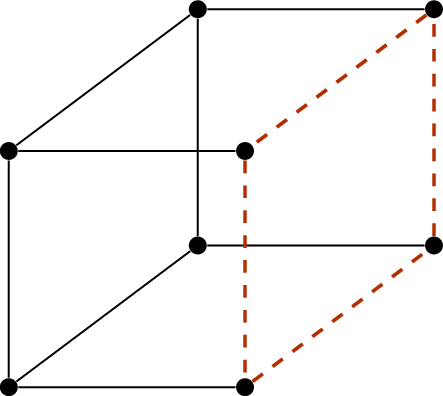
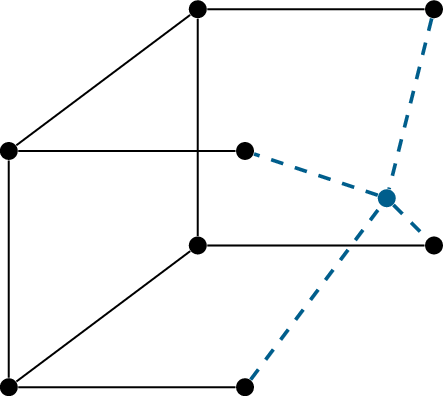
An example of this operation is shown in Figure A.2. Since the
graph gets bigger and bigger every time we perform the operation, it’s
not at all obvious that we’ll eventually have to stop!
Lemma A.2. After the operation in Problem A.1 is performed on a connected
graph, the result is another connected graph.
Proof. Let \(G\) be the
graph we started with and let \(H\) be
the result of performing the operation.
For any two vertices \(x,y \in
V(G)\), there is an \(x-y\) walk
in \(G\), because \(G\) is connected. We can turn this \(x-y\) walk in \(G\) into an \(x-y\) walk in \(H\), even though not all edges of \(G\) are still present in \(H\). Every time that the walk goes from a
vertex \(u\) to a vertex \(w\) along an edge of \(C\), replace that step by two steps, \(u\) to \(v\) to \(w\).
This proves that all vertices of \(V(G)\) are in the same connected component
of \(H\). In \(H\), there is one more vertex: the vertex
\(v\) we added. It is in the same
component as the other vertices, because it is adjacent to the vertices
on \(C\); this proves that \(H\) is connected. ◻
Lemma A.2 is a good example of
proving an invariant of an algorithm (not to be
confused with a graph invariant). By showing that some property (in this
case, the connectedness of the graph) does not change after we perform
the operation once, we can conclude that it never changes. In this case,
it follows from Lemma A.2
that no matter how many times we perform the operation in Problem A.1, we will have a connected
graph.
We can obtain another invariant by counting the vertices and
edges.
In Figure A.2, what is
the number of vertices before and after the operation, and what is the
number of edges?
The number of vertices goes from \(8\) to \(9\). The number of edges remains at \(12\): we deleted \(4\) edges on the cycle, but added \(4\) edges from the vertices of the cycle to
the new vertex.
This example is probably enough to guess what happens in general:
Lemma A.3. After the operation in Problem A.1 is performed on a graph with
\(n\) vertices and \(m\) edges, the result is a graph with \(n+1\) vertices and \(m\) edges.
Proof. The new graph has \(n+1\) vertices because \(1\) vertex is added and none are
removed.
Let the cycle \(C\) used in the
operation have length \(k\); then \(C\) has \(k\) vertices and \(k\) edges. Deleting the edges of \(C\) reduces the number of edges from \(m\) to \(m-k\), but adding an edge from \(v\) to each vertex of \(C\) increases the number of edges from
\(m-k\) back to \(m\). ◻
Technically, the number of vertices is not an invariant of the
algorithm, but a monovariant: rather than always staying the same, it
increases in a predictable way.
Armed with these two lemmas, we can explain why the operation can’t
be continued forever.
Suppose that we could perform the
operation \(100\) times on the cube
graph. What can you say about the result?
The result must be a connected graph (by
Lemma A.2) with \(108\) vertices and \(12\) edges (by Lemma A.3).
Why is this ridiculous?
In a graph with \(108\) vertices and \(12\) edges, there are not even enough edges
to give every vertex a neighbor! The graph must have many different
connected components which are isolated vertices; it certainly cannot be
connected.
Generalizing this logic, suppose that we start with a connected graph
\(G\) that has \(n\) vertices and \(m\) edges. Assume for the sake of
contradiction that we can perform the operation at least \(2m\) times. When this is done, we have a
connected graph \(G\) (by Lemma A.2) with \(2m+n\) vertices and \(m\) edges (by Lemma A.3).
To see the problem clearly, apply the handshake lemma (Lemma 4.1). If every vertex
in \(G\) has degree at least \(1\), then the sum of all \(2m+n\) degrees is at least \(2m+n\), but the handshake lemma says that
the sum of degrees is only \(2m\).
Therefore \(G\) must have some vertices
of degree \(0\). Each such vertex is a
connected component all by itself: somehow, \(G\) is not connected! This is a
contradiction, so it must be impossible to perform the operation \(2m\) times.
In fact, using techniques from Chapter 10, we can
determine the exact number of times we can perform the operation before
we have to stop. When we are forced to stop, we must have a graph that
is connected but has no cycles: by Theorem 10.2,
this graph must be a tree! A tree with \(m\) edges has \(m+1\) vertices, so if we started with a
connected graph that has \(m\) edges
and \(n\) vertices, we will be able to
perform the operation \(m-n+1\) times:
no more, and no less.
The extremal principle
Not all proofs of existence are algorithms that tell you how to
construct the object we want. There are many proof techniques that let
us prove something exists without giving us any clues about how to find
one. (For example, in Theorem 18.5, we prove
that a graph with a certain property exists by showing that a randomly
chosen graph has a positive probability of having that property.)
A notable proof technique of this type is the extremal principle. In
the first part of the book, there are two examples of its use:
In Theorem 3.1, to prove that
an \(x-y\) path exists, we chose a
shortest \(x-y\) walk, and then proved
that it represents a path.
In Theorem 4.4, to
prove that a cycle exists, we chose a longest path, and then proved that
an initial segment of that path can be turned into a cycle.
In general, the extremal principle is a way we can
make use of an assumption that something exists (as in the bottom left
quadrant of Figure A.1)
and strengthen that assumption for free. Instead of taking an arbitrary
object of that type, we take an object which is as good as possible by
some measure.
There are two caveats to this. First of all, you have to know that
there are objects of that type. When we chose a shortest \(x-y\) walk in the proof of Theorem 3.1, for example,
the existence of \(x-y\) walks was one
of our assumptions. If it was not, then the proof would not be valid: we
can’t take a shortest \(x-y\) walk if
there’s a possibility that \(x\) and
\(y\) are not in the same connected
component.
When we chose a longest path in the proof
of Theorem 4.4, how
did we know that a path exists?
If nothing else, a graph with at least one
vertex should have a path of length \(0\). (With the assumption that the graph
has minimum degree \(2\), we can even
guarantee slightly longer paths than this!)
Second, it must be guaranteed that there is a best object, however
you decide to judge “best”. Ties are okay, but when there are infinitely
many options to choose from, it’s possible that no matter which object
you choose, there’s a better one. In graph theory, we are usually
dealing with non-negative integers. In that case, it’s always okay to
pick the smallest value (as in the case of a shortest \(x-y\) walk). In situations where there’s an
upper bound on the value, we can also pick the largest; however, that’s
not valid in general.
Why is there guaranteed to be a longest
path in any graph?
In a graph with \(n\) vertices, a path can also contain at
most \(n\) vertices, which means that
it can have length at most \(n-1\).
(There’s not necessarily a path of length \(n-1\); this is just an upper bound.)
When should you consider using the extremal principle? Although you
could try using it at any time, I’ve found that there’s a specific kind
of situation where it’s convenient to use: when you can imagine doing
something over and over again, the extremal principle can let you “skip
to the end” of that process. That’s vague, so let me explain how it
works in the two examples of this section.
To prove Theorem 3.1, you can
imagine taking an \(x-y\) walk and
cleaning it up to make it represent an \(x-y\) path, step by step. How can we do
that? Well, an “un-path-like” thing for a walk to do is to revisit a
vertex \(z\). Whenever the walk does
that, we can eliminate a visit to \(z\)
by skipping the segment of the walk between the first visit to \(z\) and the last. Every time we do this, it
makes the walk shorter. Therefore if we skip ahead to an \(x-y\) walk that is as short as possible, it
must not be possible to do this again.
To prove Theorem 4.4, you
can imagine walking around the graph arbitrarily (but without
backtracking along the same edge) until you come back to a vertex. When
you’ve visited a vertex for a second time, the trajectory from your
first to your second visit must form a cycle. How can we skip ahead to
the end here? Well, every time we don’t come back to a vertex, we end up
making a longer and longer path. So if we skip ahead to the longest path
in the graph, we’ll be forced to come back to a vertex in the very next
step.
Practice problems
Rewrite each of the following statements to make the quantifiers
and logical implications inside it explicit.
Two isomorphic graphs always have the same number of
edges.
Every \(n\)-vertex graph in
which all vertices have degree at least \(\frac{n-1}{2}\) is connected.
Every graph with more edges than vertices has a vertex of degree
at least \(3\).
The difference between minimum and maximum degree in a graph can
be arbitrarily large.
Find the logical negation of each of the following statements,
simplifying as much as possible so that no negations of complicated
clauses are left. (It is okay if you are left with elementary negations
like “\(x\) is not adjacent to \(y\)”.)
Every \(k\)-vertex subgraph of
\(G\) has at most \(k\) edges.
There is a set of \(k\) vertices
in \(G\) with no edges between
them.
There is a vertex in \(G\)
adjacent to all other vertices.
For all \(n\ge 1\), if an \(n\)-vertex graph contains no copies of
\(G\), then it can have at most \(\frac13 n^2\) edges.
For every vertex \(x\) of \(G\), there is another vertex \(y\) such that every \(x-y\) walk in \(G\) has length at least \(10\).
\(G\) contains two vertices
\(x\) and \(y\) such that for every vertex \(z\) other than \(x\) or \(y\), if \(z\) is adjacent to \(x\), then \(z\) is also adjacent to \(y\).
Every graph theorist has a friend that knows somebody the graph
theorist doesn’t know.
Every textbook has a practice problem that cannot be
solved.
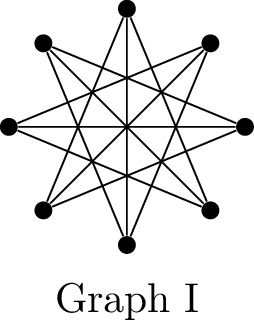
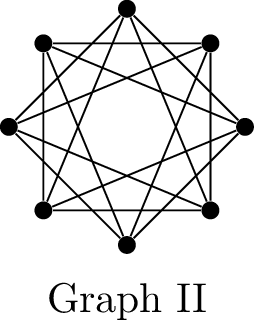
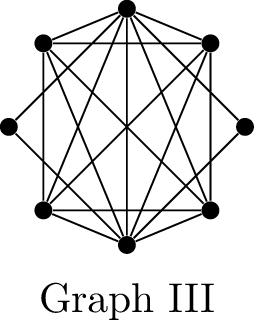
Use the three graphs below to answer the questions that
follow.
If \(G\) is a planar graph with
\(n \ge 3\) vertices, we know that
\(G\) has at most \(3n-6\) edges. Using this condition and no
other properties of planar graphs, what can we say about graphs I, II,
and III?
If \(G\) is a graph with \(n \ge 3\) vertices and minimum degree at
least \(n/2\), we know that \(G\) is Hamiltonian. Using this condition
and no other properties of Hamiltonian graphs, what can we say about
graphs I, II, and III?
A connected graph \(G\) is
Eulerian if and only if every vertex has an even degree. Using this
condition and no other properties of Eulerian graphs, what can we say
about graphs I, II, and III?
Prove that the circulant graph \(\operatorname{Ci}_8(3)\) is isomorphic to
the cycle graph \(C_8\).
Prove that for all odd \(n\ge
3\), the circulant graph \(\operatorname{Ci}_n(2)\) is isomorphic to
\(C_n\).
Prove that for even \(n \ge 4\),
the circulant graph \(\operatorname{Ci}_n(2)\) is not isomorphic
to \(C_n\).
Find the error in this proof of the statement “Graphs never have
edges”.
Let \(G\) be any graph, and let
\(x\) be an arbitrary vertex. Let \((x, x_1, x_2, \dots, x_l)\) be the longest
walk beginning at \(x\).
If there is an edge \(xy\) incident
to \(x\), then the walk \((x, y, x, x_1, x_2, \dots, x_l)\) is a
longer walk beginning at \(x\). That’s
a contradiction, because we assumed that we took the longest such walk.
So the assumption that the edge \(xy\)
exists is incorrect: there are no edges incident to \(x\). In other words, \(x\) has degree \(0\).
Since \(x\) was an arbitrary vertex,
all vertices of \(x\) have degree \(0\): in other words, the graph \(G\) has no edges at all!
Write down a scaffolding for a direct proof of the claim “If a
graph \(G\) is isomorphic to its
complement \(\overline G\), then it is
connected.”
That is, unpack all the definitions in the claim and identify all the
quantifiers and logical implications. Then, write down all the
assumptions and initial definitions you should make, as well as the
conclusions you should eventually draw. You don’t have to fill in the
details of how to get from the start to the end.
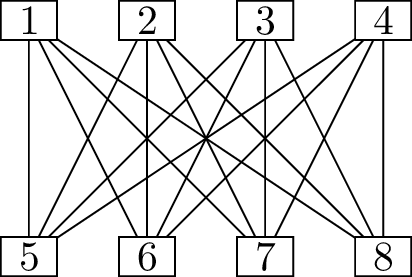
Prove that the graph shown below has diameter \(2\):
Starting from the complete graph \(K_{10}\), you repeatedly perform the
following operation: select \(4\)
vertices of the graph, and toggle the presence of all \(6\) edges between them (removing them if
they are absent, and adding them if they are present).
Can you ever end up removing all edges of the graph?
A \(P_3\)-free graph is a graph
that does not have the path graph \(P_3\) as an induced subgraph. In other
words, if you pick \(3\) vertices
inside a \(P_3\)-free graph, there will
never be exactly \(2\) edges between
them: there could be \(0\) edges, a
single edge, or all \(3\) edges.
Let \(G\) be a \(P_3\)-free graph, and let \(\sim\) be the adjacency relation in \(G\): \(x \sim
y\) if and only if \(xy \in
E(G)\).
Prove that \(\sim\) is an
equivalence relation on \(V(G)\).
What does this tell us about the structure of \(G\)? Describe what a connected component of
\(G\) can look like.
Footnotes
Thus, a mathematician would write, “You will get free
shipping if and only if you spend at least $50.”↩︎
The problem statement on the PUMaC website does not
say that \(G\) is connected, but the
official solution assumes a connected graph. If \(G\) is not connected, the same argument can
be applied to each connected component. I’ve decided to add the
assumption just so that we can skip this step.↩︎