This chapter presents the algorithmic view of matchings in bipartite
graphs. The augmenting path algorithm is the most serious algorithm seen
in this textbook so far; accordingly, I’ve given it the most serious
treatment, with a detailed proof that the algorithm works correctly, and
an example of how the algorithm is used. I do not intend to treat every
algorithm similarly; this is not a computer science textbook. This is,
however, an introductory graph theory textbook, so I hope that this
chapter introduces you to the algorithmic side of graph theory.
In my opinion, Kőnig’s theorem (Theorem 14.2) is the
right setting to consider the algorithmic questions, because it is a
result comparing two optimization problems, which is how we usually
encounter matchings in algorithmic applications. Of course, Kőnig’s
theorem has its uses in pure mathematics, and Hall’s theorem (Theorem 15.1 in the next chapter) can also
be proved by giving an algorithm. However, most uses of Hall’s theorem
are about abstractly proving the existence of a perfect matching in a
general, incompletely specified family of graphs—and that is the sort of
problem we will consider in the next chapter.
Kőnig’s theorem will also become important in Chapter 25 through Chapter 28. We will use it to prove
Menger’s theorem (Theorem 27.1).
In the other direction, algorithms for the maximum flow problem can be
used to solve the bipartite matching problem.
Kőnig’s theorem
As we’ve already seen in Chapter 4
with the notation for minimum degree (\(\delta(G)\)) and maximum degree (\(\Delta(G)\)), graph theorists like to use
Greek letters for numerical invariants of graphs. We have recently
learned two new such invariants, so let’s learn the notation for
them.
Definition 14.1. The matching
number\(\alpha'(G)\) of a
graph \(G\) is the number of edges in a
maximum (largest) matching of \(G\).
Definition 14.2. The vertex cover
number\(\beta(G)\) of a graph
\(G\) is the number of vertices in a
minimum (smallest) vertex cover of \(G\).
Unfortunately, the letters \(\alpha\) (“alpha”) and \(\beta\) (“beta”) here have no particular
meaning to help you remember them. There is a meaning to the apostrophe
present in \(\alpha'(G)\) but not
in \(\beta(G)\): it indicates that the
invariant is an “edge version” of another invariant. This means that you
can already begin to guess what \(\alpha(G)\) (the “vertex version” of the
matching number) might mean: later on, in Chapter 18,
you will learn if your guess was right.
Using the new notation, we can rewrite Proposition 13.4, which we
stated as an inequality between \(|E(M)|\) (the number of edges in a matching
\(M\)) and \(|U|\) (the number of vertices in a vertex
cover \(U\)). The new version
reads:
Proposition 14.1. In any graph \(G\), \(\alpha'(G) \le \beta(G)\).
Actually, it might not be immediately obvious that Proposition 13.4 and
Proposition 14.1 are the same: the first is
talking about an arbitrary matching and vertex cover, and the second is
only talking about maximum matchings and minimum vertex covers.
However, if Proposition 13.4 holds for all
\(M\) and \(U\), then in particular it holds when \(M\) is a maximum matching and \(U\) is a minimum vertex cover, which proves
Proposition 14.1. Conversely, if
Proposition 14.1 holds, then for any
matching \(M\) and vertex cover \(U\), we have \(|E(M)| \le \alpha'(G) \le \beta(G) \le
|U|\), proving Proposition 13.4. (The
inequalities \(|E(M)| \le
\alpha'(G)\) and \(\beta(G) \le
|U|\) come from the meanings of the words “maximum” and
“minimum”.)
The main theorem of this chapter was proved in 1931 by Dénes
Kőnig [64]. Actually, it
is ambiguous which result you mean if you say “Kőnig’s theorem”, because
Kőnig proved many results in graph theory: he was, in fact, the author
of the first graph theory textbook [65], written in 1936.1 In
this textbook, the theorem we’ll call Kőnig’s theorem is the
following:
Theorem 14.2 (Kőnig’s theorem). For any bipartite
graph \(G\), \(\alpha'(G) = \beta(G)\).
We will prove this theorem by finding an algorithm. Given a matching
\(M\), the algorithm will either
construct a larger matching \(M'\),
or find a vertex cover \(U\) with \(|E(M)| = |U|\).
If we find such a \(U\), what can we conclude?
Since every matching has at most \(|U|\) edges, and \(M\) has exactly \(|U|\) edges, we know that \(M\) is a maximum matching by Proposition 13.4. By similar
reasoning, \(U\) is a minimum vertex
cover.
However, we know that we cannot always improve a sub-optimal matching
simply by adding edges. So what does it take to improve a sub-optimal
matching?
Augmenting paths
We will need a set-theoretic operation that is not as well-known as
union and intersection, but is the natural operation to consider when
tracking changes. (This remains true whether we’re tracking changes made
to a matching in a graph, or tracking changes made to a Wikipedia entry,
for example.) At its most basic, it’s defined on sets: if \(A\) and \(B\) are two sets, then their
symmetric difference \(A \oplus
B\) is the set \((A \cup B) -
(A \cap B)\): the set containing all elements in \(A\), or in \(B\), but not in both \(A\) and \(B\).
We can think of \(A \oplus B\) as a
summary of the changes that need to be made to \(A\) to get \(B\). If we start with \(A\), and “toggle” all the elements of \(A \oplus B\) (removing them from \(A\) if they are in \(A\), and adding them to \(A\) if not), then the result is \(B\).
If we know \(A\) and \(A
\oplus B\), what operation on them lets us find \(B\)?
It’s the symmetric difference again: \(B\) is \(A
\oplus(A \oplus B)\). The elements in \(A \oplus B\) but not \(A\) are the elements only in \(B\), which we need to add to \(A\); the elements in both \(A\) and \(A
\oplus B\) are exactly the ones not in \(B\), which we need to remove.
Which elements does a triple symmetric
difference \((A \oplus B) \oplus C\)
contain?
The elements contained in an odd number
(one, or all three) of the sets \(A, B,
C\). This rule generalizes, and can also be used to prove that
\(\oplus\) is associative: \((A \oplus B) \oplus C = A \oplus(B \oplus
C)\), because the rule applies to both sides.
For example, Figure 14.1 shows
a table listing the top ten countries in the International Mathematical
Olympiad in 2024 and in 2025. If we think of these lists as sets, we can
take the symmetric difference, shown in the third column. This symmetric
difference shows the six countries whose status changed from 2024 to
2025: Belarus, the United Kingdom, and Hungary left the top ten list,
while Japan, Israel, and Vietnam entered it.
IMO 2024
IMO 2025
2024 ⊕ 2025
United States of America
People’s Republic of China
Belarus
People’s Republic of China
United States of America
United Kingdom
Republic of Korea
Republic of Korea
Hungary
India
Japan
Japan
Belarus
Poland
Israel
Singapore
Israel
Vietnam
United Kingdom
India
Hungary
Singapore
Poland
Vietnam
Türkiye
Türkiye
Top ten IMO teams in 2024 and in 2025
Rather than continue thinking about competition performance, let’s
switch to thinking about graphs. Given two graphs \(G\) and \(H\), the symmetric difference \(G \oplus H\) is the graph with
vertex set \(V(G \oplus H) = V(G) \cup
V(H)\) and edge set \(E(G \oplus H) =
E(G) \oplus E(H)\). We’re taking the symmetric difference of the
edge sets, which are the star of the show; we take the union of the
vertex sets to be sure that we’ve included the endpoints of every edge
we need.
We want to use this idea to see what changes need to be made to get
from one matching to another. We are looking for small, incremental
changes. So we will compare two matchings \(M\) and \(N\) such that \(M\) only has one more edge than \(N\).
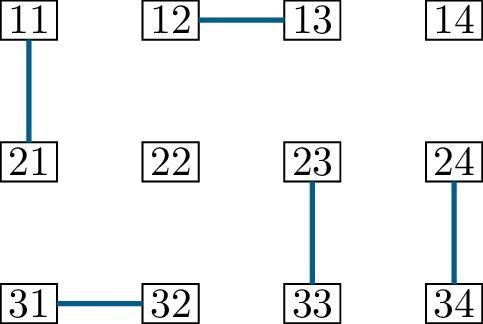
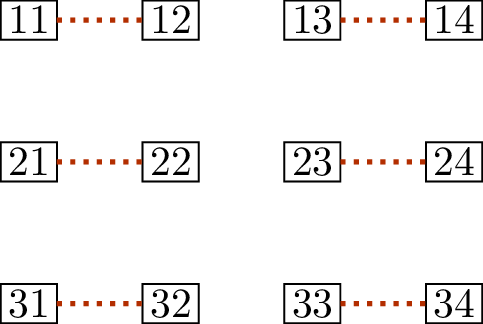
Figure 14.2 shows one such example. To
make the drawing more clear, I have not included the edges of the
original graph (which you may assume to be a \(3 \times 4\) grid graph). Matching \(M\) (in Figure 14.2(a)) has
only \(5\) edges, while \(N\) (in Figure 14.2(b)) is a
perfect matching with \(6\) edges.
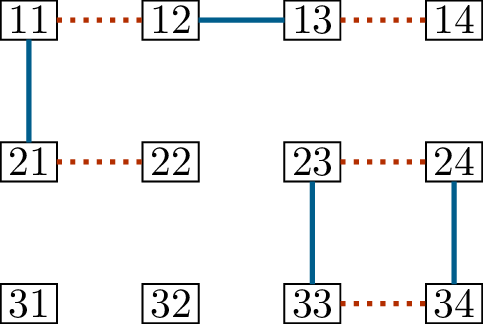
Matching \(M\)Matching \(N\)\(M \oplus N\)
Two matchings in a \(3 \times
4\) grid
As a graph, \(M \oplus N\) (shown in
Figure 14.2(c)) consists of four
connected components. Two of them are just isolated vertices, and don’t
have a lot to tell us. Another, with the vertices \(\{23,24,33,34\}\), is a cycle, and
represents only that the matchings \(M\) and \(N\) match those four vertices in two
different ways.
The last component is the most interesting one: the path represented
by \((22, 21, 11, 12, 13, 14)\). It’s
this component that tells us how to improve matching \(M\): we must swap the two edges \(\{11,21\}\) and \(\{12,13\}\) for the three edges \(\{11, 12\}\), \(\{13,14\}\), and \(\{21,22\}\).
We will call such a subgraph an \(M\)-augmenting path (or just an augmenting
path, if it is clear what matching \(M\) it is meant to augment). In general, if
\(M\) is a matching in a graph \(G\), then an \(M\)-augmenting path is a path in
\(G\) with the following
properties:
The path begins and ends at two vertices that are not covered by
\(M\).
The edges used by the path alternate between edges not in \(M\) and edges in \(M\).
In a symmetric difference of two matchings, we can also see connected
components (paths or cycles) that satisfy only the second property, but
not the first: we call such paths and cycles \(M\)-alternating.
The length of an \(M\)-augmenting
path must be odd, or else it will not end at an uncovered vertex. If it
has length \(2k+1\), then the \(1^{\text{st}}, 3^{\text{rd}}, \dots,
(2k+1)^{\text{th}}\) edges are not part of \(M\), while the \(2^{\text{nd}}, 4^{\text{th}}, \dots,
(2k)^{\text{th}}\) edges are.
If we find a path \(P\) in \(M \oplus N\) that helps us improve \(M\) to be more like \(N\), then we should apply that difference
to \(M\) by taking the symmetric
difference \(M \oplus P\). This is
generalized by the following lemma:
Lemma 14.3. Let \(M\) be a matching in a graph \(G\) and let \(P\) be an \(M\)-augmenting path. Then \(M \oplus P\) is a matching with one more
edge than \(M\).
Proof. We verify that \(M \oplus
P\) is a matching by checking the degree of every vertex in \(M \oplus P\).
Let \(P\) be an \(x-y\) path; then \(\deg_P(x) = \deg_P(y) = 1\). Because \(P\) is an \(M\)-augmenting path, \(\deg_M(x)=0 = \deg_M(y) = 0\). Therefore
\(x\) and \(y\) have degree \(1\) in \(M \oplus
P\) as well; they each get an incident edge from \(P\), and do not gain or lose anything from
\(M\).
For every vertex \(z \in V(P)\)
other than \(x\) and \(y\), the path \(P\) has two edges incident to \(z\), one of which is in \(M\) and the other is not (because \(P\) is \(M\)-alternating). In \(M \oplus P\), the edge in \(M\) is lost, but the edge not in \(M\) is kept, so \(\deg_{M\oplus P}(z)=1\).
Finally, all vertices not on the path are unaffected by the change
from \(M\) to \(M \oplus P\): they still have the same
degree they had in \(M\), which is at
most \(1\). Therefore \(M \oplus P\) is a matching.
Looking above, we can see that vertices \(x\) and \(y\) have degree \(1\) in \(M \oplus
P\), but degree \(0\) in \(M\); for every other vertex, its degree in
\(M\) and \(M
\oplus P\) is the same. Therefore \(M
\oplus P\) is a matching that covers two more vertices than \(M\), which means it has one more edge than
\(M\). ◻
In general, given two matchings \(M\) and \(N\), the symmetric difference \(M \oplus N\) is a graph with maximum degree
\(2\): each vertex has at most one
incident edge in each matching. The connected components of such a graph
are \(M\)-alternating paths and \(M\)-alternating cycles.
Suppose now that, as in our example, \(N\) is a slight improvement over \(M\): \(|E(N)| =
|E(M)|+1\). Then, after canceling out the edges common between
\(M\) and \(N\), the symmetric difference \(M \oplus N\) still has one more edge from
\(N\) than from \(M\). So there must also be at least one
connected component of \(M \oplus N\)
where this is true!
If a connected component of \(M \oplus N\) is a cycle, can it contain
more edges from \(N\) than from \(M\)?
No: to be \(M\)-alternating, exactly half of its edges
must be from \(M\), and exactly half
must be from \(N\).
If a connected component of \(M \oplus N\) is a path, can it contain more
edges from \(N\) than from \(M\)?
Only if it is an \(M\)-alternating path of odd length where
the first and last edge both come from \(N\). This is an \(M\)-augmenting path!
In particular, this argument proves that there exists an \(M\)-augmenting path, but not usefully: to
find it, we needed to know the bigger matching \(N\). In our proof of Kőnig’s theorem, we
will see how to find an \(M\)-augmenting path in a more helpful
fashion, but only in bipartite graphs.
The augmenting path
algorithm
Let \(G\) be a bipartite graph with
bipartition \((A,B)\), and let \(M\) be a matching in \(G\). The main tool we need to prove Kőnig’s
theorem is an algorithm for finding an \(M\)-augmenting path.
Our algorithm will be yet another breadth-first search algorithm.
However, we will not explore the graph along all possible trajectories,
but only along ones that can form an \(M\)-augmenting path.
We are searching for a path between two uncovered vertices, so let’s
introduce some notation to help us. Write \(A\) as \(A_0 \cup
A_1\), where the vertices in \(A_0\) are uncovered by \(M\) and the vertices in \(A_1\) are covered by \(M\). (That is, \(x \in A_k\) if \(x\) has degree \(k\) in \(M\).) Split \(B\) into \(B_0\) and \(B_1\) in the same way.
Since an augmenting path has odd length, and every path in \(G\) alternates between \(A\) and \(B\), an augmenting path must have one end
in \(A_0\) and one end in \(B_0\). We will arbitrarily choose to start
our exploration in \(A_0\), with the
goal of eventually reaching a vertex in \(B_0\).
To keep track of our progress, let \(A_{\exp}\) and \(B_{\exp}\) be the set of
explored vertices in \(A\) and in \(B\), respectively. These will change over
the course of the algorithm. Since we start our exploration in \(A_0\), initially \(A_{\exp} = A_0\) and \(B_{\exp} = \varnothing\).
Finally, we will also want to know how we reached the explored
vertices: when we add a new vertex \(x\) to \(A_{\exp}
\cup B_{\exp}\), we make note of \(f(x)\), the vertex from
which we explored \(x\). This will help
us find an augmenting path, if one exists.
The augmenting path algorithm repeats the following steps, which I’ve
given short names to help us refer to them.
Explore: For each vertex \(a \in A_{\exp}\), explore all its
neighbors: if a neighbor \(b\) of \(a\) is not already in \(B_{\exp}\), add it, and set \(f(b) = a\). (After the first iteration,
this only needs to be done for the vertices newly added to \(B_{\exp}\).)
Check: At this step, there are two stopping
conditions to check, which conclude the algorithm with different
results.
Path? If there is a vertex \(b \in B_{\exp} \cap B_0\) (an explored
vertex uncovered by \(M\)), stop and
return the path represented by the walk \[(b,
f(b), f(f(b)), \dots)\] that traces back the vertices from which
we reached \(b\), ending at a vertex in
\(A_0\). We will show that this is an
\(M\)-augmenting path.
Cover? If no new vertices were added to \(B_{\exp}\) in the most recent
Explore step, stop and return the set \(U\) defined2 to
be \((A - A_{\exp}) \cup B_{\exp}\). We
will show that \(U\) is a vertex cover
and \(|U| = |E(M)|\).
Match: Otherwise, \(B_{\exp} \subseteq B_1\): all the vertices
in \(B_{\exp}\) are covered by \(M\). For each vertex \(b\) added to \(B_{\exp}\) in the most recent
Explore step, find the edge \(ab \in E(M)\) incident to \(b\). Explore vertex \(a\) (the vertex that \(b\) is matched to): add it to \(A_{\exp}\), and set \(f(a) = b\).
To prove the correctness of this algorithm, we must show that when
the Path or Cover stopping conditions
are met, the path really is an \(M\)-augmenting path and the cover really is
a vertex cover of the same size as \(M\).
We must also show that the algorithm
cannot loop forever. Why must it halt?
At every iteration in which we don’t stop
by the Cover condition, we add a new vertex to \(B_{\exp}\), and \(|B_{\exp}|\) is limited in size by \(|B|\).
In practice, this algorithm is applied multiple times. Starting from
an initial matching, which does not need to be very good, we repeatedly
use the algorithm to grow the matching by one edge. Eventually, we
either find a perfect matching, or find a vertex cover that proves we
cannot proceed any further. This self-certifying feature, in addition to
being theoretically useful in the proof of Kőnig’s theorem, is also
practically convenient: it means that we can verify the output of the
algorithm independently if we’re not certain that an implementation of
it is bug-free.
Which initial matching do we start with? One option is to begin with
the empty matching: \(E(M) =
\varnothing\).
What does the algorithm do if \(E(M) = \varnothing\)?
We start with all vertices of \(A\) already in \(A_{\exp}\), and all vertices of \(B\) in \(B_0\). If even a single edge exists, we
will explore a vertex of \(B_0\) and
halt in the first step, returning a path of length \(1\).
When a path of length \(1\) is an \(M\)-augmenting path, what does this
mean?
It means that the edge on that path can be
added to \(M\) without removing any
edges.
Starting from the empty matching, not just the first time we augment
the matching but the first few times will typically end equally quickly:
they will find an edge between two uncovered vertices. In effect, this
is no different from a greedy algorithm. Only once the greedy algorithm
would give up, because it cannot add any more edges, does the augmenting
path algorithm start finding longer augmenting paths.
Analyzing the algorithm
A common technique when analyzing an algorithm is to prove an
invariant of the algorithm. Just like a graph invariant is a property
that does not change when the graph is relabeled, an invariant of an
algorithm is also a property that does not change—it does not change
over the course of the algorithm. Appendix A discusses this
proof technique, but this is the first time we really need it in the
main body of the textbook.
There are two invariants we track for the augmenting path algorithm:
one invariant to help us find an \(M\)-augmenting path, and one invariant
that
For the first invariant, we define a path \(P(x)\) for each vertex \(x \in A_{\exp} \cup B_{\exp}\). It is the
path represented by \[(x, f(x), f(f(x)),
\dots)\] that starts at \(x\)
and traces back the vertices from which we reached \(x\), ending at a vertex in \(A_0\). Recall that in the
Path stopping condition, this is the path we return,
for a vertex \(x \in B_{\exp} \cap
B_0\).
Lemma 14.4. For any vertex \(x \in A_{\exp} \cup B_{\exp}\), the path
\(P(x)\) is an \(M\)-alternating path.
Proof. More precisely, we prove the following: each edge
\(y f(y)\) is in \(E(M)\) if \(y \in
A_{\exp}\), and not in \(E(M)\)
if \(y \in B_{\exp}\). The path \(P(x)\) must alternate between \(A_{\exp}\) and \(B_{\exp}\): like any other path in \(G\), it alternates between \(A\) and \(B\), and it only passes through explored
vertices. So this claim will prove that \(P(x)\) is an \(M\)-alternating path.
Let \(a \in A_{\exp}\) be a vertex
on \(P(x)\). Then either \(a \in A_0\) (in which case, it is the end
of the path) or else \(a\) was explored
from a vertex \(f(a) \in B_{\exp}\). We
explore from vertices in \(B_{\exp}\)
in a Match step; therefore \(af(a) \in E(M)\).
Let \(b \in B_{\exp}\) be a vertex
on \(P(x)\). Then \(b\) was explored from a vertex \(f(b) \in A_{\exp}\); we must prove that
\(b f(b) \notin E(M)\). If \(f(b) \in A_0\), this is automatic, because
then \(M\) has no edges incident
to \(f(b)\). Otherwise, \(f(b)\) was itself explored from some vertex
\(f(f(b))\), and as we’ve proved above,
\(f(b) f(f(b)) \in E(M)\). Therefore
\(b f(b) \notin E(M)\), because \(f(b)\) cannot be incident to two edges of
\(M\). This completes the proof. ◻
Next, we turn our attention to the set \(U
= (A - A_{\exp}) \cup B_{\exp}\), which we return if the
Cover stopping condition is satisfied. First of all,
let’s understand where this set comes from.
If a vertex cover \(U\) satisfies \(|U|=|E(M)|\), can \(U\) ever use both endpoints of an edge in
\(M\)?
No: if we select just one endpoint of each
edge in \(M\), we’ve already selected
\(|E(M)|\) different vertices. Choosing
both endpoints of an edge in \(M\) is
wasteful and we cannot afford it.
If a vertex cover \(U\) satisfies \(|U|=|E(M)|\), how must it treat \(A_0\) and \(B_0\)?
\(U\)
cannot contain any vertices in \(A_0\)
and \(B_0\). Again, we’ve already
reached \(|E(M)|\) vertices just by
selecting a vertex from each edge in \(M\). We can’t select any more without going
over our limit, so we can’t select any vertices not covered by \(M\).
These two guiding questions tell us what to do to the vertices we
explore. Our initial set \(A_{\exp}\)
consists just of \(A_0\): these
vertices cannot be part of \(U\). This
means that to cover the edges with an endpoint in \(A_0\), we must add all their other
endpoints to \(U\). These neighbors are
exactly what we put in \(B_{\exp}\) in
the Explore step. Next, if a vertex \(b\) we’ve added to \(U\) is an endpoint of an edge \(ab \in E(M)\), we can’t put the other
endpoint of \(ab\) in \(U\) as well, so \(a \notin U\). So the vertices matched to
\(B_{\exp}\) cannot be part of \(U\), and these are exactly the vertices we
put in \(A_{\exp}\) in the
Match step.
This logic continues: at each step, vertices we put in \(A_{\exp}\) are vertices we know cannot be
part of \(U\), and vertices we put in
\(B_{\exp}\) are vertices we know must
be part of \(U\). Since we don’t know
anything about vertices outside \(A_{\exp}
\cup B_{\exp}\), a reasonable first try is to define \(U = (A - A_{\exp}) \cup B_{\exp}\), and we
we will see that this turns out to work.
We can define \(U = (A - A_{\exp}) \cup
B_{\exp}\) at any point over the course of the algorithm, not
just at the end. It is not a vertex cover before the end, but it
satisfies an invariant of its own:
Lemma 14.5. Immediately before every
Explore step, \(|U| =
|E(M)|\).
Proof. At the beginning of the algorithm, \(A_{\exp} = A_0\) and \(B_{\exp} = \varnothing\); therefore \(U = A - A_0 = A_1\). Every edge of \(M\) has one endpoint in \(A_1\) and one endpoint in \(B_1\); therefore \(|U| = |A_1| = |E(M)|\).
In the Explore step, some vertices are added to
\(B_{\exp}\). Then, in the
Match step, for every vertex \(b\) that we added to \(B_{\exp}\), we add a vertex \(a\) to \(A_{\exp}\): the vertex \(a\) such that \(ab \in E(M)\). Such a vertex \(a\) cannot already have been in \(A_{\exp}\): it is not in \(A_0\) (because \(ab \in E(M)\)), and so it can only be
explored in the Match step, and only from \(b\).
Therefore, if we add \(k\) vertices
to \(B_{\exp}\) in the
Explore step, we also add \(k\) vertices to \(A_{\exp}\) in the Match
step (provided we do not stop before then). As a result, \(|A - A_{\exp}|\) decreases by \(k\) and \(|B_{\exp}|\) increases by \(k\), so \(|U| =
|A - A_{\exp}| + |B_{\exp}|\) remains unchanged.
Since \(|U|\) starts equal to \(|E(M)|\), and a single
Explore–Check–Match
iteration of the algorithm does not change \(|U|\), we must also have \(|U| = |E(M)|\) before every
Explore step. ◻
Many uses of invariants to study algorithms are proofs by induction
in disguise, and you can see that in the proof of Lemma 14.5. Here, we begin
with a base case: we show that \(|U| =
|E(M)|\) at the beginning of the algorithm. Next, we show that
whenever this property holds, it still holds after one more
iteration.
Together, Lemma 14.4 and Lemma 14.5 are not enough to
draw any conclusions about what happens at the end of the algorithm: we
need to see how the stopping conditions contribute.
Proposition 14.6. If the Path
stopping condition holds, then for a vertex \(b \in B_{\exp} \cap B_0\), the path \(P(b)\) is an \(M\)-augmenting path.
Proof. We already know from Lemma 14.4 that \(P(b)\) is an \(M\)-alternating path. Moreover, its
endpoints are uncovered by \(M\): its
start is \(b\), which is in \(B_0\), and its end can only be a vertex in
\(A_0\), because all other explored
vertices were explored from somewhere. Therefore \(P(b)\) is an \(M\)-augmenting path. ◻
Proposition 14.7. If the Cover
stopping condition holds, then \(U = (A -
A_{\exp}) \cup (B_{\exp})\) is a vertex cover with \(|E(M)| = |U|\).
Proof. To show that \(U\)
is a vertex cover, take any edge \(ab \in
E(G)\), where \(a \in A\) and
\(b \in B\). If \(a \in A_{\exp}\), then in the most recent
explore step, we would have made sure that \(b
\in B_{\exp}\) (if it was not already there for some other
reason); in this case, \(b \in U\). But
if \(a \notin A_{\exp}\), then \(a \in U\). In either case, one of the
endpoints of \(ab\) is in \(U\).
From Lemma 14.5, we know that
\(|E(M)| = |U|\) before any
Explore step. If the Cover stopping
condition holds, then no new vertices were added to \(A_{\exp}\) in the explore step, so \(|U|\) did not change; therefore \(|E(M)| = |U|\) at the end of the
algorithm. ◻
This completes the proof that the algorithm is correct. It also gives
us all the tools we need to prove Kőnig’s theorem.
Proof of Theorem 14.2. Let \(M\) be a maximum matching in the bipartite
graph \(G\); starting with the matching
\(M\), run the augmenting path
algorithm.
The algorithm cannot find an \(M\)-augmenting path, because by Lemma 14.3, we could use it to obtain a
bigger matching, which contradicts our choice of \(M\). So it must stop by satisfying the
Cover stopping condition. By Proposition 14.7, the algorithm
outputs a vertex cover \(U\) with \(|E(M)| = |U|\).
Since \(\alpha'(G) = |E(M)|\)
(by our choice of \(M\)) and \(\beta(G) \le |U|\) (the minimum vertex
cover is at least as small as \(U\)),
we conclude that \(\alpha'(G) \ge
\beta(G)\). From Proposition 14.1,
we know \(\alpha'(G) \le
\beta(G)\); therefore the two are equal. ◻
Using the algorithm
Algorithms like the augmenting path algorithm are not really intended
to be performed by hand. Very rarely, if a graph is neither so small
that we can find a matching without any algorithms, nor too big to deal
with by hand, we can use the algorithm to check a matching we suspect to
be optimal. Most of the time, though, you should use a computer. So the
purpose of the example here is simply as an illustration, so that you
can better understand the algorithm and its proof by seeing it in
action. (You will gain even better understanding if you try doing this
yourself, and I’ve included a practice problem about this. After you
understand the algorithm perfectly, there’s no point.)
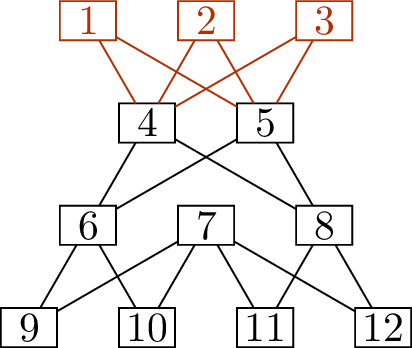
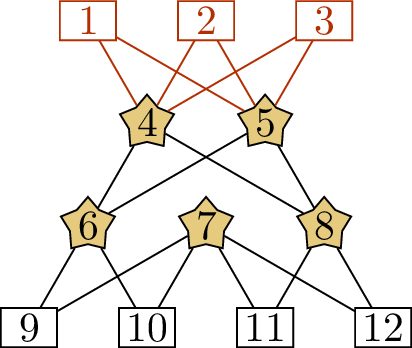
The graph we will use as an example is a graph I’ve called
volcano graph, shown in Figure 14.3(a). It
does not really have any special properties, but I defined it and named
it and I have a hat with the volcano graph on it, so it is my favorite.
One of my whims about the definition is that I insist that the top of
the volcano graph must always be drawn in red.
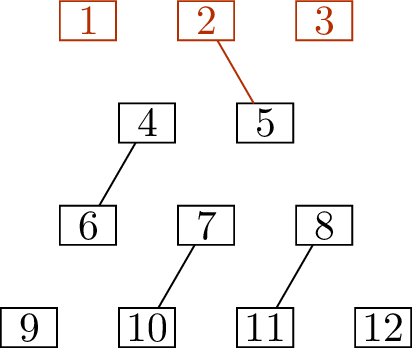
The volcano graphA \(4\)-edge matching \(M\)
The volcano graph and an initial matchingWhy is the volcano graph bipartite?
All edges have one endpoint in \(\{1,2,3,6,7,8\}\) and one endpoint in \(\{4,5,9,10,11,12\}\).
I have mentioned that the first few rounds of finding augmenting
paths are essentially equivalent to a greedy algorithm, so I will skip
them to avoid wasting time on cases that don’t help us understand
anything. We will begin with the matching \(M\) shown in Figure 14.3(b), with \(E(M) = \{\{2,5\}, \{4,6\}, \{7,10\},
\{8,11\}\}\).
We must make an arbitrary choice between the two sides: let’s say
that side \(A\) (the side that we
explore from) is \(\{1,2,3,6,7,8\}\).
For our initial matching, we start with \(A_0
= \{1,3\}\) and \(B_0 = \{9,
12\}\).
The algorithm proceeds as follows:
Explore vertices \(4\) and \(5\), adding them to \(B_{\exp}\), with \(f(4) = 1\) and \(f(5) = 3\).
Check the stopping conditions:
Is there a Path? No: \(B_{\exp} \cap B_0 = \varnothing\).
Is there a Cover? No: we added \(2\) new vertices to \(B_{\exp}\).
Match vertex \(4\) to vertex \(6\) and vertex \(5\) to vertex \(2\). Add \(2\) and \(6\) to \(A_{\exp}\), with \(f(2) = 5\) and \(f(6)=4\).
Explore vertices \(9\) and \(10\), with \(f(9)=f(10)=6\). As before, add them to
\(B_{\exp}\).
Check the stopping conditions:
Is there a Path? Yes: \(B_{\exp} \cap B_0 = \{9\}\).
We stop, and output the augmenting path represented by \[(9, f(9), f(f(9)), f(f(f(9))))) = (9, 6, 4,
1).\]
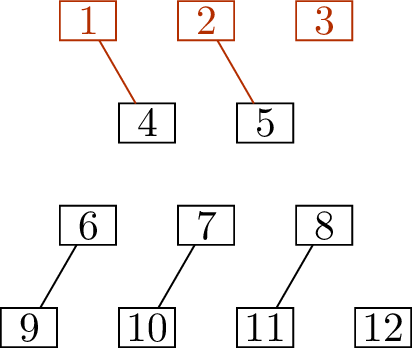
Of the edges on the augmenting path, edge \(\{4,6\}\) is part of \(M\), while edges \(\{1,4\}\) and \(\{6,9\}\) are not. Therefore we improve our
matching \(M\) by removing \(\{4,6\}\), adding \(\{1,4\}\) and \(\{6,9\}\) instead. The resulting matching
(call it \(M'\)) is shown in
Figure 14.4(b).
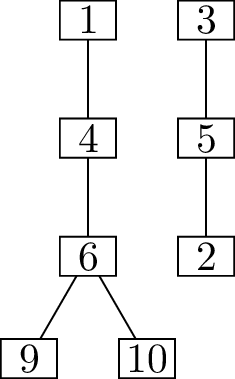
It is common to represent the exploration process by a forest, with
the vertices arranged in levels. At the top level are the vertices in
\(A_0\); from there, the levels
alternate between vertices added to \(B_{\exp}\) in an Explore
step and vertices added to \(A_{\exp}\)
in a Match step. The forest we get in this example is
shown in Figure 14.4(a).
How can we tell which edges of this forest
are edges of \(M\)?
They are the edges whose top vertex is in
a \(B_{\exp}\) level and whose bottom
vertex is in an \(A_{\exp}\) level. In
Figure 14.4(a), these are just the
edges down from \(\{4,5\}\), but if we
had kept going, any edges down from \(\{9,10\}\) would also have been in \(M\).
The exploration forestA \(5\)-edge matching \(M'\)The vertex cover \(U\)
An example of the augmenting path algorithmThe forest in Figure 14.4(a) looks like it has other
augmenting paths, such as the one represented by \((10, 6, 4, 1)\). Could we have used this
path instead?
No: this path only looks like an
augmenting path because we stopped before the next
Match step, but in reality, vertex \(10\) is covered by \(M\). If we had kept going, we would have
found a longer augmenting path.
We have improved the matching, but we’re still not done, so we
continue with another round of the algorithm. The edges of the new
matching are \(\{\{1,4\}, \{2,5\}, \{6,9\},
\{7,10\}, \{8,11\}\}\), so the uncovered vertices are given by
\(A_0 = \{3\}\) and \(B_0 = \{12\}\). Now we:
Explore vertices \(4\) and \(5\), adding them to \(B_{\exp}\), with \(f(4) = f(5) = 3\).
Check the stopping conditions:
Is there a Path? No: \(B_{\exp} \cap B_0 = \varnothing\).
Is there a Cover? No: we added \(2\) new vertices to \(B_{\exp}\).
Match vertex \(4\) to vertex \(1\) and vertex \(5\) to vertex \(2\). Add \(1\) and \(2\) to \(A_{\exp}\), with \(f(1) = 4\) and \(f(2) = 5\).
Explore, but fail to find any vertices: vertices
\(1\) and \(2\) are only adjacent to vertices \(4\) and \(5\), which are already in \(B_{\exp}\).
Check the stopping conditions:
Is there a Path? No: \(B_{\exp} \cap B_0 = \varnothing\).
Is there a Cover? Yes: we did not add any new
vertices to \(B_{\exp}\).
We stop, and output the vertex cover \[U =
(A - A_{\exp}) \cup B_{\exp} = \{6,7,8\} \cup \{4,5\}.\]
Indeed, the vertex \(U =
\{4,5,6,7,8\}\) shown in Figure 14.4(c) really is a vertex
cover: it consists of the middle two layers of the volcano graph. Every
edge between the first two layers is incident to \(4\) or \(5\), every edge between the last two layers
is incident to \(6\), \(7\), or \(8\), and every edge between the second and
third layer has both endpoints in \(U\). Since \(|U|=|E(M')| = 5\), we conclude that
\(M'\) is a maximum matching.
Practice problems
Use the augmenting path algorithm to improve the matching in
Figure 14.2(a). Does this result in the
perfect matching in Figure 14.2(b), or a
different one?
Viewing the domino tiling in Figure 13.3 as a
matching, find a set of \(10\)
augmenting paths (with no vertices in common) that will transform it
into a perfect matching.
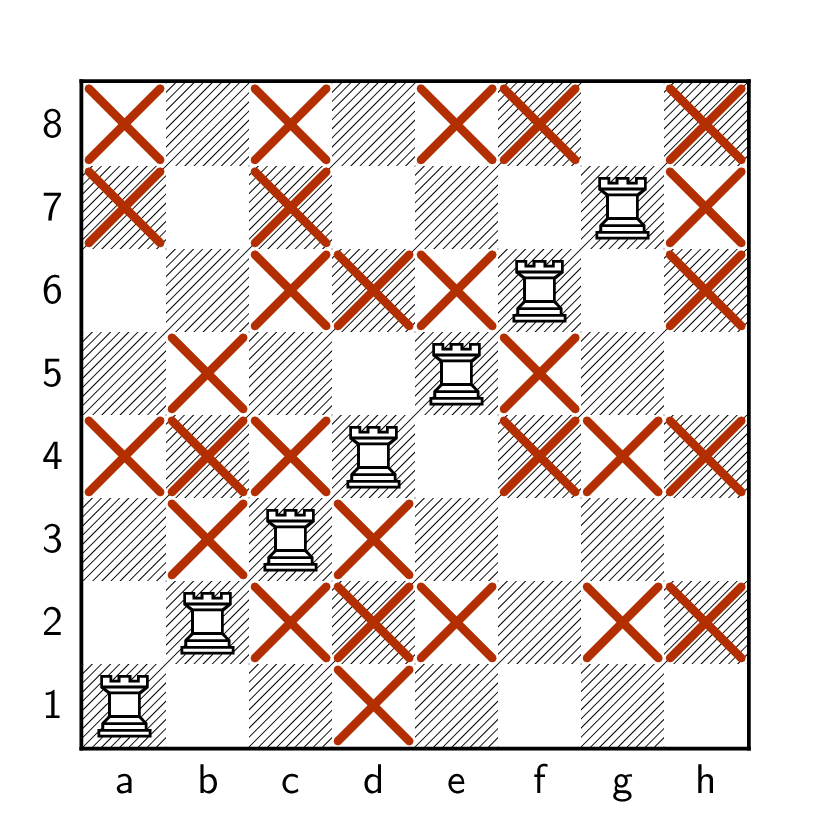
On the chessboard below, how many rooks can be placed so that no
two rooks occupy the same row or column, and all the crossed-out squares
are empty?
A \(7\)-rook solution is shown. Use
the augmenting path algorithm to find either an \(8\)-rook solution, or a vertex cover
proving that the \(7\)-rook solution is
optimal.
Let \(G\) be a bipartite graph
with bipartition \((A,B)\) and minimum
degree \(\delta(G)\); let \(U\) be a vertex cover that does not contain
either \(A\) or \(B\).
Prove that \(|U| \ge
2\delta(G)\). When does it follow that \(\alpha'(G) \ge 2 \delta(G)\), and
why?
In the case \(|A|=|B|=10\) and
\(\delta(G)=3\), give an example of a
bipartite graph in which this lower bound is true: \(\alpha'(G) = 6\).
If \(G\) is not bipartite, then
Proposition 14.1 still guarantees that
\(\alpha'(G) \le \beta(G)\), but
the two quantities may be different.
Find \(\alpha'(G)\) and
\(\beta(G)\) when \(G = C_{2k+1}\), a cycle graph with an odd
number of vertices, in terms of \(k\).
Verify that they are, in fact, different.
Find a graph \(G\) which
satisfies \(\alpha'(G) =
\beta(G)\), but is not bipartite.
Let \(G\) be a bipartite graph
\(G\) with bipartition \((A,B)\) which is \(r\)-regular: every vertex has degree \(r\). Let \(n =
|A|\).
Prove that \(|B|=n\) as well,
and find \(|E(G)|\) in terms of \(n\) and \(r\).
Prove that a set of \(k\)
vertices in \(G\) can cover at most
\(kr\) of the edges. What does this say
about the size of a vertex cover?
Use Kőnig’s theorem to prove that \(G\) must have a perfect matching.
Prove if the augmenting path algorithm is applied to a maximum
matching, then \(A_{\exp}\) is the set
of all vertices on side \(A\) which are
left uncovered by some maximum matching in the graph.
(You must prove two things: that if \(a \in
A_{\exp}\), then there is some maximum matching which does not
cover \(a\), and that if \(a \in A - A_{\exp}\), then all maximum
matchings cover \(a\).)
Footnotes
By a happy coincidence, this is 200 years after Euler
first modeled a problem—the problem of the seven bridges of
Königsberg—using what we’d now call a graph.↩︎
When learning about this algorithm for the first time,
this definition may feel like it came out of nowhere! In the next
section, we’ll discuss where this formula for the vertex cover comes
from.↩︎