This chapter concludes the part of this book devoted to vertex
degrees. It is an application of the concept of vertex degrees, as well
as some results from Chapter 4, to
solve a problem that could be said to be the beginning of graph
theory.
There is a striking contrast in graph theory between the theory of
Euler tours and Eulerian graphs, discussed in this chapter, and the
theorem of Hamilton cycles and Hamiltonian graphs, discussed in
Chapter 17. Superficially, the two
problems are very similar, yet we are able to pin down the exact
circumstances in which an Euler tour exists; for Hamiltonian cycles,
hard work is required in most cases.
Everything we say about the Euler tour problem for graphs remains
true for multigraphs, with no substantial change. For directed graphs,
the situation is a bit more complicated, and it is discussed at the end
of the chapter. However, many of the important applications of Euler
tours, such as the one in Chapter 20, are
applications to directed graphs, so this is an important case of the
problem to understand.
Don’t lift your pencil!
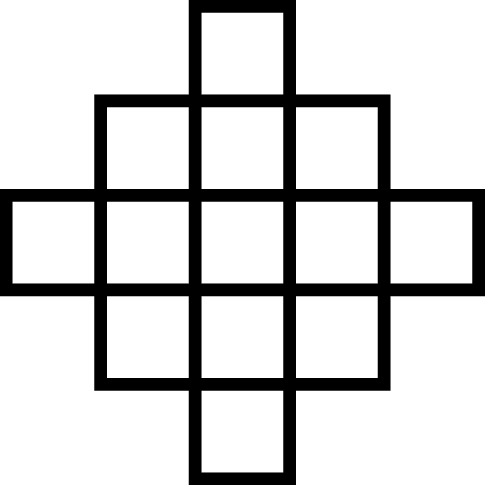
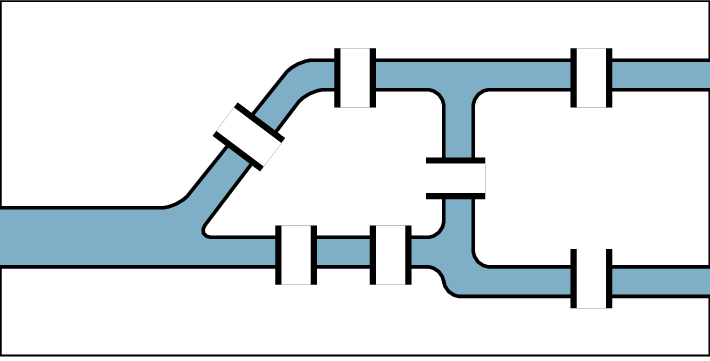
Can you draw this figure without lifting your
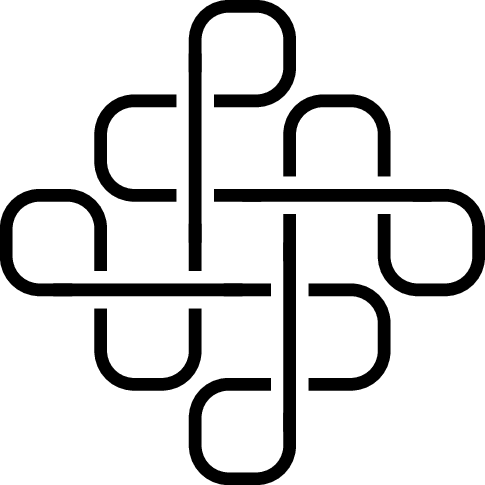
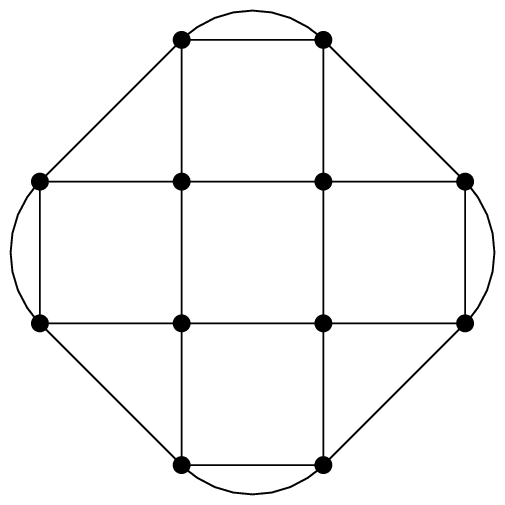
pencil?Solution to the challenge in Figure 8.1(a)Modeling the puzzle as a multigraph
Drawing without lifting your pencil
You might have seen a brainteaser like this before! Look at the
diagram in Figure 8.1(a). Can you draw this shape on
paper without lifting your pencil (or pen), and without going over the
same line more than once?
You can: Figure 8.1(b) shows you one particularly
symmetric way to do it. (To make it clear what the solution is, the
lines are bent away from each other slightly to indicate where the path
does or does not cross itself.) As a bonus, the path in Figure 8.1(b) returns to where it started.
This is a book on graph theory, though, not on pencil drawings. So
what does this question have to do with graph theory? This is the same
question that this book started with: how do we model this problem as a
graph?
The places in the drawing that matter most are the places where
several lines meet: when tracing the drawing with your pencil, those are
the only places where we make a decision. So it makes sense to have a
vertex for each of those points. The rest of the drawing consists of
lines that go from one such point to another, and their shape does not
matter for solving the puzzle: only the starting and ending point
matters. So for every such line, we will add an edge between the two
vertices it joins. If we apply idea to Figure 8.1(a), the
result is shown in Figure 8.1(c).
The result is a multigraph; how did that
happen?
We get parallel edges whenever there are
two or more lines that start and end at the same pair of intersection
points.
What sort of graph-theoretic object are we
looking for when we solve the brainteaser?
We are looking for a walk in the graph
which uses every edge exactly once.
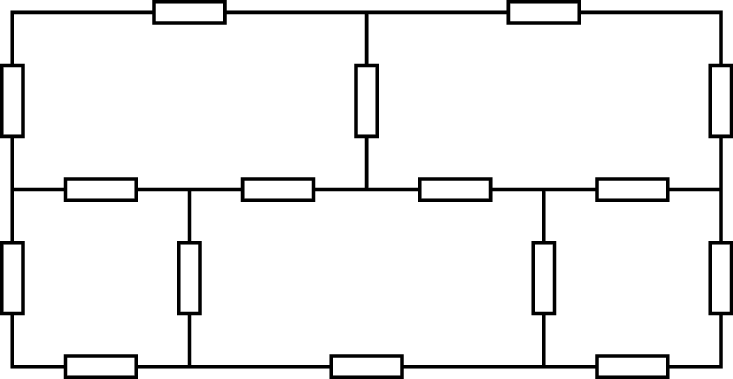
There are two other well-known puzzles that are an instance of the
same type of problem. One is the five rooms puzzle, shown in Figure 8.2(a). Here, five rooms are connected
by a total of \(16\) doors, and the
challenge is to plot a path through the rooms that passes exactly once
through every door.
The five rooms puzzleThe bridges of Königsberg
Two more puzzles equivalent to pencil drawingWhat should the vertices and edges be in
the multigraph that makes the five rooms puzzle equivalent to the
pencil-drawing puzzle?
There should be six vertices: one for each
room, where we consider the outside region to be a room as well. Each
door between two rooms should be an edge incident to both rooms.
Another such puzzle, the problem of the seven bridges of Königsberg,
has historical significance. It was first studied by Leonhard Euler, in
1736 [6], and it may be
one of the first mathematical problems to be abstracted into a
graph-theoretic model before being solved. (It predates modern graph
theory, so the terminology used by Euler was quite different from what
you are reading here.) The problem itself is based on a map of the city
of Königsberg, shown somewhat abstractly in Figure 8.2(b). In Euler’s time, there were
seven bridges connecting the two sides of the river and the two large
islands in the middle of the river. The challenge was to find a path
through the city that crossed each bridge exactly once.
What should the vertices and edges be in
the multigraph that models the bridges of Königsberg?
There should be a vertex for each of the
four landmasses, with an edge for every bridge.
The problem we are solving in all three of these puzzles is named in
Euler’s honor.
Definition 8.1. A walk that contains every edge
of a graph or multigraph exactly once is called an Euler
walk. If, additionally, the Euler walk is closed, it is called
an Euler tour.
All three puzzles we have looked at are about finding an Euler walk.
Even though the solution in Figure 8.1(b)
happens to be an Euler tour, we have not had a reason to consider Euler
tours for their own sake so far. However, you are about to see in this
chapter that Euler tours are actually the more fundamental and more
natural object. This is reflected in the following definition:
Definition 8.2. A graph or multigraph is called
Eulerian if it has an Euler tour.
First steps
The key to determining whether an Euler walk or Euler tour exists
turns out to depend on the degree of the vertices. To simplify
terminology just for this chapter, we will call a vertex odd or
even if it has odd degree or even degree, respectively.
The following result does not completely answer our question, but is
easier to prove than the main theorem of this chapter, so it is where we
will begin. I will give the proof in the language of multigraphs, so
that we can be sure it works even then.
Lemma 8.1. In an Eulerian multigraph, every
vertex must be even.
Proof. Let \(G\) be an
Eulerian multigraph, and let the walk \[(x_0,
e_1, x_1, e_2, x_2, \dots, e_m, x_m)\] with \(x_m = x_0\) be an Euler tour of \(G\). We prove a stronger statement: if a
vertex \(x\) appears \(k\) times among \(x_1, \dots, x_m\), then \(\deg_G(x) = 2k\). Intuitively, the argument
for this is that if we follow the Euler tour around \(G\), then every time the tour enters and
leaves \(x\), it uses \(2\) more edges incident to \(x\).
Formally, let \(I\) be the set \(\{i : 1 \le i \le m \text{ and } x_i =
x\}\): the set of all positive positions in the Euler tour where
\(x\) appears. If \(|I|=k\), then the \(k\) edges \(\{e_i
: i \in I\}\) and the \(k\)
edges \(\{e_{i+1} : i \in I\}\) are all
the edges incident to \(x\),
contributing \(2k\) to \(\deg_G(x)\). This has two caveats:
If \(x = x_i = x_{i+1}\) for
some \(i\), then edge \(e_i\) is double-counted in the argument
above. However, in this case, edge \(e_i\) is a loop with both endpoints at
\(x\), contributing \(2\) to \(\deg_G(x)\): it should be
double-counted.
If \(x = x_m\), then there is no
edge \(e_{m+1}\) to count. However, in
this case, \(x = x_0\) as well, so edge
\(e_1\) should be counted
instead.
So in both unusual cases, the total contribution to the degree of
\(x\) is still \(2k\).
Every edge of \(G\) appears in the
Euler tour exactly once, and so by counting the contribution of edges
\(e_1, \dots, e_m\) to the degree of
\(x\), we compute the degree
completely. This shows that \(\deg_G(x) =
2k\), an even number; since \(x\) was arbitrary, all vertices must be
even. ◻
Why doesn’t Lemma 8.1 solve the problem
completely?
If every vertex in a multigraph is even,
the lemma doesn’t guarantee that the multigraph really does have an
Euler tour.
In other words, we have shown that the condition “every vertex in
\(G\) is even” is a necessary condition
for \(G\) to be Eulerian: that is,
\(G\) can’t be Eulerian without it. We
have not determined whether it is a sufficient condition for \(G\) to be Eulerian: whether all graphs that
satisfy the condition do in fact have Euler tours.
If \((x_0, e_1,
x_1, e_2, x_2, \dots, e_m, x_m)\) were an Euler walk, but not an
Euler tour, what would change in the proof of Lemma 8.1?
When \(x=x_m\), it would no longer be true that
\(x=x_0\) as well, so the degree of
\(x\) would be \(2k-1\) rather than \(2k\): \(x\) would be odd. Also, when \(x=x_0\), the argument wouldn’t “notice” the
contribution of edge \(e_1\) to \(x\)’s degree, because \(I\) only contains positive integers, so
\(x\) would be odd in this cases as
well.
Following this reasoning carefully gives us the following claim:
Lemma 8.2. If a multigraph \(G\) has an \(x-y\) Euler walk, where \(x\ne y\), then vertices \(x\) and \(y\) must be odd, while all other vertices
must be even.
Which of the puzzles in Figure 8.2 have solutions?
Neither puzzle has a solution. If we
convert them to multigraphs, then in both cases there will be four odd
vertices. However, Lemma 8.2 implies that a graph
with an Euler walk can have at most two odd vertices.
The condition “at most two odd vertices” is a bit more complicated
than the condition “no odd vertices”, but that’s not the real reason
that Euler tours are taken to be more fundamental than Euler walks.
Imagine for a moment that we had a method for finding Euler tours,
but not Euler walks, and suppose that we were faced with a graph \(G\) where only two vertices, \(x\) and \(y\), were odd. Well, we could fix this
quite easily: we could simply add an edge \(e\) with endpoints \(x\) and \(y\). In the new graph1\(H\), all vertices would be even, so
\(H\) would have an Euler tour.
In our imagination, we already have a method for finding Euler tours,
so we could easily find an Euler tour in \(H\). That Euler tour would have to use the
new edge \(e\) at some point. Well, if
we simply delete edge \(e\) from the
tour, we could follow the tour starting from \(x\) and visit all the other edges, ending
at \(y\). This is an Euler walk in
\(G\).
Outside our imagination, we don’t have any systematic method of
finding Euler walks or Euler tours, yet. However, this argument lets us
reduce the Euler walk problem to the Euler tour problem. It tells us
that all we need to focus on is finding Euler tours in graphs where all
vertices are even. As soon as we find an algorithm to do this, we will
immediately have an algorithm for Euler walks as well!
Cycle decompositions
Let’s take a detour2 and consider cycle
decompositions.
In general, a decomposition of \(G\)
is a set of subgraphs \(\{G_1, G_2, \dots,
G_k\}\) such that every edge of \(G\) is an edge of exactly one subgraph
\(G_i\). We have already seen one kind
of decomposition: the decomposition of a graph into its connected
components. We will encounter two other examples of decompositions
later: \(1\)-factorizations in
Chapter 16 and ear decompositions in
Chapter 25.
In particular, a cycle decomposition of \(G\) is a set of cycles in \(G\) such that every edge of \(G\) is an edge of exactly one of the
cycles. This uses the terminology in a straightforward way, but one
thing is awkward: the notation. We cannot write a cycle decomposition
\(\{C_1, C_2, \dots, C_k\}\), because
the notation \(C_n\) already refers to
the \(n\)-vertex cycle graph. When we
must, we resort to a standard option all mathematicians take when not
allowed to use subscripts: use superscripts instead, writing the cycle
decomposition as \(\{C^{(1)}, C^{(2)}, \dots,
C^{(k)}\}\).
When studying the Euler tour problem in 1912, Oswald Veblen realized
that a single closed walk and a collection of many cycles share a common
feature: in both cases, if they visit a vertex \(k\) times, they use \(2k\) edges incident to that vertex.
Therefore the necessary condition for Eulerian graphs is also necessary
for having a cycle decomposition. However, Veblen was able to
prove [102] that for
cycle decompositions, this condition is both necessary and
sufficient!
A key step of this proof uses Theorem 4.4: if a
graph has minimum degree at least \(2\), then it contains a cycle. We proved
this theorem for simple graphs, but if you go back and examine our
argument, you should be able to convince yourself that it can be carried
out in multigraphs as well.
Alternatively, there is a way to
generalize the theorem to multigraphs without looking at the proof of
Theorem 4.4 at all.
How?
If a multigraph has a loop, it has a cycle
of length \(1\), and if it has two
parallel edges, it has a cycle of length \(2\). In both cases, we already get the
conclusion we want. If the multigraph has neither of these, then we can
think of it as a simple graph.
Theorem 8.3. A graph has a cycle decomposition
if and only if all of its vertices are even.
Proof. Suppose first that \(G\) is a graph with a cycle decomposition
\(\mathcal D\), and let \(x\) be an arbitrary vertex of \(G\).
Cycles are \(2\)-regular graphs, so
for every cycle \(C \in \mathcal D\)
with \(x \in V(C)\), \(\deg_C(x) = 2\). Together, the cycles in
\(\mathcal D\) include each edge of
\(G\) exactly once, so we can split up
the degree \(\deg_G(x)\) as a sum over
the degree of \(x\) on cycles. Let
\(\mathcal D_x\) be the set of all
cycles in \(\mathcal D\) containing
\(x\): then \[\deg_G(x) = \sum_{C \in \mathcal D_x} \deg_C(x) =
\sum_{C \in \mathcal D_x} 2 = 2|\mathcal D_x|.\] In particular,
\(\deg_G(x)\) must be even.
This argument shows that the condition is necessary; now, we must
prove that it is sufficient. So let \(G\) be a graph in which all vertices are
even; our task is to find a cycle decomposition of \(G\). We will do this by strong induction on
the number of edges in \(G\). As our
base case, if \(G\) has \(0\) edges, then the empty set is a cycle
decomposition: it includes every edge exactly once, because there are no
edges to include.
Suppose \(G\) has \(m>0\) edges. Pick any connected
component of \(G\) that has at least
one edge. In that component, no vertices can have degree \(0\): an isolated vertex would be a
component with no edges, all by itself. Also, no vertices can have
degree \(1\): by assumption, all
vertices in \(G\) are even. Therefore
the component has minimum degree at least \(2\). By Theorem 4.4, this
component contains a cycle \(C\).
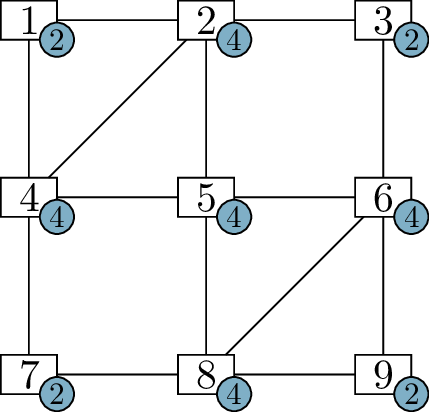
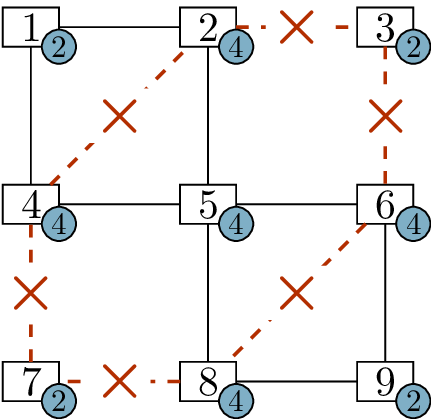
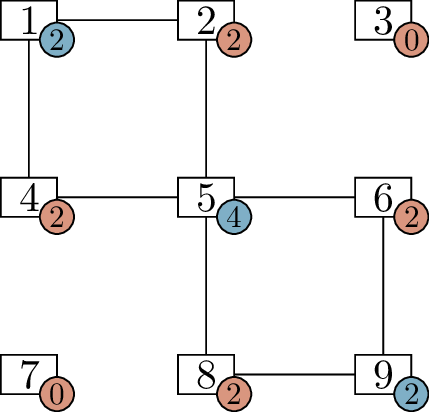
The initial graph \(G\)Deleting a cycle \(C\)Vertex degrees in \(G-C\)
Finding a cycle decomposition, one cycle at a
time
In \(G-E(C)\) (the graph we get by
deleting the edges of \(C\), leaving
the vertices as they are), all vertices are still even: the degree of
every vertex that lies on \(C\) goes
down by \(2\), and all other degrees
are unchanged. (An example of such a deletion is illustrated in
Figure 8.3.) Also, \(G-E(C)\) has fewer than \(m\) edges (since \(C\) has at least one edge), so our
induction hypothesis applies to it: \(G -
E(C)\) has a cycle decomposition. Add \(C\) to that cycle decomposition, and we get
a cycle decomposition of \(G\).
By induction, a cycle decomposition exists for any number of
edges. ◻
This proof also gives us an algorithm for finding a cycle
decomposition. Simply find any cycle, set it aside, and repeat with the
remainder of the graph until we are out of edges. How do we find a
cycle? Well, the proof of Theorem 4.4 begins
by taking a longest path, but this is done only to simplify the proof.
Really, we can build up a path by aimless wandering through the graph,
taking care only not to leave a vertex by the same edge we used to enter
it. As soon as we revisit the vertex, we obtain a cycle in the same way
that we obtained it from the longest path.
Gluing cycles together
Before we go on, let me clear the air about one thing: the condition
that all vertices are even is not sufficient to guarantee that a graph
is Eulerian. However, the exception is rather silly.
How can you find a graph where all
vertices are even, but which does not have an Euler tour? (Small
examples include a multigraph with \(2\) edges and a simple graph with \(6\) edges.)
Just make sure that your graph has
multiple connected components with edges in them! A walk can never jump
from one component to another, so you can never include all edges of the
graph in a single walk.
This is a minor quibble; we will be fine if we restrict our attention
to connected graphs. We can even allow graphs with multiple components,
as long as all components except for one are merely isolated vertices.
The cycle decomposition we get from Theorem 8.3 is the key
ingredient in putting together an Euler tour.
Theorem 8.4. A graph is Eulerian if and only if
it is connected (except possibly for isolated vertices) and all of its
vertices are even.
Proof. We know that both parts of this condition are
necessary: by Lemma 8.1, all vertices must be
even, and we have just discussed why the graph cannot have two
components with edges. It remains to show that together, these two
conditions are sufficient.
Let \(G\) be a graph which has only
one connected component aside from isolated vertices, and in which every
vertex of \(G\) is even. For
simplicity, delete all the isolated vertices (which will not affect our
argument) so that we can simply assume \(G\) is connected. (If \(G\) has only isolated vertices, then a walk
of length \(0\) is an Euler tour.) The
first thing we’ll do is use Theorem 8.3 to find a
cycle decomposition \(\mathcal D\) of
\(G\).
Next, we’ll build an Euler tour step by step. This is a proof by
algorithm. Throughout this process, we will update the following
objects:
a “partial tour” \(PT\), which
is a closed walk that uses each edge at most once, but might miss some
edges.
A subgraph \(H\) whose edges are
exactly the edges missed by \(PT\).
A set \(\mathcal U\) of
“unprocessed cycles”: a cycle decomposition of \(H\).
Initially, we’ll take \(PT\) to be a
walk representing one cycle \(C \in \mathcal
D\). Let \(H = G - E(C)\), and
let \(\mathcal U = \mathcal D -
\{C\}\). We will stop when \(\mathcal U
= \varnothing\).
One by one, we will remove a cycle from \(\mathcal U\), and splice it into \(PT\). To make this possible, it’s important
to find a cycle in \(\mathcal U\) that
contains one of the vertices visited by \(PT\).
There must always be such a cycle! Assuming otherwise, let \(S\) be the set of vertices visited by \(PT\): \(S\) is not empty, but also does not contain
any vertices of the cycles in \(\mathcal
U\). Every edge of \(G\) is
either used by \(PT\) (and joins two
vertices in \(S\)) or is an edge of a
cycle in \(\mathcal U\) (and joins two
vertices not in \(S\)). No edge of
\(G\) has exactly one endpoint in \(S\), and by Lemma 3.2, \(G\) is not connected, which is a
contradiction.
So let’s suppose that we have found such a cycle \(C\). Let \(PT\) be the closed walk \[(x_0, x_1, x_2, \dots, x_{l-1}, x_0)\] and
let \(C\in \mathcal U\) be a cycle
containing a vertex \(x_i\). Choose a
closed walk \[(y_0, y_1, y_2, \dots, y_{k-1},
y_0)\] to represent \(C\) with
the property that \(y_0 = x_i\). Then
to incorporate \(C\) into \(PT\), replace \(PT\) by the closed walk \[(x_0, x_1, x_2, \dots, x_{i-1}, \underbrace{y_0,
y_1, y_2, \dots, y_{k-1}, y_0}, x_{i+1}, \dots, x_{l-1}, x_0).\]
That is, the vertex \(x_i\) is replaced
by the entire closed walk representing \(C\). Replace \(H\) by \(H -
E(C)\), and \(\mathcal U\) by
\(\mathcal U - \{C\}\).
After this process, every edge used by the old \(PT\) is still used by the new \(PT\), and so is every edge in \(E(C)\): after all, \(E(C) = \{y_0 y_1, y_1y_2, \dots,
y_{k-1}y-0\}\), and all of these appear as pairs of consecutive
vertices in the new \(PT\). Therefore
\(H\) is still the subgraph whose edges
are exactly the edges missed by \(PT\),
and \(\mathcal U\) is still a cycle
decomposition of \(H\). Also, it’s
still true that the new \(PT\) uses
every edge at most once: all of the new edges came from \(H\), so they did not appear in the old
\(PT\).
Repeat this until \(\mathcal U\) is
empty. Throughout the algorithm, it’s been true that all edges of \(G\) are either part of \(PT\), or part of a cycle in \(\mathcal U\). Now that there are no cycles
in \(\mathcal U\), all edges must be
part of \(PT\), so \(PT\) is an Euler tour. ◻
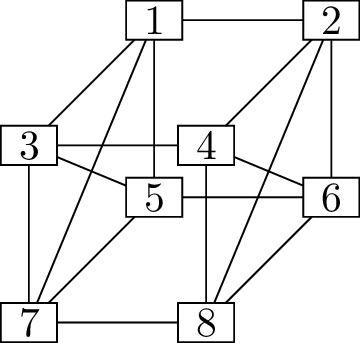
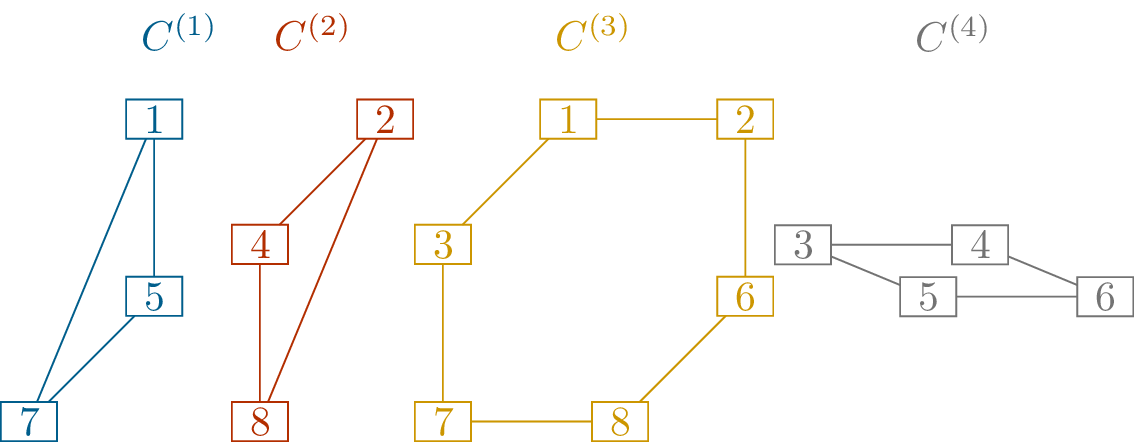
To truly understand the proof and the algorithm, let’s go through an
example, finding an Euler tour of the graph in Figure 8.4(a). We will begin with
a cycle decomposition. The one shown in Figure 8.4(b) is actually
not the best one to use—life would be easier for us if we had fewer
longer cycles. The decomposition with many short cycles will let us see
more steps of the algorithm in action.
A modified cube graphA cycle decomposition \(\{C^{(1)},
C^{(2)}, C^{(3)}, C^{(4)}\}\)
A graph and its cycle decomposition, in preparation for
finding an Euler tour
Initially, our partial tour \(PT\) is a walk \((1,5,7,1)\) representing \(C^{(1)}\).
Next, we want to add a cycle that shares a vertex with \(PT\): that is, we can’t use \(C^{(2)}\). Let’s take \(C^{(4)}\) instead; \(C^{(3)}\) would also work.
The only vertex of \(C^{(4)}\)
appearing on \(PT\) is vertex \(5\). So we choose to represent \(C^{(4)}\) by the closed walk \((5, 3, 4, 6, 5)\), and replace the \(5\) in \(PT\) by this closed walk: now, \[PT = (1, \underbrace{5, 3, 4, 6, 5}, 7,
1).\]
At this point, \(PT\) has lots
of vertices, so we can add either remaining cycle. Let’s add \(C^{(2)}\). It shares vertex \(4\) with \(PT\), so we represent \(C^{(2)}\) by \((4, 2, 8, 4)\) and splice it into \(PT\): now, \[PT
= (1, 5, 3, \underbrace{4, 2, 8, 4}, 6, 5, 7, 1).\]
Finally, only \(C^{(3)}\) is
left to add; it shares many vertices with \(PT\), but in particular, it shares vertex
\(1\), so we choose to represent it by
\((1, 2, 6, 8, 7, 3, 1)\). We replace
the first occurrence of \(1\) in \(PT\) by this closed walk, getting the final
result: \[PT = (\underbrace{1, 2, 6, 8, 7, 3,
1}, 5, 3, 4, 2, 8, 4, 6, 5, 7, 1).\]
To check that \(PT\) is an Euler
tour for yourself, draw all the vertices of the graph in Figure 8.4(a), with no edges
between them. Then, follow \(PT\),
drawing each edge as you use it. As you go, check that you never draw an
edge more than once; at the end, check that you have drawn all of
Figure 8.4(a).
Variations on Euler tours
Of course, now that we have an algorithm for Euler tours, we
immediately have an algorithm for Euler walks, as well as a test for
their existence. The only thing that changes is that a graph with two
odd vertices can still have an Euler walk.
In a graph with exactly two odd vertices,
is it possible for them to be in different connected components?
It is not: if this happened, then looking
at one of those components by itself, we’d see a subgraph with only one
odd vertex. However, by Corollary 4.2 to the
handshake lemma, the number of odd vertices in any graph is even.
Can you think of a way to modify the
algorithm for Euler tours so that it finds an \(x-y\) Euler walk instead?
Instead of a partial tour \(PT\), begin with a partial walk \(PW\) representing an \(x-y\) path \(P\), and let \(H
= G - E(P)\). In \(H\), all
vertices are even, so we can take \(\mathcal
U\) to be a cycle decomposition of \(H\). From here, the algorithm can be
continued as before.
Another interesting problem is the problem of finding Euler tours in
a directed graph. The first novelty in the directed setting is that we
no longer check for whether a vertex is even: entering and leaving a
vertex has a different effect on its indegree and outdegree.
If a directed graph \(D\) has an Euler tour, what can you say
about the degree of a vertex that appears on the tour \(k\) times?
Each arc into the vertex adds \(1\) to its indegree, and each arc out of
the vertex adds \(1\) to its outdegree.
Thus, the vertex will have indegree \(k\) and outdegree \(k\).
What, then, is the corresponding necessary
condition for a digraph to be Eulerian?
Every vertex must have an indegree equal
to its outdegree. (We can call such vertices balanced.)
To prove a necessary and sufficient condition for directed graphs, we
must retrace the steps we took in the undirected setting. The only new
ingredient is the result we use to find a single cycle; we proved it in
Chapter 7. Can you
anticipate it before it is used?
Lemma 8.5. A digraph has a cycle decomposition
if and only if all of its vertices are balanced.
Proof. Suppose first that \(D\) is a digraph with a cycle decomposition
\(\mathcal D\), and let \(x\) be an arbitrary vertex of \(D\).
In the directed cycle graph \(\overrightarrow{C_n}\), every vertex has
indegree \(1\) and outdegree \(1\). Together, the cycles in \(\mathcal D\) include each arc of \(D\) exactly once, so we can split up the
indegree and outdegree of \(x\) as a
sum over cycles. Let \(\mathcal D_x\)
be the set of all cycles in \(\mathcal
D\) containing \(x\): then \[\begin{aligned}
\deg^+_D(x) &= \sum_{C \in \mathcal D_x} \deg^+_C(x) = \sum_{C \in
\mathcal D_x} 1 = |\mathcal D_x|, \text{ and} \\
\deg^-_D(x) &= \sum_{C \in \mathcal D_x} \deg^-_C(x) = \sum_{C \in
\mathcal D_x} 1 = |\mathcal D_x|.
\end{aligned}\] In particular, \(\deg^+_D(x) = \deg^-_D(x)\): \(x\) is balanced.
This argument shows that the degree condition is necessary; now, we
must prove that it is sufficient. So let \(D\) be a digraph in which all vertices are
balanced; our task is to find a cycle decomposition of \(D\). We will do this by strong induction on
the number of arcs in \(D\). As our
base case, if \(D\) has \(0\) arcs, then the empty set is a cycle
decomposition: it includes every arc exactly once, because there are no
arcs to include.
Suppose \(D\) has \(m>0\) arcs; the same is true if we pass
to \(D'\) by deleting all isolated
vertices of \(D\). If a balanced vertex
has outdegree \(0\), it also has
indegree \(0\), so it is an isolated
vertex; therefore for all \(x \in
V(D')\), \(\deg^+(x) \ge
1\). By Theorem 7.2, \(D'\) contains a cycle \(C\).
Delete the arcs of \(C\) from \(D\) to get a digraph \(D-E(C)\) with fewer arcs: by the induction
hypothesis, it has a cycle decomposition. Add \(C\) to that decomposition to obtain a cycle
decomposition of \(D\), completing the
proof. ◻
Starting from a cycle decomposition, the algorithm for finding an
Euler tour is the same as it was for undirected graphs. However, there
is a further difficulty with stating the final result. We do not know
exactly which graphs it applies to, because do not yet know what it
means for a directed graph to be connected.
I will give you the statement first, and then we will determine what
it means. This is the proper way to go about it: we figure out what we
should prove by figuring out the assumptions we need to use.
Corollary 8.6. A directed graph is Eulerian if
and only if it is weakly connected (except possibly for isolated
vertices) and all of its vertices are balanced.
The proof is the same as the proof of Theorem 8.4: we
start with a cycle decomposition, and splice the cycles into a partial
Euler tour, one by one.
Looking at the proof of Theorem 8.4, where did we need the graph to be
connected?
We needed it to be impossible for the
partial tour \(PT\) and the unused
cycles \(\mathcal U\) to have no
vertices in common.
So the notion of connectedness we need is simply that it should be
impossible to split the vertices of our digraph \(D\) into two sets, with no arcs between
them in either direction: that’s what we’d get if \(PT\) and the cycles of \(\mathcal U\) shared no vertices. This is a
notion of connectedness that ignores the orientations of the arcs.
Formally, we call a digraph \(D\)weakly connected if the underlying graph is connected. Now we
know what Corollary 8.6
means!
Practice problems
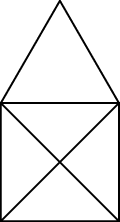
The classic brainteaser in the “draw without lifting your pencil”
genre is the picture of a stylized house shown below:
In order to draw this picture without lifting your pencil or
retracing any line, where must you start and end? (Of course, you can
always swap the start and end.)
Find a cycle decomposition of the circulant graph \(\operatorname{Ci}_{10}(1,2)\), and use it
to find an Euler tour of \(\operatorname{Ci}_{10}(1,2)\).
Find an Euler tour of the \(4\)-dimensional hypercube graph, \(Q_4\).
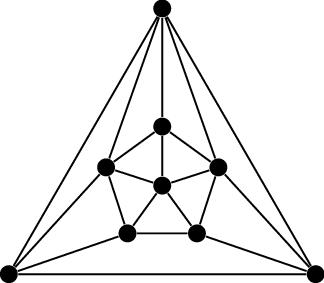
Let \(G\) be the graph below.
Find a vertex \(x\) such that \(G-x\) is Eulerian.
The graph below is not Eulerian, because some of its vertices are
odd. What is the maximum length of a closed walk in this graph that does
not use any edge more than once? Prove your answer.
In the complete graph \(K_7\),
every vertex has degree \(6\), so by
Theorem 8.3, \(K_7\) has a cycle decomposition.
Suppose we wanted to decompose \(K_7\) into as few cycles as possible. How
many cycles would we want to use, and of what lengths? Give an example
of such a decomposition.
Suppose we wanted to decompose \(K_7\) into as many cycles as possible. How
many cycles would we want to use, and of what lengths? Give an example
of such a decomposition.
Suppose that the complete graph \(K_n\), where \(95
< n < 105\), has a cycle decomposition in which every cycle
has length \(5\). What must the value
of \(n\) be?
Prove that every connected graph has a “double tour”: a closed walk which
uses every edge exactly two times, once in each direction. (That is, for
every edge \(xy\), the walk contains
one segment \(\dots, x, y, \dots\) and
one segment \(\dots, y, x,
\dots\).)
This exercise presents part of a method due to Noga Alon [2] for finding perfect
matchings (which we will cover in detail starting in Chapter 13) using Euler tours.
Let \(G\) be a bipartite
graph: that is, \(V(G)\) is the
union of two sets \(A\) and \(B\), with \(A
\cap B = \varnothing\), such that all edges of \(G\) have one endpoint in \(A\) and one endpoint in \(B\).
Prove that if every vertex of \(G\)
is even, then \(G\) has an even number
of edges.
Let \(G\) be a graph in which
every vertex is even and (as in part (a)) the number of edges is even.
Prove that \(G\) has a spanning
subgraph \(H\) such that for every
vertex \(x\), \(\deg_H(x) = \frac12 \deg_G(x)\).
Prove by induction on \(k\) that
for all \(k \ge 0\), every \(2^k\)-regular bipartite graph has a \(1\)-regular spanning subgraph.
(BMO 1977) Prove that for each integer \(n>1\) it is possible to construct a
necklace having \(2n^2\) beads in all,
these being of \(2n\) different colors,
in such a way that for each pair of different colors there is at least
one pair of adjacent beads of these two colors. Is it possible to do the
same using \(2n^2-1\) beads in all?
Give a reason for your answer.
Footnotes
Or multigraph: even if \(G\) is a simple graph, it might already
have an edge \(xy\), so we need to
switch to a multigraph model to add edge \(e\).↩︎