As an extension of studying planar graphs and their plane embeddings,
it is natural to study drawings of general graphs in the plane with few
crossings. Even though I did not include this content in the textbook
for reasons of time and space, it would fit quite well at some point
after Chapter 22 or perhaps Chapter 23. (However, the
probabilistic machinery used to prove the crossing number inequality is
a bit more advanced than what I use in the textbook.)
As I started writing this bonus chapter, a mini-theme developed: the
theme of incorrect proofs. It appears that proofs of bounds on crossing
numbers can be quite tricky, and easy to make subtle mistakes in! We all
learn best from mistakes—ideally, other people’s mistakes—so I have
included some opportunities for you to test whether you can spot the
error in a proof.
For most of this document, I have consulted the original sources I am
citing, but when writing the section on complete graphs, I referenced
the book Crossing Numbers of Graphs by Marcus Schaefer [6]. This is also a good place to read more about crossing numbers, though it is
written at a more advanced level than this bonus chapter.
Not-quite-planar graphs
What are the non-planar graphs that are as close as possible to being
planar?
Probably the most reasonable answer is: the graphs \(K_5\) and \(K_{3,3}\). By Kuratowski’s theorem
(Theorem 22.7), every non-planar
graph contains a subdivision of one of these graphs, so in some sense,
any graph is at least as non-planar as \(K_5\) and \(K_{3,3}\). We cannot, of course, draw \(K_5\) or \(K_{3,3}\) without crossing edges, but we
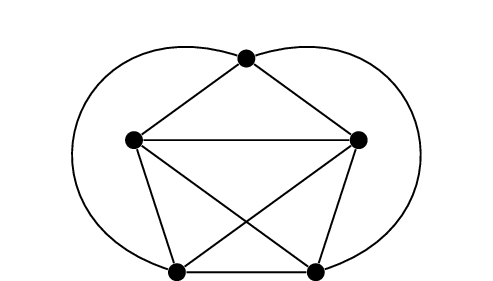
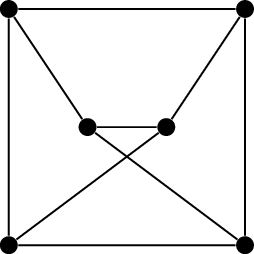
can draw them with just one crossing edge. How? You could probably
figure it out yourself, but I have given one way to do it in Figure 1(a) (for \(K_5\)) and in Figure 1(b) (for \(K_{3,3}\)).
\(K_5\) with one
crossing\(K_{3,3}\) with one
crossing
Drawings with few crossings
If we delete one of the crossing edges from these diagrams, we are
left with a planar graph.1 On the other hand, there are also
graphs which are one edge away from being planar, but cannot be drawn in
the plane without many crossings!
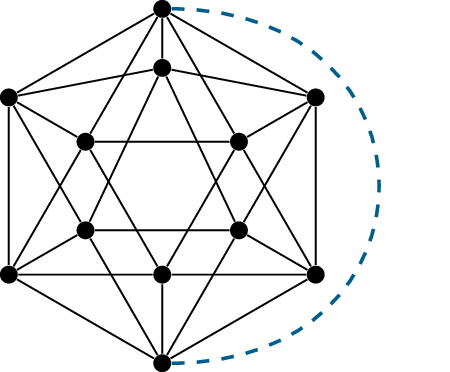
To find one such graph, consider what happens when we start with the
skeleton graph of the icosahedron and add an extra edge between two
opposite vertices, as shown in Figure 2(a). All the faces of the
icosahedron are triangles, so the graph was already a maximal planar
graph; with the addition of the extra edge, it stops being planar.
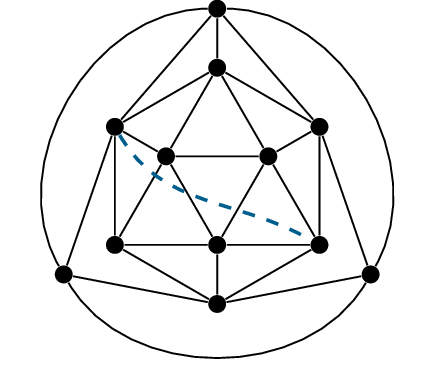
The extra edgeA three-crossing drawing
Adding an edge to an icosahedron
If we need to draw this graph in the plane, how many crossings do we
need? Well, Figure 2(b) shows a solution
with three crossings; it is obtained by starting with a plane embedding
of the icosahedral graph, and then drawing the extra edge to cross as
few of the existing edge as possible.
You might worry that there were other ways to attempt to draw the
graph that would have resulted in fewer crossings. Let me give you some
reassurances!
First, there’s no better plane embedding of the icosahedral graph
which we could have started with, in which the endpoints of the extra
edge are somehow closer together. Of course, we can wiggle around the
vertices and edges in various ways, and we can change which face is the
outer face, but we’ll still be looking at more or less the same picture.
In particular, in any plane embedding, by Proposition 22.4, all
faces must be triangles. By Euler’s formula (Theorem 21.4), there must
be \(20\) triangular faces. But there
are only \(20\) cycles of length \(3\) in the graph, so it is these cycles
that must bound each face of whatever plane embedding you pick.
Second, there’s no way to draw the extra edge that crosses fewer than
three existing edges. The number of crossings forced by the extra edge
is determined by the number of faces it must pass through: if the extra
edge must pass through at least four faces, then it must cross their
boundaries at least three times. A quick way to see that the extra edge
must, indeed, pass through at least four faces is to use the
distance-finding algorithm from Chapter 3.
Label the five faces whose boundary contains the top vertex with a
\(0\): these can be reached without
crossing any edge. Label their neighboring (and unlabeled) faces with a
\(1\): these can be reached by crossing
only one edge. Label their neighboring (and unlabeled) faces
with a \(2\): these can be reached by
crossing only two edges. We end by labeling the last five faces with a
\(3\), showing that we must cross three
edges at a minimum to reach them; these five faces are exactly the five
faces whose boundary contains the bottom vertex.
What do you think?
Have I successfully given a proof that the
graph in Figure 2 cannot be drawn in the
plane with fewer than three crossings?
No; this proof still has a gap in
it!
How do you know that the optimal drawing of this graph is obtained by
starting from a plane embedding of the icosahedral graph? Perhaps we can
draw that graph in a different way, with one or two crossings—but then
add the extra edge in a way that generates fewer additional crossings,
or maybe none at all!
One of the practice problems at the end gives a better way to approach this question, which does not leave such a gap.
The crossing number
Let’s generalize the ideas we’ve seen in these examples.
First, we should ask: when we talk about drawings of a graph in the
plane in this bonus chapter, what sort of drawings are we
considering?
Most of the setup can be inherited from Chapter 21,
where we discussed plane embeddings of graphs for the first time. Of
course, one thing has to change: we now allow edges to cross. However,
we should still be careful about how they are allowed to cross.
First of all, we should not allow an edge to pass through a
vertex (except by starting and ending at one). Otherwise, it’s unclear
how to count that intersection.
Second, we should not allow three or more edges to cross at the
same point. If we did, any graph could be drawn with just one crossings.
(I leave the details to you, in practice problem 1.)
Third, it will make our lives easier to assume that two edges
incident to the same vertex \(x\) never
cross. It’s easy to imagine drawings in which they do cross, but
whenever this happens, we can always modify the drawing to eliminate the
crossing.
In particular, edges should not cross themselves!
With these caveats in mind for the definition that follows and the
rest of the chapter, we say:
Definition 1. The crossing
number\(\operatorname{cr}(G)\) of a graph \(G\) is the minimum number of crossing edges
in any drawing of \(G\) in the
plane.
In this terminology, we’ve shown that \(\operatorname{cr}(K_5) =
\operatorname{cr}(K_{3,3}) = 1\), and I’ve given you most of a
proof that the graph in Figure 2 has crossing number
\(3\).
If we trust that example, then it’s
possible for a graph to be one edge away from planar, and still have a
crossing number bigger than \(1\). What
about the other way around: can every graph \(G\) with \(\operatorname{cr}(G)=1\) be made planar by
deleting one edge?
Yes: simply take a drawing of \(G\) with only one crossing, and delete an
edge \(e\) involved in the crossing!
The resulting drawing is a plane embedding of \(G-e\).
If a graph \(G\) has crossing number
\(\operatorname{cr}(G) = k\), then a
proof that \(\operatorname{cr}(G) \le
k\) can be very short: just draw a picture! To prove that \(\operatorname{cr}(G) \ge k\), we need to
make an argument that applies to every embedding, and (as we’ve already
seen by example) this can be very difficult. Just like the invariants
discussed in Chapter 17, Chapter 18, and Chapter 19, computing the crossing
number is a hard problem.
It’s even harder than that actually. If I asked you, “Is the complete
graph \(K_n\) Hamiltonian?” or “What is
the chromatic number of the complete bipartite graph \(K_{n,n}\)?” then you would have an
immediate answer. Meanwhile, the crossing numbers of these graphs (in
general, in terms of \(n\)) are still
open questions!
The brick factory problem
We should start with the complete bipartite graph, because it is
easier (but not easy!) and because it is historically the first crossing
number to be studied in graph theory. The problem first appears in print
in a 1955 article by Casimir Zarankiewicz [8], but its origin
is attributed to Pál Turán, who had to deal with it in a practical
situation.2
In 1944, Turán was forced to work in a brick factory near Budapest. There
were \(n\) kilns where the bricks are
made and \(m\) storage yards where they
were kept. (We do not know the exact numbers, so we have no choice but
to deal in variables.) All the kilns were connected by rail to all the
storage yards, forming a drawing of the complete graph \(K_{m,n}\) in the plane. Since \(m\) and \(n\) were both at least \(3\), the rails had to cross in some
places.
The small trucks rolling on the rails had a great deal of trouble at
the crossings; they would derail (both Turán and Zarankiewicz describe
this as a regular occurrence, not an occasional one) and spill the
bricks. Naturally, we want to minimize the crossings; but how can this
be done? In other words; what is \(\operatorname{cr}(K_{m,n})\) as a function
of \(m\) and \(n\)?
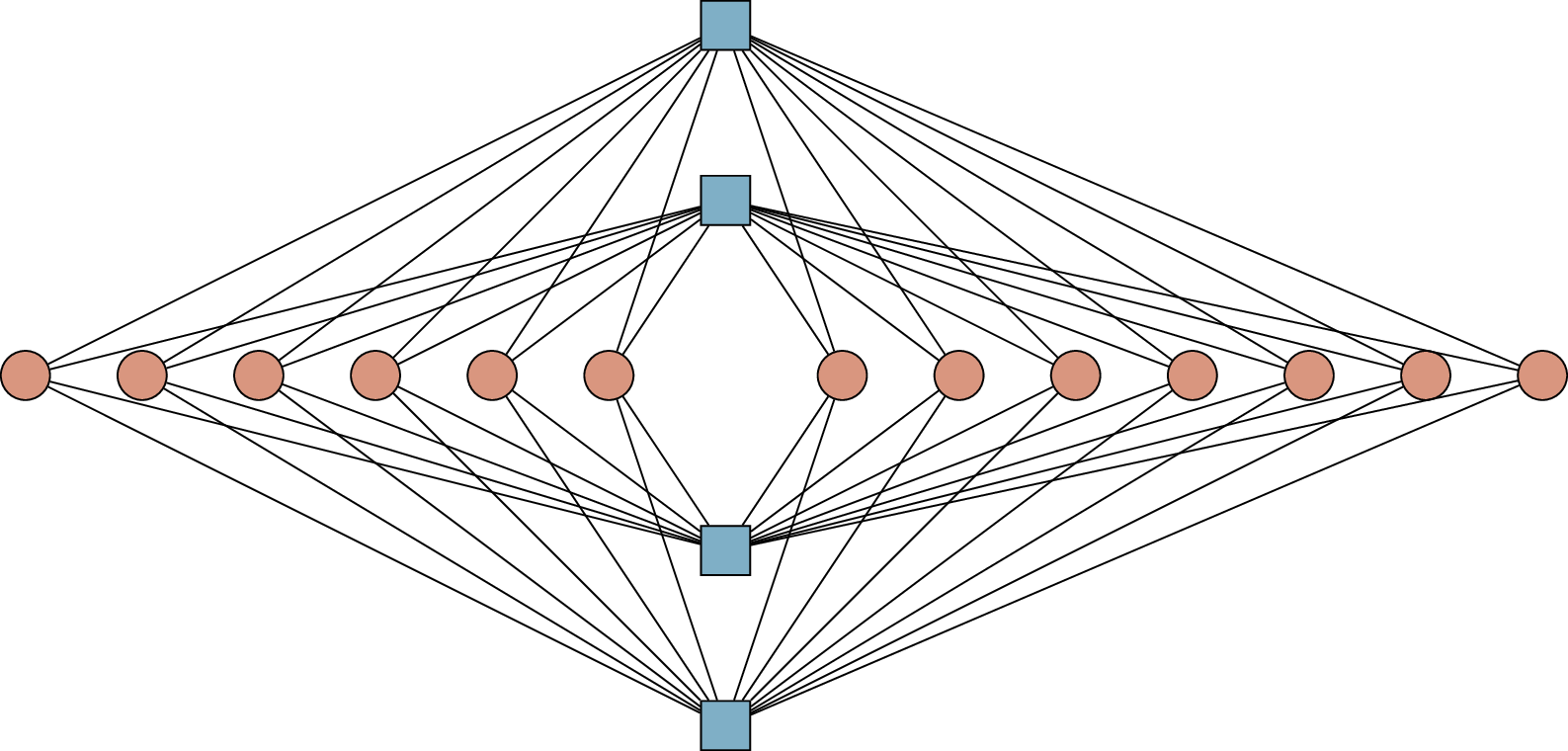
Zarankiewicz found, first of all, a general method to draw \(K_{m,n}\) in the plane without too many
crossings. This is illustrated in Figure 3 on the example of
\(K_{4,13}\). In general, to draw \(K_{m,n}\), the vertices on one side of the
bipartition are placed along the \(y\)-axis, half above the \(x\)-axis and half below. The vertices on
the other side of the bipartition are placed along the \(x\)-axis, half to the left of the \(y\)-axis and half to the right. When \(m\) and/or \(n\) are odd, the vertices cannot be split
in half exactly, so we divide them as close to equally as possible.
A drawing of \(K_{4,13}\)
in the plane with only \(72\)
crossings
In this construction, in order for two edges \(ab\) and \(a'b'\) (where \(a,a'\) are drawn on the \(y\)-axis and \(b,b'\) on the \(x\)-axis) to cross, several things have to
happen. First of all, the two edges have to be drawn in the same
quadrant: this happens if \(a\) and
\(a'\) were sorted into the same
half, and so were \(b\) and \(b'\). Second, if \(a\) is further from the origin than \(a'\), then \(b\) must be closer to the origin than \(b'\), and vice versa; among the four
edges \(\{ab, ab', a'b,
a'b'\}\), there is only one intersection.
This description is enough to give a formula for the number of
crossings in the drawing we get. It takes a bit more work to obtain the
simplest expression for the formula, which is generally accepted to be
the following: \[\operatorname{cr}(K_{m,n})
\le \left\lfloor \vphantom{\frac12} \frac n2 \right\rfloor \left\lfloor
\frac {n-1}2 \right\rfloor \left\lfloor \vphantom{\frac12}\frac m2
\right\rfloor \left\lfloor \frac {m-1}2 \right\rfloor.\] (This is
an upper bound on \(\operatorname{cr}(K_{m,n})\), because it’s
the number of crossings in only one possible drawing; there could be a
better drawing!)
This construction is generally believed to give the least possible
number of crossings. This is now called the Zarankiewicz conjecture3, but that’s not how Zarankiewicz
thought of it. He thought that he found a proof of a matching lower
bound, but it turned out to have a gap in it.
I do not bring this up to criticize Zarankiewicz. First of all, every
mathematician has written many proofs with mistakes in them; it is a
regrettable part of doing mathematics, and we just hope that someone
finds the mistakes. Second, since 1955, nobody has been able to do
better and find a correct proof. I bring this up because I am going to
present Zarankiewicz’s proof to you, and make you figure out
what is wrong with it.
The proof begins with a correct lemma, which gives a correct lower
bound in the case \(m=3\). Pay careful
attention to the proof of this lemma.
Lemma 1. For all \(n\ge 1\), \(\operatorname{cr}(K_{3,n}) \ge \lfloor \frac
n2\rfloor \lfloor \frac{n-1}{2}\rfloor\).
Proof. We will induct on \(n\), but in an unusual way: going from
\(n-2\) to \(n\). Is this okay? Yes, if we have the
right base cases: we must check both \(n=1\) (from which the induction step will
prove the lemma for all odd \(n\)) and
\(n=2\) (from which the induction step
will prove the lemma for all even \(n\)).
Actually, both \(n=1\) and \(n=2\) are easy: in this case, the lower
bound \(\lfloor \frac n2\rfloor \lfloor
\frac{n-1}{2}\rfloor\) is \(0\).
It is also good to observe what happens in the \(n=3\) case: here, \(\lfloor \frac n2\rfloor \lfloor
\frac{n-1}{2}\rfloor = 1\), and indeed \(\operatorname{cr}(K_{3,3}) \ge 1\) because
\(K_{3,3}\) is not planar.
Now assume that for \(n \ge 4\), the
bound in the lemma holds for \(\operatorname{cr}(K_{3,n-2})\); we will set
out from this to prove that the lemma also holds for \(\operatorname{cr}(K_{3,n})\).
Let \(K_{3,n}\) have vertices \(1,2,\dots,n+3\) with each of \(1,2,3\) being adjacent to each of \(4,5,\dots,n+3\). Take a drawing of \(K_{3,n}\) in the plane and suppose, first,
that for all \(\{x,y\} \subset
\{4,5,\dots,n+3\}\) there is at least one crossing between one of
the edges \(1x, 2x, 3x\) and one of the
edges \(1y, 2y, 3y\). There are \(\binom n{2}\) pairs \(x,y\) to consider, so we get at least this
many crossings in the drawing. For all \(n
> 0\), it is true that \[\binom n2
= \frac{n(n-1)}{2} > \frac n2 \cdot \frac{n-1}{2} \ge \left\lfloor
\vphantom{\frac12} \frac n2 \right\rfloor \left\lfloor
\frac{n-1}{2}\right\rfloor,\] so if such a drawing is the best we
can do, then we’ve proven the lemma without any induction at all.
If we can do better than such a drawing, then there must be a pair
\(\{x,y\} \subset \{4,5,\dots,n+3\}\)
such that the edges \(1x, 2x, 3x\) and
\(1y, 2y, 3y\) have no crossings. For
every \(z \in \{4,5,\dots,n+3\} -
\{x,y\}\), however, there must be a crossing between one of the
edges \(1x,2x,3x,1y,2y,3y\) and one of
the edges \(1z, 2z, 3z\). (Otherwise,
we’d have a drawing of the subgraph induced by \(\{1,2,3,x,y,z\}\) with no crossings at all,
which is impossible!) That’s a total of \(n-2\) crossings for which the vertices
\(x\) and \(y\) are to blame.
If we delete vertices \(x\) and
\(y\), we’re left with a drawing of a
copy of \(K_{3,n-2}\), which by our
inductive assumption has at least \(\lfloor
\frac {n-2}2\rfloor \lfloor \frac{n-3}{2}\rfloor\) crossings. So
in the original drawing of \(K_{3,n}\),
there must be at least \(\lfloor \frac
{n-2}2\rfloor \lfloor \frac{n-3}{2}\rfloor + n-2\) crossings. You
should feel free to check the arithmetic that \[\left\lfloor \frac {n-2}2\right\rfloor
\left\lfloor \frac{n-3}{2}\right \rfloor + n-2 = \left\lfloor
\vphantom{\frac{n-1}{2}} \frac n2 \right\rfloor \left\lfloor
\frac{n-1}{2}\right\rfloor\] (try simplifying it for even \(n\) and for odd \(n\) separately), from which the lemma
follows by induction on \(n\). ◻
The intended proof of the general case that Zarankiewicz gave works
very similarly, but with one key difference that makes it fail. Can you
find it?
The argument. We will try to prove that for all \(m \ge 1\) and \(n
\ge 1\), \[\operatorname{cr}(K_{m,n})
\ge \left\lfloor \vphantom{\frac12}\frac n2 \right\rfloor \left\lfloor
\frac {n-1}2 \right\rfloor \left\lfloor \vphantom{\frac12}\frac m2
\right\rfloor \left\lfloor \frac {m-1}2 \right\rfloor,\] by
induction on \(m\). We will not try any
fancy tricks here: this is ordinary induction on \(m\), and we only need one base case. We can
give three: the right-hand side simplifies to \(0\) when \(m=1\) or \(m=2\), and when \(m=3\), the statement we want to prove is
exactly the statement of Lemma 1.
Pick any drawing of \(K_{m,n}\) in
the plane. Let \(x\) be one of the
vertices on the first side of \(K_{m,n}\); we divide the other \(m-1\) vertices into \(\lfloor \frac{m-1}{2}\rfloor\) pairs, with
one vertex left over when \(m\) is
even.
For each pair \(\{y,z\}\) in this
division, the subgraph induced by vertices \(\{x,y,z\}\) on the first side and all \(n\) vertices on the second side is a copy
of \(K_{3,n}\); therefore by Lemma 1, our drawing of \(K_{m,n}\) contains at least \(\lfloor \frac n2\rfloor \lfloor
\frac{n-1}{2}\rfloor\) crossings between its edges. As we take
\(\{y,z\}\) to be each of the \(\lfloor \frac{m-1}{2}\rfloor\) pairs, in
turn, the crossings we get each time are different. (Only the edges out
of \(x\) repeat as we look at new
pairs, but these edges do not cross each other.) Altogether, we’ve found
\(\lfloor \frac n2\rfloor \lfloor
\frac{n-1}{2}\rfloor \lfloor \frac{m-1}{2}\rfloor\)
crossings.
In addition to these, if we remove the vertex \(x\), we have a copy of \(K_{m-1,n}\) remaining, whose drawing (by
the induction hypothesis) has at least \(\lfloor \frac n2\rfloor \lfloor
\frac{n-1}{2}\rfloor \lfloor \frac{m-1}{2}\rfloor \lfloor
\frac{m-2}{2}\rfloor\) crossings. This means that the total
number of crossings is at least \[\left\lfloor \vphantom{\frac12}\frac n2
\right\rfloor \left\lfloor \frac {n-1}2 \right\rfloor \left\lfloor
\vphantom{\frac12}\frac {m-1}2 \right\rfloor \left\lfloor \frac {m-2}2
\right\rfloor + \left\lfloor \vphantom{\frac12}\frac n2 \right\rfloor
\left\lfloor \frac {n-1}2 \right\rfloor \left\lfloor
\vphantom{\frac12}\frac {m-1}2 \right\rfloor.\] Factoring out
\(\lfloor \frac n2\rfloor \lfloor
\frac{n-1}{2}\rfloor \lfloor \frac{m-1}{2}\rfloor\) and
simplifying \(\lfloor \frac{m-2}{2}\rfloor +
1\) to \(\lfloor \frac m2
\rfloor\), we get exactly the lower bound we wanted; by
induction, it holds for all \(m\ge
1\). ◻
If you were paying attention, you should have been asking yourself
this question all along, but:
Where is the mistake in this proof? What
does the induction in Lemma 1 do right
that the intended proof of the general case does wrong?
In the proof of Lemma 1, removing the vertices \(x\) and \(y\) is guaranteed to eliminate every
crossing involving the edges \(1x, 1y,
1z\), \(2x, 2y, 2z\), \(3x, 3y, 3z\), so it eliminates the \(n-2\) “extra crossings” we got: the
remaining \(\lfloor \frac{n-2}{2}\rfloor
\lfloor \frac{n-3}{2}\rfloor\) crossings are different ones.
In the intended proof of the general case, for each pair \(\{y,z\}\), we found \(\lfloor \frac n2\rfloor \lfloor
\frac{n-1}{2}\rfloor\) crossings between the edges out of \(x\), \(y\), and \(z\). However, if some of these crossings
are between an edge out of \(y\) and an
edge out of \(z\), then those crossings
remain when we delete vertex \(x\). In
that case, they are also counted among the \(\lfloor \frac n2\rfloor \lfloor
\frac{n-1}{2}\rfloor \lfloor \frac{m-1}{2}\rfloor \lfloor
\frac{m-2}{2}\rfloor\) crossings we get from the induction
hypothesis, and overall they are double-counted.
If you did not spot the error, do not feel bad; it took eleven years
after Zarankiewicz’s publication for it to be discovered!
The complete graph
An equally natural but trickier problem is determining \(\operatorname{cr}(K_n)\), as a function of
\(n\). Here, too, we have a
construction that we believe is optimal, but we cannot prove it…
…and actually, things are even more interesting than that. We have
two constructions, which give the same upper bound in two
completely separate ways. That seems like very good evidence that they
are in fact the best construction, even though we have no proof. (We
have yet to find a better construction, which is also good
evidence!)
For both constructions, it helps to first think about what happens if
we don’t try at all to find the best solution. Let’s draw \(K_n\) in the usual way, by placing the
\(n\) vertices as points spaced around
a circle. It’s tempting to space them evenly around a circle,
but that violates our rules about drawings: we will usually get many
points where three or more edges intersect. For example, if \(n\) is even, there would be \(n/2\) diameters intersecting at the center
of the circle.
Instead, we can place the vertices at \(n\) points on a circle at random! For
example, generate a uniformly random angle \(\theta \in [0,2\pi]\) for each vertex, and
draw it at the point with coordinates \((\cos
\theta, \sin\theta)\). It does not actually matter too much how
we do it, as long as enough randomness is injected, because in a
continuous world, it’s an incredible coincidence when three chords of a
circle all pass through the same point.
Another common way to add randomness is to start with a diagram where
some intersections might be bad, and randomly move every point by a very
tiny amount; this also eliminates all triple intersections.
Mathematicians call this a perturbation, and sometimes say that
a diagram is in general position when all such unlikely
coincidences are eliminated.
Lemma 2. When the \(n\) vertices of \(K_n\) are drawn as points in general
position on a circle, and the edges are drawn as straight lines, there
are exactly \(\binom n4\)
crossings.
Proof. Every crossing involves two edges with four different
endpoints, so consider four vertices \(w, x,
y, z\). No matter how they appear around the circle, the edges
\(wx, wy, wz, xy, xz, yz\) will form a
convex quadrilateral together with its diagonals. Among these edges,
only the two diagonals intersect, giving us one crossing.
There are \(\binom n4\) ways to
choose the four vertices \(w, x, y,
z\), so there are \(\binom n4\)
crossings in total. ◻
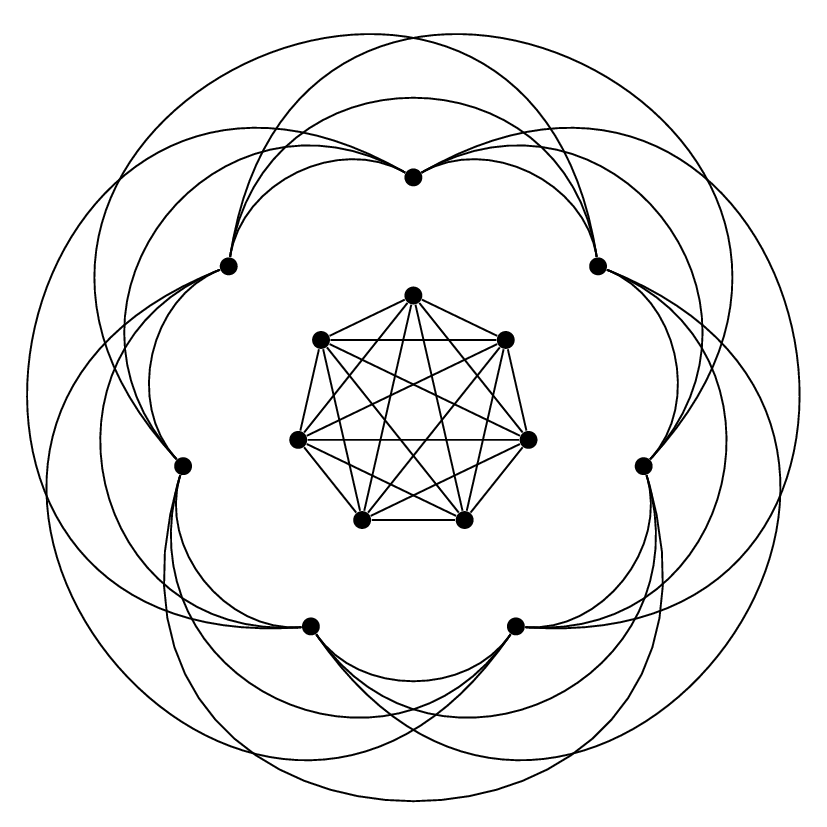
The same drawing can also be turned “inside out”, drawing every edge
as a curve outside the circle rather than a chord inside the circle. The
same crossings show up: two curved edges outside the circle intersect
each other if and only if they would have intersected inside the circle
as chords.
Two copies of \(K_7\), one
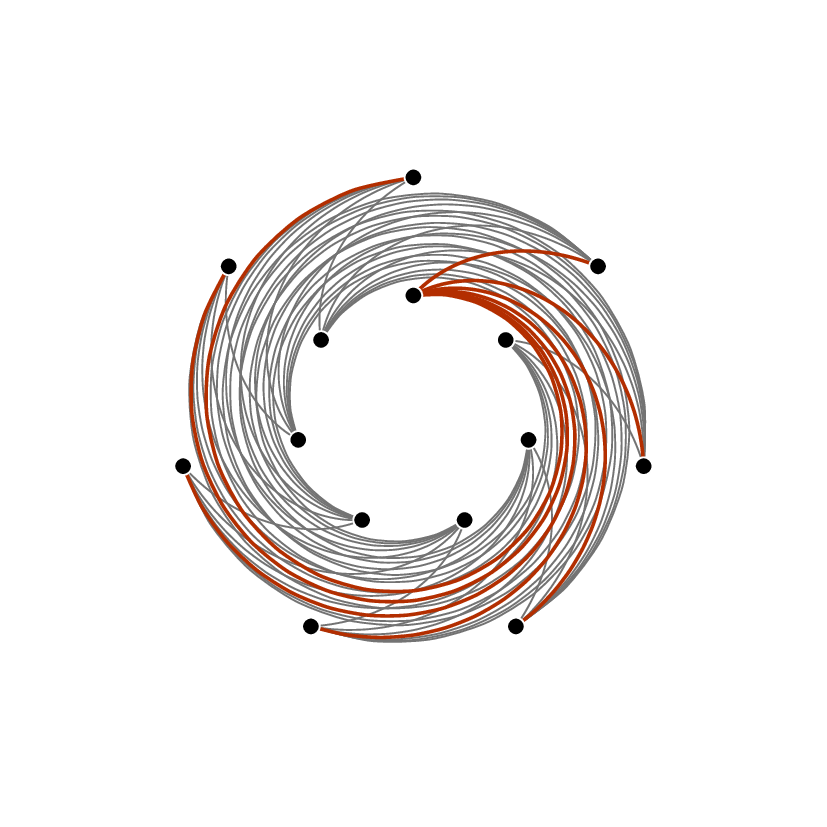
“inside out”The spiraling edges joining them
Drawing \(K_{14}\) with
\(315\) crossings
We are not especially excited to have two ways to draw \(K_n\) with \(\binom n4\) crossings, but we can use them
both at once to draw \(K_{2n}\)
efficiently.
First, draw a small copy of \(K_n\)
with straight edges, and a larger copy of \(K_n\) around it with “inside out” curved
edges, as shown in Figure 4(a) for
\(n=7\). What’s missing? We still need
to draw the edges between the two copies of \(K_n\).
This is the same as drawing \(K_{n,n}\); why can’t we just reuse the
results from the previous section?
Unfortunately, we’re restricted in where
we can place the vertices, and with this vertex placement, the
Zarankiewicz construction cannot be used.
We will take an artistic approach and draw all edges as spirals going
clockwise from inside to outside, as shown in Figure 4(b); the edges incident to the top
inside vertex are highlighted in red, to make the pattern easier to
see.
It may seem silly that, in particular, to go from an inside vertex to
the very closest outside vertex, we have a spiral winding all the way
around! This does not add additional crossings, though. If you imagine
rotating the inner copy of \(K_7\)
halfway, you can make all the spirals shorter (and some will reverse),
without changing which spirals cross.
To count all the crossings in Figure 4(b), we
will first count the total number of times that a spiral highlighted in
red crosses a spiral which is shorter. (We’ll do it in general, for all
\(n\).) Here, the reason why the
spirals wind around as much as they do becomes apparent: I did it to
make the counting more natural.
Number the positions of the vertices clockwise around the circle by
\(0, 1, 2, \dots, n\), with positions
\(0\) and \(n\) being the same. The highlighted spirals
are exactly the spirals which start in inside position \(0\). If a highlighted spiral from inside
position \(0\) to outside position
\(k\) crosses a shorter spiral, then
the shorter spiral must go from inside position \(i\) to outside position \(j\), where \(i
< j < k\). There are \(\binom
n3\) ways to choose \(i\), \(j\), and \(k\) such that \(1
\le i < j < k \le n\), so there are \(\binom n3\) crossings between a highlighted
spiral and a shorter spiral.
We’re now on the finish line! Multiply by \(n\) to account for the \(n\) different inside vertices where the
highlighted spirals could have started. Add the \(2\binom n4\) crossings within the two
copies of \(K_7\), and we learn that
this construction has \[2\binom n4 + n \binom
n3 = \frac14 n(n-1)^2(n-2)\] crossings in total.
Why do I insist on only counting crossings
where the highlighted spiral is longer?
Otherwise, we will count each crossing
twice, once from the perspective of each spiral.
This construction only works for \(K_{2n}\), but it can be modified slightly
for an odd number of vertices. If each crossing involves two edges with
four different endpoints, then the average vertex is involved in a \(4/n\) fraction of the crossings: \((n-1)^2(n-2)\) of them. But the
construction is extremely symmetrical: every vertex should be involved
in the same number of crossings! (The only tricky part of seeing that is
turning the diagram “inside out” to see that the inside vertices are no
different from the outside ones.) So by deleting any vertex we like, we
get a drawing of \(K_{2n-1}\) with
\[\frac14 n(n-1)^2(n-2) - (n-1)^2(n-2) =
\frac14 (n-1)^2(n-2)(n-4)\] crossings.
We have obtained a proof of the following theorem, due to Richard
Guy [3]:
Theorem 3. \(\operatorname{cr}(K_{2n}) \le \frac14
n(n-1)^2(n-2)\) and \(\operatorname{cr}(K_{2n-1}) \le \frac14
(n-1)^2(n-2)(n-4)\). Equivalently, \[\operatorname{cr}(K_n) \le \begin{cases}
\frac1{64} n(n-2)^2(n-4) & n\text{ is even,} \\
\frac1{64} (n-1)^2(n-3)(n-5) & n\text{ is odd.}
\end{cases}\]
Another way to express the upper bound of Theorem 3, unifying the even and odd cases,
is \[\operatorname{cr}(K_n) \le \frac14
\left\lfloor \vphantom{\frac12} \frac n2 \right\rfloor \left\lfloor
\frac{n-1}{2}\right\rfloor \left\lfloor \frac{n-2}{2}\right\rfloor
\left\lfloor \frac{n-3}{2}\right\rfloor.\]
I mentioned two constructions. The second, due to Frank Harary and
Anthony Hill [4], is conceptually more natural, but harder to analyze. Starting with the
drawing of \(K_n\) in Lemma 2, Harary and Hill ask: what
if we turn only some of the edges inside out, drawing them as
curves outside the circle? I will leave the story of what happens next
to you, in the last practice problem.
The crossing number
inequality
A graph with \(n \ge 3\) vertices
and \(3n-5\) edges has too many edges
to be planar, by Theorem 22.2, so its crossing number must be
at least \(1\). We can prove a
generalization of this, if the graph exceeds the upper limit of \(3n-6\) edges by more than \(1\).
Lemma 4. Let \(G\) be a graph with \(n\) vertices and \(m\) edges. Then \[\operatorname{cr}(G) \ge m -
3n.\]
Proof. Take a drawing of \(G\) in the plane with only \(\operatorname{cr}(G)\) crossings. Each
crossing can be eliminated in a draconian fashion: simply delete one of
the edges involved. If we do this for all the crossings, we are left
with a plane embedding, but not of \(G\): it is a plane embedding of a subgraph
of \(G\) with \(m - \operatorname{cr}(G)\) edges.
By Theorem 22.2, this subgraph can have at most
\(3n-6\) edges, but this only holds if
\(n\ge 3\). We will want a result that
holds for all \(n\), and we will not
much care about the \(6\), so we will
replace this bound by \(3n\): now it
works for \(n=1\) and \(n=2\) as well. (It even works for \(n=0\), if you don’t ask too many
troublesome questions about graphs with \(0\) vertices.)
Therefore \(m -
\operatorname{cr}(G)\) (the number of edges this subgraph
actually has) is at most \(3n\) (the
upper limit on how many edges it can have), and \(m - \operatorname{cr}(G) \le 3n\) can be
rearranged to prove the lemma. ◻
If \(m\) is large, however, then
Lemma 4 is very weak. The graph \(K_{100,100}\) has \(200\) vertices and \(10\,000\) edges, so Lemma 4 tells us that it has at least
\(9\,400\) crossings. That’s over nine
thousand, but much less than \(\lfloor
\frac{100}{2}\rfloor \lfloor \frac{99}{2}\rfloor\lfloor
\frac{100}{2}\rfloor\lfloor \frac{99}{2}\rfloor = 6\,002\,500\):
the number of crossings that we’d get if the Zarankiewicz conjecture
were true.
Can we do better? Let’s try.
Lemma 5. Let \(G\) be a graph with \(n\) vertices and \(m\) edges. Then \[\operatorname{cr}(G) \ge 4m -
24n.\]
Proof. Take a drawing of \(G\) in the plane with only \(\operatorname{cr}(G)\) crossings, and apply
the Thanos method of problem-solving: for every vertex, flip a coin, and
with probability \(\frac12\) erase that
vertex. (Of course, when a vertex is erased, all the edges incident to
it are gone, too.)
On average, there are \(\frac12n\)
vertices left after the snap. However, edges are even less likely to
survive: if either of the endpoints of an edge is erased, the edge is
erased, so there is only a \(\frac14\)
chance that the edge is kept. We are left with \(\frac14m\) edges, on average.
On average, how many crossings are left in
the drawing?
A crossing disappears if either of the
edges through it disappears. There is only a \(\frac 1{16}\) chance that all \(4\) endpoints of both edges are kept. On
average, then only \(\frac 1{16}
\operatorname{cr}(G)\) crossings are left.
We are not satisfied with either claim about the average case,
though; we need a fourth statement about averages, which is a bit more
technically precise. Let \(H\) is the
graph whose drawing remains after the snap. Then the average value of
\(\operatorname{cr}(H) - |E(H)| +
3|V(H)|\) is \(\frac1{16}
\operatorname{cr}(G) - \frac14 m + \frac32 n\).
This follows from a property known as linearity of
expectation: the sum of the average values of several random
variables is equal to the average value of their sums. As intuition for
this property, suppose that an exam is given with five problems worth
\(20\) points each. The teacher
computes the class average for each problem: it is 18 points for problem
1, 16 points for problem 2, 20 points for problem 3, 10 points for
problem 4, and 15 points for problem 5. From this information alone, we
can say that the class average for the exam was \(18+16+20+10+15 = 79\) points out of \(100\).
Back to graph theory. Why do we care about the average value of \(\operatorname{cr}(H) - |E(H)| + 3|V(H)|\),
in particular? Because Lemma 4
tells us that this number is always nonnegative, no matter what \(H\) is!
The average of many nonnegative possibilities must also be
nonnegative, so we deduce the inequality \[\frac1{16} \operatorname{cr}(G) - \frac14 m +
\frac32 n \ge 0.\] We deduce that \(\operatorname{cr}(G) \ge 16(\frac14m - \frac32n) =
4m - 24n\). ◻
Of course, Lemma 5 is not always better than
Lemma 4, but it is better when \(m\) is much larger than \(n\). For example, it tells us that \(\operatorname{cr}(K_{100,100}) \ge
37\,600\), so we’ve made a tiny bit of progress in the direction
of what we believe to be true.
What just happened here? This style of argument resembles a story of
Baron Munchausen [5]. The Baron is riding a horse, when he finds himself in
a swamp, sinking deeper and deeper by the moment. What does he do? He
pulls himself free by his own hair: “Gripping my noble steed with both
knees, I seized my pigtail with my free hand and pulled myself and my
horse out of the bog.”
In our case, too, it seems like we proved Lemma 5 using nothing more but the weaker
tool of Lemma 4. How is this possible?
Well, Lemma 4 is only bad when the number of
edges far exceeds the number of vertices. When the graph is more sparse,
it is not such a bad bound! So we switch from looking at \(G\) to looking at \(H\), a subgraph of \(G\). We do not know which subgraph \(H\) is best to look at, and in such a case,
we take the resort of the probabilistic graph theorist: we pick \(H\) at random.
We can keep going, though. The argument carried to its logical
conclusion is a theorem first shown by Ajtai, Chvátal, Newborn, and
Szemerédi [2], though the probabilistic argument and the better bound it
implies is attributed to Chazelle, Sharir, and Welzl.4
They did not prove the result below, which is missing an
important qualifier. I will present a proof of the theorem without the
qualifier; the proof will, accordingly, have an error. As you read, try
to tell me: where did I cheat?
Theorem 6 (An incomplete statement). Let \(G\) be a graph with \(n\) vertices and \(m\) edges. Then \[\operatorname{cr}(G) \ge
\frac{m^3}{64n^2}.\]
Proof. We proceed as in the proof of Lemma 5, but we snap much more
aggressively: we only keep a vertex with probability \(\frac{4n}{m}\). (For example, in the case
of \(K_{100,100}\), we would only keep a
vertex with probability \(\frac{2}{25}\).)
Now, the probability that an edge survives is only \(\frac{16n^2}{m^2}\), and the probability
that a crossing survives is only \(\frac{256n^4}{m^4}\). If \(H\) is the graph whose drawing we obtain,
then:
The average number of vertices left in \(H\) is \(n \cdot
\frac{4n}{m} = \frac{4n^2}{m}\).
The average number of edges left in \(H\) is \(m \cdot
\frac{16n^2}{m^2} = \frac{16n^2}{m}\).
The average number of crossings left in \(H\) is \(\frac{256n^4}{m^4}
\operatorname{cr}(G)\).
The average value of \(\operatorname{cr}(H) - |E(H)| + 3|V(H)|\)
is \(\frac{256n^4}{m^4} \operatorname{cr}(G) -
\frac{16n^2}{m} + \frac{12n^2}{m}\).
As in our previous argument, we apply Lemma 4 to conclude that this
quantity is nonnegative: \[\frac{256n^4}{m^4}
\operatorname{cr}(G) - \frac{16n^2}{m} + \frac{12n^2}{m} \ge 0.\]
If we solve for \(\operatorname{cr}(G)\), we get \(\operatorname{cr}(G) \ge
\frac{m^3}{64n^2}\). ◻
Before asking the big question and trying to figure out what’s wrong
with this proof, let’s ask a little question: where did \(\frac{4n}{m}\) come from?
A little bit of calculus can get it for us. If we had used a variable
probability \(p\), then we would have
arrived at the inequality \[p^4
\operatorname{cr}(G) - p^2 m + 3p n \ge 0 \implies \operatorname{cr}(G)
\ge \frac{pm - 3n}{p^3}.\] We would like the largest possible
lower bound, so we must choose the value of \(p\) that makes this quantity as large as
possible. Setting the derivative equal to zero and solving, we get…
…well, we get \(p =
\frac{4.5n}{m}\), actually. But the resulting inequality is \(\frac{4m^3}{243n^2}\), which is not much
better, and a bit messier. For practical reasons, \(p = \frac{4n}{m}\) and a \(64\) in the denominator is good enough.
There’s only one problem with the theorem we get: it’s clearly,
painfully wrong on simple examples.
Let \(G\)
be the cycle graph \(C_n\). What does
Theorem 6 tell us about \(G\)?
Since \(C_n\) has \(n\) vertices and \(n\) edges, the bound in Theorem 6 simplifies to \(\operatorname{cr}(C_n) \ge n/64\).
Why is that so bad?
Well, \(C_n\) is a planar graph: draw it as a
regular \(n\)-sided polygon, and there
are no crossings. So the lower bound \(\operatorname{cr}(C_n) \ge n/64\) is wrong
for all \(n\): it is always positive.
For large cycles like \(C_{64\,000}\)
the bound is not just wrong but very wrong.
The mistake in the proof is one which can often be easy to make in
proofs by the probabilistic method, like this one. However, if you’ve
never written or read such a proof before, you may not be on guard
against it.
We are only allowed to say “keep a vertex with probability \(\frac{4n}{m}\)” if \(\frac{4n}{m}\) really is a probability: if
it is between \(0\) and \(1\). So the condition we must add is that
\(m \ge 4n\). This is not a hardship,
since we plan to use the theorem on graphs with many more edges than
that.
Now let’s state the theorem correctly. (The theorem is also often
called the “crossing lemma”, but it’s also one of the biggest results in
this bonus chapter, so I had to make it a theorem.)
Theorem 7 (Crossing number inequality). Let
\(G\) be a graph with \(n\) vertices and \(m\) edges, where \(m \ge 4n\). Then \[\operatorname{cr}(G) \ge
\frac{m^3}{64n^2}.\]
For example, if we return once again to the case of \(K_{100,100}\), we get a much better lower
bound: any drawing of this graph must contain at least \(390\,625\) crossings.
Theorem 7 also tells us something more
general: that the drawings of \(K_n\)
and \(K_{n,n}\) which we believe to
have the fewest crossings are at the very least only off by a constant.
If we simplify, the theorem tells us that \(\operatorname{cr}(K_n) \ge
\frac{n(n-1)^3}{512}\) and that \(\operatorname{cr}(K_{n,n}) \ge
\frac{n^4}{256}\). Both of these are degree-\(4\) polynomials in \(n\). Our upper bounds are also degree-\(4\) polynomials in \(n\) (ignoring floors and ceilings): we can
now confirm that at least we’ve gotten that part right!
Practice problems
Suppose that we relax the
conditions in our drawings, and allow any number of edges to cross at
the same point.
Prove that now, every graph can be drawn in the plane with at most
one crossing point. (It’s enough to prove that this can be done for
\(K_n\) for every value of \(n\).)
Prove that for any graph \(G\),
if \(H\) is a subdivision of \(G\), then the crossing numbers of \(G\) and \(H\) are equal.
One way to deal with the graph in Figure 2 is to prove that if two
“ordinary” edges of the graph are deleted, but the extra edge is kept,
the result can never be planar.
I verified this fact by a brute-force search in Mathematica, but
try to convince yourself informally by finding many subdivisions of
\(K_{3,3}\) using the extra edge, so
that it’s impossible to destroy all of them by removing only one or two
ordinary edges.
Explain why it follows from this fact that the graph has crossing
number at least \(3\).
Prove that \(\operatorname{cr}(K_6) =
3\).
Prove that \(\operatorname{cr}(Q_4) \ge
4\). (It is known that \(\operatorname{cr}(Q_4) = 8\), but I do not
know if that is easy to prove.)
Use Theorem 22.6 to help you prove that the
Petersen graph has crossing number \(2\).
In a drawing of \(K_n\) in the
plane, every copy of \(K_6\) is drawn
with at least \(\operatorname{cr}(K_6) =
3\) crossings. This does not mean that there are \(3\binom n6\) crossings total, because many
of them are counted multiple times.
If we correct for the double-counting, what lower bound on \(\operatorname{cr}(K_n)\) do we
get?
In a drawing of \(K_n\) in the
plane, every copy of \(K_{n-1}\) is
drawn with at lest \(\operatorname{cr}(K_{n-1})\) crossings.
This does not mean that there are \(n \cdot
\operatorname{cr}(K_{n-1})\) crossings total, because many of
them are counted multiple times.
If we correct for the double-counting, what inequality between \(\operatorname{cr}(K_{n-1})\) and \(\operatorname{cr}(K_n)\) do we
get?
Use induction and the inequality in part (b) to obtain another
lower bound on \(\operatorname{cr}(K_n)\).
In this problem, you will
investigate the ideas behind the Harary–Hill construction for drawing
\(K_n\) with few crossings. As a
reminder, we position the \(n\)
vertices around a circle, and draw each edge either as a chord of the
circle or as a curve outside the circle.
It would be too complicated to make the decision for each edge, so we
group them together into \(n\)
matchings: if \(V(K_n) =
\{1,2,\dots,n\}\), then the \(k\)th matching \(M_k\) consists of the edges \(xy\) with \(x+y
\equiv k \pmod n\).
Prove that if \(n\) is odd, then
\(|E(M_k)| = \frac{n-1}{2}\) for all
\(k\). This is impossible when \(n\) is even; what happens then?
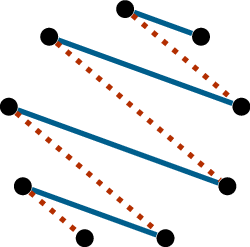
If \(M_i\) and \(M_j\) are both drawn on the same side of
the circle, how many crossings are there between them, in terms of \(i\), \(j\), and \(n\)? The four distinct cases when \(n=9\) are shown below:
To avoid cases where the answer to (b) is large, if we split the
\(n\) matchings into half inside and
half outside, how should we do it?
Verify that the total number of crossings in this case matches
the bound in Theorem 3.
Footnotes
This also follows from Kuratowski’s theorem. For
example, if an edge is deleted from \(K_5\), the resulting graph cannot contain a
subdivision of \(K_5\), since it does
not have enough edges, nor a subdivision of \(K_{3,3}\), since it does not have enough
vertices. Thus it must be planar!↩︎
Later, in 1977, Pál Turan gave his own account of the
story, as part of a welcoming note [7] in the first issue of the
Journal of Graph Theory.↩︎
It is not called Zarankiewicz’s conjecture, because
nobody knows how to pronounce the “…cz’s” ending.↩︎
“The proof we now present arose from e-mail
conversations between Bernard Chazelle, Micha Sharir and Emo Welzl,”
write Martin Aigner and Günter Ziegler in Proofs from the
Book[1].↩︎
References
Aigner, M., K. H. Hofmann, and G. M. Ziegler. 2014. Proofs from THE
BOOK. Mathematics and Statistics. Springer Berlin Heidelberg.
Ajtai, Miklós, Václav Chvátal, Monroe Newborn, and Endre Szemerédi.
1982. “Crossing-Free Subgraphs.”North-Holland
Mathematics Studies 60: 9–12. https://doi.org/10.1016/S0304-0208(08)73484-4.
Guy, Richard. 1972. “Crossing Numbers of Graphs.” In
Graph Theory and Applications, edited by Y. Alavi, D. R. Lick,
and A. T. White, 111–24. Berlin, Heidelberg: Springer Berlin Heidelberg.
https://doi.org/10.1007/BFb0067363.
Harary, Frank, and Anthony Hill. 1963. “On the Number of Crossings
in a Complete Graph.”Proceedings of the Edinburgh
Mathematical Society 13 (4): 333–38. https://doi.org/10.1017/S0013091500025645.