After this chapter, I have a whole part of the textbook devoted to
the degrees of vertices and the properties of graphs that we can deduce
from them. Originally, I had placed this chapter at the beginning of
that part, but after writing more of the book, I realized that an
introduction to the basics of vertex degrees is too fundamental: the
ideas in this chapter will appear over and over again.
To reflect this, I’ve moved this chapter to be the end of the first
part of the textbook. After finishing it, you should feel a bit more
free to skip around this book depending on what you’re interested in.
You may still need to read each part of the textbook in order, and I do
assume the knowledge of some things that are covered in previous parts,
but there’s less interdependence.
The first half of this chapter consists of computational problems
that I find fairly light-hearted; the second half contains some more
serious proofs, and it may be a spike in difficulty. If you’re new to
writing proofs in graph theory, it is important to study the proof of
Lemma 4.6 until you are comfortable with
it; it is a good example of how (and why) to induct on the number of
vertices in a graph.
The hypercube graphs
Before we begin discussing vertex degrees, let me introduce a new
family of graphs to you: the hypercube graphs. The family of hypercube
graphs generalizes the cube graph previously mentioned in Chapter 3:
Definition 4.1. The \(n\)-dimensional hypercube graph \(Q_n\) has:
Vertex set \(V(Q_n) =
\{0,1\}^n\), which we will denote with \(n\)-bit strings \(b_1b_2\dots b_n\). For example, \(V(Q_2) = \{00, 01, 10,
11\}\).
An edge between every pair of vertices that differ only in
one position. For example, in \(Q_3\),
vertex \(010\) is adjacent to vertices
\(110\), \(000\), and \(011\).
The \(3\)-dimensional hypercube
graph \(Q_3\) is also known as the
cube graph.
In \(Q_4\), what are the neighbors of vertex
\(0101\)?
Vertices \(1101\), \(0001\), \(0111\), and \(0100\): we get \(1101\) by flipping the first bit, \(0001\) by flipping the second bit, \(0111\) by flipping the third bit, and \(0100\) by flipping the fourth bit.
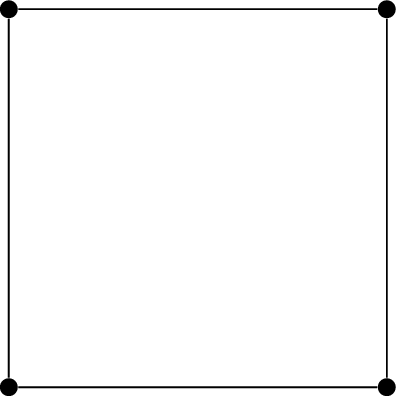
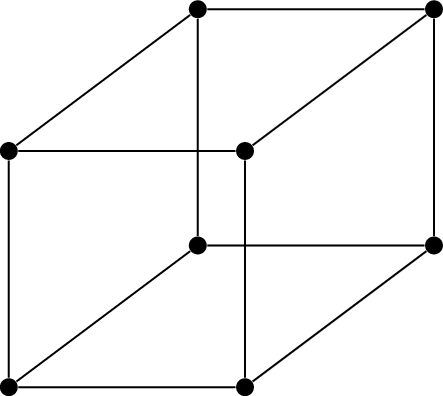
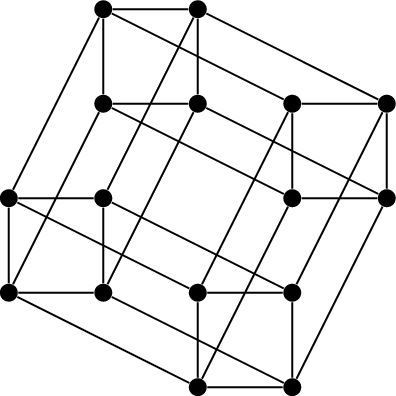
\(Q_2\)\(Q_3\)\(Q_4\)
Three hypercube graphs of three different
dimensions
In Appendix B, I give an alternate,
recursive definition of \(Q_n\): useful
when proving any of its properties by induction on \(n\).
Figure 4.1 shows three examples of
hypercube graphs: \(Q_2\), \(Q_3\), and \(Q_4\). You may notice that \(Q_2\) resembles a \(2\)-dimensional square, and \(Q_3\) resembles a \(3\)-dimensional cube; in general, \(Q_n\) is the graph that describes the
geometrical structure of an \(n\)-dimensional hypercube. However, \(Q_n\) also has a variety of applications
that have nothing to do with geometry:
For computer scientists, it is the graph of \(n\)-bit sequences with adjacency defined by
flipping bits. When is that kind of adjacency useful? For example, when
designing error-correcting codes, which need to detect accidental bit
flips. The code words in an error correcting code are vertices of \(Q_n\) all at a high distance from each
other.
We can also think of the vertices of \(Q_n\) as subsets of the set \(\{1,2,\dots,n\}\), where an \(n\)-bit string \(b_1 b_2 \dots b_n\) corresponds to the
subset \(B = \{i : b_i = 1\}\). With
this interpretation, the graph theory behind \(Q_n\) can tell us about the combinatorics
of set families.
In graph theory, \(Q_n\) can be
useful as a simple construction of a graph with many vertices and lots
of symmetry; additionally, despite having relatively few edges for how
many vertices it has, none of the vertices are very far apart.
But “relatively few edges for how many vertices it has” is a vague
statement. How many vertices does \(Q_n\) have, and how many edges?
To count the vertices, it’s enough to think about the number of ways
to choose an element \(b_1b_2 \dots b_n \in
Q_n\): for each bit \(b_i\),
there are \(2\) choices, and each
choice can be made independently of the others, so there are \(2^n\) choices overall.
To find the number of edges in \(Q_n\), we will first develop a bit of the
theory of vertex degrees, which will make the problem much easier.
The handshake lemma
Let’s begin with the main definition:
Definition 4.2. The degree of a
vertex is the number of incident edges it has. The degree of vertex
\(x\) in a graph \(G\) is written \(\deg_G(x)\), or just \(\deg(x)\) if the graph is clear from
context.
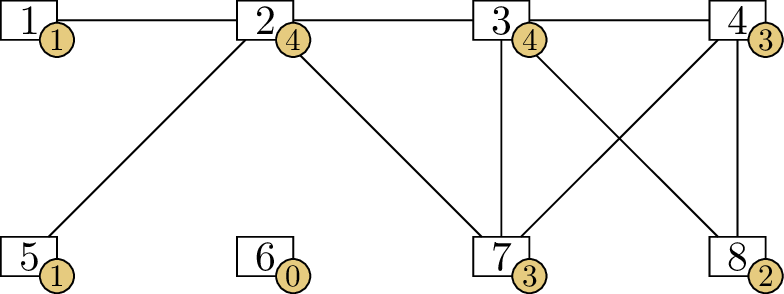
Figure 4.2 shows an \(8\)-vertex graph with vertices labeled
according to their degree.
An \(8\)-vertex graph
labeled with the degrees of its verticesIn a graph with \(8\) vertices, what is the largest number
that could be the degree of a vertex?
\(7\): if
a vertex \(x\) is adjacent to every
other vertex, then \(\deg(x) = 7\). In
general, in an \(n\)-vertex graph, the
largest degree possible is \(n-1\).
There is a lot of associated terminology.
Definition 4.3. An isolated
vertex is a vertex whose degree is \(0\); a leaf is a vertex
whose degree is \(1\).
Isolated vertices are interesting because they are the smallest
possible connected components in a graph. Leaves are less obviously
notable; we will (appropriately) find out what’s interesting about them
when we study trees in Chapter 10.
Definition 4.4. The maximum
degree\(\Delta(G)\) of a
graph \(G\) is the largest degree of
any vertex. The minimum degree\(\delta(G)\) of a graph \(G\) is the smallest degree of any
vertex.
The notation \(\Delta(G)\) and \(\delta(G)\) is only the beginning of a
general trend to use Greek letters for numerical properties of graphs;
for the important properties, these letters are mostly standard. (If you
are unfamiliar with the Greek alphabet, \(\Delta\) and \(\delta\) are an uppercase and lowercase
“delta”, respectively; this is a “d” for “degree”, uppercase for maximum
and lowercase for minimum. It’s not entirely random.)
The handshake lemma, or degree sum formula, is the first tool that
gives degrees any sort of purpose. In my opinion, it is one of the main
results from graph theory that mathematicians from all fields should
know: not just for its statement, but to use as a way of thinking about
graphs. The other result that I’d put in that category is Hall’s theorem
(Theorem 15.1), which we’ll prove in
Chapter 15.
Lemma 4.1 (Handshake lemma). In any graph \(G\), the vertex degrees add up to twice the
number of edges: \[\sum_{v \in V(G)}
\deg_G(v) = 2 |E(G)|.\]
Proof. Many proofs exist; for the sake of practice, let’s do
a proof by induction. We will prove that for any graph with \(m\) edges, the sum of degrees is \(2m\), by induction on \(m\).
The base case is \(m=0\). Here, we
have a graph with no edges. No matter how many vertices we have, their
degrees are all \(0\), the sum of the
degrees is \(0\), and \(2m\) is also \(0\).
Assume that the degree sum formula holds for all \((m-1)\)-edge graphs. Let \(G\) be a graph with \(m \ge 1\) edges, and let \(xy\) be any edge of \(G\). We can apply the induction hypothesis
to \(G-xy\) (the graph we get by
deleting edge \(xy\) from \(G\)), a graph with \(m-1\) edges.
What is the relationship between the degrees of \(G\) and the degrees of \(G - xy\)? Both \(x\) and \(y\) have one extra incident edge in \(G\) that they don’t have in \(G-xy\): edge \(xy\) itself. So \[\deg_G (x) = 1 + \deg_{G-xy}(x) \text{ and }
\deg_G(y) = 1 + \deg_{G-xy}(y).\] For any other vertex \(v\), \(G-xy\) and \(G\) have the same number of edges, so we
have \[\deg_G(v) = \deg_{G-xy}(v).\]
Also, \(G-xy\) and \(G\) have the same set of vertices. So if we
add up the vertex degrees in \(G-xy\)
and \(G\), the result is that \[\sum_{v \in V(G)} \deg_G(v) = 2 + \sum_{v \in
V(G-xy)} \deg_{G-xy}(v).\] Applying the induction hypothesis, we
get that the degree sum in \(G-xy\) is
\(2(m-1)\), so the degree sum in \(G\) is \(2(m-1) +
2 = 2m\).
By induction, the degree sum formula holds for all graphs. ◻
Using the handshake lemma, we can immediately answer our earlier
question: how many edges does the hypercube \(Q_n\) have? There are \(2^n\) vertices in \(Q_n\), and each of them has \(n\) neighbors: every bit sequence \(b_1 b_2 \dots b_n\) has \(n\) places in which a bit an be toggled. So
the sum of degrees is \(n \cdot 2^n\),
and therefore the number of edges is \(n \cdot
2^{n-1}\).
Here are some other questions we can answer quickly using the
handshake lemma:
Problem 4.1. In particular, \(Q_3\) has \(8\) vertices of degree \(3\). Can we have a \(7\)-vertex graph where all the vertices
have degree \(3\)?
Answer to Problem 4.1. No: then the
degree sum would be \(7 \cdot 3 = 21\),
so there would be \(10.5\) edges, which
is impossible. ◻
Problem 4.2. A soccer ball has \(12\) black pentagonal panels (and some
white hexagonal panels I’m too lazy to count). Panels are stitched along
their edges, and meet at corners; at each corner, a pentagon and two
hexagons meet. How many edges are there where two panels meet?
Answer to Problem 4.2. Each black pentagon
has \(5\) corners, which will be the
\(12 \cdot 5 = 60\) vertices of our
graph; the edges will be the edges where panels meet. Here, each vertex
has degree \(3\), so the sum of degrees
is \(60 \cdot 3 = 180\), and there are
\(90\) edges.
(Some slightly fancier logic can convince us that there are \(20\) hexagons; see the practice problems at
the end of this chapter.) ◻
Problem 4.3. Suppose you have a graph \(G\) with \(9\) vertices and \(20\) edges. What can the minimum degree
\(\delta(G)\) of this graph
be?
Answer to Problem 4.3. Since the sum of
the degrees is \(2 \cdot 20 = 40\), the
average of the degrees is \(\frac{40}{9}
\approx 4.44\). So the minimum degree can be at most \(4\): if every vertex had degree \(5\) or more, then the sum of degrees would
be at least \(5 \cdot 9 = 45\). We can
find \(9\)-vertex, \(20\)-edge graphs with a minimum degree of
each of \(0\), \(1\), \(2\), \(3\), or \(4\); try it yourself! ◻
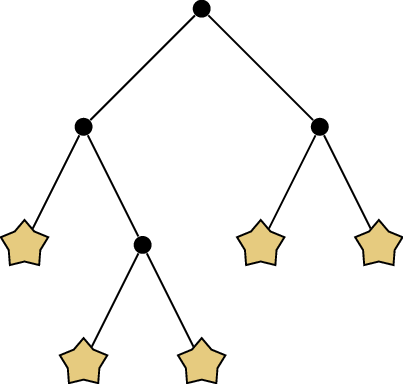
An full binary tree with \(8\) vertices; the marked vertices are
leaves.
Problem 4.4. In computer science, a full binary
tree is a graph where every vertex is adjacent to up to \(3\) vertices: a parent and up to \(2\) children. Every vertex except one (the
root) has a parent; every vertex has either \(0\) children or \(2\) children. (The parent-child
relationship is symmetric.) Figure 4.3
shows a \(9\)-vertex full binary tree;
\(5\) of its vertices are leaves. In a
\(99\)-vertex full binary tree, how
many leaves would there be?
Answer to Problem 4.4. Suppose there
are \(k\) leaves, which each have
degree \(1\); there is \(1\) root, with degree \(2\), leaving \(99-k-1\) vertices with degree \(3\) (a parent and \(2\) children). So the total degree is \(k + 2 + 3(99-k-1)\) or \(3 \cdot 99 - 2k - 1\).
By the handshake lemma, this is twice the number of edges. But we can
count the edges differently! Each edge is between a parent and a child;
all \(98\) vertices except the root
have a parent, so there are \(98\)
edges. Setting \(3 \cdot 99 - 2k - 1\)
equal to \(2\cdot 98\) and solving for
\(k\), we get \(k=50\): there must be \(50\) leaves. ◻
Corollary 4.2. Every graph \(G\) must have an even number of vertices
(possibly \(0\)) whose degree is
odd.
Proof. What is the parity of the sum of degrees of \(G\): is it odd or even?
One way to answer that question is simply to add up all the degrees.
Starting from \(0\) (an even number),
when we add an even degree to the total, it does not change the parity;
when we add an odd degree to the total, it flips the parity. So if the
number of odd degrees is even, the parity is flipped an even number of
times, and ends at an even number; if the number of odd degrees is odd,
the parity is flipped an odd number of times, and ends at an odd
number.
Another way to answer the question, however, is to use the handshake
lemma. The sum of degrees of \(G\) is
definitely an even number, because it’s twice the number of edges!
For the two answers to agree, as we know they must, there must be an
even number of vertices with odd degree. ◻
Degrees and connectedness
Here’s another way we can use the minimum degree of a graph:
Proposition 4.3. Let \(G\) be a graph with \(n\) vertices whose minimum degree \(\delta(G)\) is at least \(\frac{n-1}{2}\). Then \(G\) is connected.
Proof. We want to show that given any two vertices \(x\) and \(y\), \(G\)
must have an \(x-y\) walk.
This is definitely true if \(xy\) is
an edge of \(G\): in this case, the
sequence \((x,y)\) is an \(x-y\) walk. So let’s suppose that \(xy \notin E(G)\).
There are \(n-2\) vertices in \(G\) other than \(x\) and \(y\). Of these \(n-2\) vertices, at least \(\frac{n-1}{2}\) are adjacent to \(x\), and at least \(\frac{n-1}{2}\) are adjacent to \(y\). Together, \(\frac{n-1}{2} + \frac{n-1}{2}\) adds up to
more than \(n-2\), so there must be
some overlap! That overlap is a vertex \(z\) adjacent to both \(x\) and \(y\).
In this case, \((x,z,y)\) is an
\(x-y\) walk, completing our
proof. ◻
(Actually, we’ve shown more: we’ve shown that the distance between
any two vertices is at most \(2\). In
such cases, we say that \(G\) has
diameter at most \(2\): more
on this topic in Chapter 5.)
Proposition 4.3 is a very common type
of theorem to prove; it is, in some sense, our first glimpse of extremal
graph theory. Extremal graph theory is the sub-discipline of graph
theory that explores the relationships between possible values of
different graph properties. Here are a couple of ways this can go:
Suppose we consider two numerical invariants of graphs: \(x(G)\) and \(y(G)\). It is very rare that knowing \(x(G)\) will tell us \(y(G)\), if we’ve bothered to define both
numbers at all. However, maybe knowing \(x(G)\) will give us a range of possible
values of \(y(G)\): there is a region
in the \(xy\)-plane where the points
\((x(G), y(G))\) can go.
To describe that region, it’s natural to explore its boundaries.
That’s why extremal graph theory is “extremal”: it studies the extreme
(highest or lowest) values that one invariant can have, based on
another. We might describe the relationship between the two invariants
by an inequality: for example, the inequality \(\delta(G) \le \Delta(G)\) is a rather silly
statement of extremal graph theory.
Suppose we consider a numerical invariant \(x(G)\) and a property \(P\) that a graph \(G\) either has or does not have. Then the
“extremal” question we can ask is this: among graphs that have \(P\), what is the range of possible values
of \(x(G)\)? What about graphs that do
not have \(P\)? Using this, we might be
able to deduce whether a graph \(G\)
has property \(P\) or not, based on the
value of \(x(G)\).
Proposition 4.3 is an example of the
second type of statement, describing the relationship between minimum
degree and connectedness. It is very common in extremal graph theory to
ask: what is a lower bound \(\delta(G) \ge
\underline{\phantom{n/2}}\) that will guarantee that \(G\) has a certain property?
Of course, we have to try to find a good lower bound. It is much
easier to prove the statement, “If an \(n\)-vertex graph \(G\) has minimum degree \(n-1\), then \(G\) is connected,” because the only \(n\)-vertex graph \(G\) with minimum degree \(n-1\) is the complete graph \(K_n\). However, Proposition 4.3 is stronger: it
applies to more graphs. Is it as strong as possible?
To answer that question, we look for a so-called “extremal example”.
If we can find a graph \(G\) which just
barely fails the condition \(\delta(G) \ge
\frac{n-1}{2}\), but is not connected, then we know that
Proposition 4.3 cannot be improved
any further: that graph \(G\) is the
limit. (Ideally, we’d find such a graph for many possible values of
\(n\), to give an example that applies
to all situations.)
There is such an example. Suppose \(n\) is even, and \(G\) has two connected components which are
complete graphs with \(\frac n2\)
vertices each. Then each vertex is adjacent to the \(\frac n2 - 1\) other vertices in its
component, and \(\delta(G) = \frac n2 -
1\), yet \(G\) is not
connected.
Suppose that \(n\) is odd: \(n=2k+1\) for some \(k\). What is the largest possible degree in
a graph \(G\) which is not
connected?
It is \(k-1\), which we can achieve when one
component of \(G\) is a \(k\)-vertex complete graph, and the other is
a \((k+1)\)-vertex complete graph.
How do we know we can’t do better than
this example?
The next integer after \(k-1\) is \(k\), which is exactly equal to \(\frac{n-1}{2}\): at this point, by
Proposition 4.3, we know that the
graph must be connected.
Degrees and cycles
The following theorem, and Corollary 4.7 in
the next section, will both be very useful to us many times in future
chapters; notably, in Chapter 8 to
find cycle decompositions and in Chapter 10 to study
graphs with no cycles. In the meantime, they will show a few other ways
we can use vertex degrees in proofs.
Theorem 4.4. Every graph \(G\) whose minimum degree \(\delta(G)\) is at least \(2\) contains a cycle.
Proof. Let the walk \((x_0, x_1,
\dots, x_l)\) represent a longest path in \(G\).
We know \(\delta(G) \ge 2\) and
therefore in particular \(\deg(x_l) \ge
2\). Is it possible that \(x_l\)
has a neighbor \(y\) which is not one
of \(x_0, x_1, \dots, x_{l-1}\)? No! In
that case, the walk \((x_0, x_1, \dots, x_l,
y)\) would represent a longer path.
So \(x_l\) has at least two
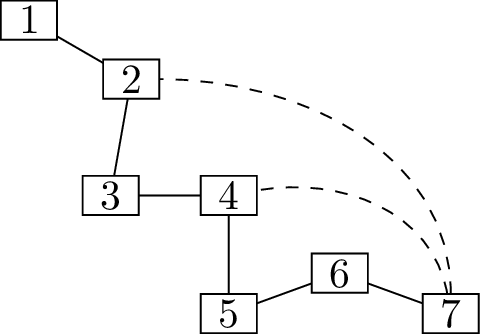
neighbors, and they are all in the set \(\{x_0, x_1, \dots, x_{l-1}\}\). Figure 4.4(a) shows an example in which
the walk representing the longest path is \((1,2,3,4,5,6,7)\), and \(x_l = 7\) is adjacent to vertices \(2\), \(4\), and \(6\).
One of \(x_l\)’s neighbors is \(x_{l-1}\): the previous vertex on the path.
This doesn’t help us. But there must be another vertex \(x_i\) with \(i
< l-1\) which is also adjacent to \(x_l\).
Then the closed walk \((x_i, x_{i+1},
\dots, x_l, x_i)\) represents the cycle we wanted. ◻
How do we know that a longest path in
\(G\) exists?
There’s an upper limit to the length of a
path: in an \(n\)-vertex graph, there
can be no path of length \(n\) or
larger, because such a path would need to contain \(n+1\) different vertices.
Why does this matter for our proof?
If we begin our proof by taking a longest
path in \(G\), then it had better be
the case that such an object exists. We could not begin a proof by
saying, “Let \((x_0, x_1, x_2, \dots,
x_l)\) be a longest walk in \(G\),” because there are often arbitrarily
long walks.
What if we raise the minimum degree, and assume \(\delta(G) \ge 3\), or \(\delta(G) \ge 10\)? In that case, we have
greater flexibility in choosing vertex \(x_i\), because \(x_l\) will have more neighbors among \(\{x_0, x_1, \dots, x_{l-2}\}\). One
possible way to use that flexibility is to strengthen the result in
Theorem 4.4 by choosing the vertex
\(x_i\) that will give us the longest
cycle. For example, in Figure 4.4(a),
going from vertex \(7\) back to vertex
\(4\) gives us a cycle of length \(4\), but going back all the way to vertex
\(2\) gives a cycle of length \(6\).
What lower bound can we prove on the length of this cycle, in terms
of \(\delta(G)\)? This is an instance
in which, if you are feeling sufficiently motivated, you should stop
reading and take a moment to try to state, and prove, a stronger result
on your own.
If not, join me and continue!
Proposition 4.5. Every graph \(G\) with \(\delta(G) \ge 2\) contains a cycle of
length at least \(\delta(G)+1\).
Proof. As in the proof of Theorem 4.4, if the walk \((x_0, x_1, \dots, x_l)\) represents a
longest path in \(G\), then \(x_l\) has at least \(\delta(G)\) neighbors, which are all in the
set \(\{x_0, x_1, \dots,
x_{l-1}\}\).
We are still going to continue by choosing a vertex \(x_i\) adjacent to \(x_l\) and looking at the closed walk \((x_i, x_{i+1}, \dots, x_l, x_i)\), but
we’re trying to find a long cycle.
Which \(x_i\) should we pick to make the closed
walk as long as possible?
The \(x_i\) with the least value of \(i\).
As long as \(\delta(G) \ge 2\), the
\(x_i\) with the least \(i\) will come before \(x_{l-1}\), so the closed walk \((x_i, x_{i+1}, \dots, x_l, x_i)\) really
will represent a cycle. (All that’s necessary here is that it has length
at least \(3\).) What’s more, the
vertices of the cycle include \(x_l\)
as well as every neighbor of \(x_l\),
because we went back to the earliest neighbor we could. This tells us
that the cycle has at least \(\delta(G)+1\) vertices, and therefore its
length is at least \(\delta(G)+1\). ◻
As before, we should ask if this is the best possible result: can we
find examples where no cycle has length more than \(\delta(G)+1\)? One example where we cannot
exceed this is a complete graph: in \(K_n\), the minimum degree is \(n-1\) and no cycle has length more than
\(n\).
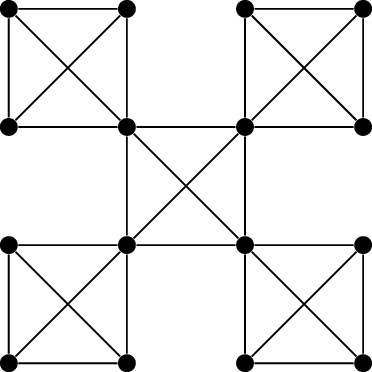
Figure 4.4(b) shows a more satisfying kind
of example, in my opinion. Here, we take the union of several copies of
\(K_n\) that overlap in individual
vertices. If we arrange them with some care, then the minimum degree is
still \(n-1\) and there is still no
cycle of length more than \(n\). But
the number of vertices can be made arbitrarily large, so it is clear
that it’s not the limiting factor.
Average degree
Even if you have lots and lots and lots of edges, your minimum degree
can be very small. For example, a \(100\)-vertex graph might consist of a \(99\)-vertex complete graph and a single
isolated vertex. This has \(4851\)
edges, which is close to the maximum number of edges a \(100\)-vertex graph can have: \(4950\). And yet the minimum degree is \(0\), and we can’t apply any nice results
like Theorem 4.4 to this graph.
The following lemma partially solves this problem, and is very
commonly used in extremal graph theory. It was first proved by Pál Erdős
in 1964 [30] to solve a
problem relating average degree to the existence of certain subgraphs,
though special cases of it were used even earlier.
Lemma 4.6. Let \(G\) be a graph with average degree at least
\(d\), where \(d\) is a positive integer. Then \(G\) contains a subgraph \(H\) with \(\delta(H) > \frac d2\).
Proof. We induct on \(n\),
the number of vertices in \(G\). (This
proof carefully follows the induction template from Appendix B, to avoid any
errors.)
When \(n \le d\), the theorem “holds
trivially”: that is, when \(n \le d\),
the highest possible degree in \(G\) is
\(d-1\), so \(G\) cannot have average degree \(d\) or more to begin with! We could use
that as our base case, but it’s a bit more satisfying to use \(n=d+1\).
In this case, the highest possible degree in the graph is \(d\). The average degree can only be this
high if every vertex has degree \(d\):
if \(G = K_{d+1}\). In this case, \(G\) itself is the subgraph \(H\) we’re looking for. This base case also
holds.
Either way, suppose that the theorem holds for all \((n-1)\)-vertex graphs with average degree
at least \(d\). Let \(G\) be an \(n\)-vertex graph with average degree at
least \(d\).
At this point, let’s say something about average degree. If \(G\) has vertices \(x_1, x_2, \dots, x_n\), then the average of
the degrees is \[\frac{\deg(x_1) + \deg(x_2)
+ \dots + \deg(x_n)}{n} = \frac{2|E(G)|}{n},\] by the handshake
lemma. This equation tells us that the average degree of \(G\) is \(\frac12
n\) times the number of edges in \(G\). In particular, the statement “\(G\) has average degree at least \(d\)” is equivalent to the statement “\(G\) has at least \(\frac12 nd\) edges”.
We’re assuming \(G\) has average
degree at least \(d\), so we’re
assuming that \(G\) has at least \(\frac12 nd\) edges. Also, if \(\delta(G) > \frac d2\), then we are
already done: we were looking for a subgraph with this minimum degree,
and \(G\) itself can be that subgraph!
So we can add on a further assumption for free: that \(G\) has a vertex \(x\) with \(\deg(x) \le \frac d2\).
In that case, let \(G' = G-x\):
the graph obtained from \(G\) by
deleting \(x\). We know that \(G'\) has \(n-1\) vertices and at least \(\frac12 nd - \frac d2\) edges: we started
with at least \(\frac12 nd\) edges, and
we lost at most \(\frac d2\) of them
from deleting \(x\). This simplifies to
\(\frac12(n-1)d\), so \(G'\) has at least \(\frac12(n-1)d\) edges, which means \(G'\) has average degree at least \(d\), too!
By applying the induction hypothesis to \(G'\), we learn that \(G'\) has a subgraph \(H\) with \(\delta(H) > \frac d2\). Since \(H\) is a subgraph of \(G'\), and \(G'\) is a subgraph of \(G\), we have found the subgraph of \(G\) we wanted.
By induction, the theorem holds for graphs with any number of
vertices. ◻
Using Lemma 4.6, we can convert minimum-degree
results to average-degree results. For example, we can use Lemma 4.6 to turn Theorem 4.4 into a result about
average degree—or, equivalently, about the number of edges.
Corollary 4.7. If \(G\) has \(n\) vertices and at least \(n\) edges, then \(G\) contains a cycle.
Proof. If \(G\) has \(n\) vertices and at least \(n\) edges, it has average degree at least
\(d=2\). By Lemma 4.6, \(G\) has a subgraph \(H\) with \(\delta(H) > \frac d2 = 1\). If \(\delta(H) > 1\), then \(\delta(H) \ge 2\), so by Theorem 4.4, \(H\) contains a cycle. This is also a cycle
in \(G\). ◻
Is the lower bound “at least \(n\) edges” in Corollary 4.7 the best lower bound
possible?
Yes: a graph with \(n\) vertices and \(n-1\) edges does not need to contain a
cycle. For example, the graph \(P_n\)
has \(n\) vertices, \(n-1\) edges, and no cycles.
Practice problems
Suppose that \(G\) is a graph
with \(5\) vertices and \(7\) edges. For which pairs \((a,b)\) is it possible that \(\delta(G) = a\) and \(\Delta(G) = b\)?
For the cases where it is possible, give an example. For the cases
where it is not possible, explain why not.
The five Platonic solids (defined in more detail in
Chapter 23) are:
The tetrahedron, which has \(4\)
vertices and \(4\) triangular faces,
with \(3\) faces meeting at every
corner.
The cube, which has \(8\)
vertices and \(6\) square faces, with
\(3\) faces meeting at every
corner.
The octahedron, which has \(6\)
vertices and \(8\) triangular faces,
with \(4\) faces meeting at every
corner.
The dodecahedron, which has \(20\) vertices and \(12\) pentagonal faces, with \(3\) faces meeting at every corner.
The icosahedron, which has \(12\) vertices and \(20\) triangular faces, with \(5\) faces meeting at every corner.
In each case, find the number of edges where two faces meet.
Let’s return to the soccer ball in Problem 4.2. Let the soccer ball have
\(12\) pentagons and \(x\) hexagons. Each pentagon borders \(5\) hexagons; each hexagon borders \(3\) pentagons and \(3\) other hexagons.
Consider a different graph describing the soccer ball: its vertices
are the pentagonal and hexagonal panels, and two vertices are adjacent
whenever the panels are stitched together.
Use the handshake lemma to compute the number of edges in this
graph.
Use the handshake lemma on a subgraph of this graph to find the
number of edges corresponding to hexagon-to-hexagon boundaries.
Solve for \(x\).
Prove that when \(n\ge 3\), every \(n\)-vertex graph with at least \(\binom n2 - (n-2)\) edges is connected.
(You should think of this bound in the following way: every \(n\)-vertex graph which is missing at most
\(n-2\) edges is connected.)
Is this the best bound possible? Is there an example of an \(n\)-vertex graph with \(\binom n2 - (n-2)\) edges which is not connected?
Let \(G_n\) be the subgraph of
\(Q_n\) induced by the vertices in
which the total number of \(1\)’s is
either \(1\) or \(2\). (For example, the vertices of \(G_3\) are \(\{001, 010, 100, 011, 101, 110\}\).)
Draw a diagram of \(G_4\), and
find the degree of each vertex.
How many edges does \(G_n\)
have, as a function of \(n\)?
A connected graph \(G\) has the
property that for every edge \(xy\),
\(\deg(x) = \deg(y)\). Prove that all
vertices of \(G\) have the same
degree.
A connected graph \(G\) has the
property that for every vertex \(x\),
the degree of \(x\) is at most the
average degree of the neighbors of \(x\). That is, if the neighbors of \(x\) are \(y_1,
y_2, \dots, y_k\), then \[\deg(x) \le
\frac{\deg(y_1) + \deg(y_2) + \dots + \deg(y_k)}{k}.\] Prove that
all vertices of \(G\) have the same
degree.
An open problem called Conway’s \(99\)-graph problem is to determine whether
there is a \(99\)-vertex graph with the
following properties:
Every two adjacent vertices have exactly one common
neighbor;
Every two non-adjacent vertices have exactly two common
neighbors.
If such a graph exists, then every vertex in it must have the same
degree, \(d\). What is \(d\)?
(I am not asking you to find the graph. John Conway offered a $1000
reward [20] for a
solution to the problem! That gives you an idea of how hard that would
be.)
(IMO 1971) Prove that for every positive integer \(m\) we can find a finite set \(S\) of points in the plane, such that given
any point \(A\) of \(S\), there are exactly \(m\) points in \(S\) at unit distance from \(A\).