It may be a slightly odd choice to put a chapter on directed acyclic
graphs in the part of the book about trees, but I think there is a
thematic fit. We will see some analogies between directed acyclic graphs
and trees. (Or should it be forests?)
Additionally, just as trees can help us study connected graphs,
directed acyclic graphs can help us study the connectedness of digraphs,
via strongly connected components and condensations. This is mostly a
coincidence, though; the use of directed acyclic graphs is very
different from the use of trees. However, in this way, we can take a
second look at some of the concepts from Chapter 3, and
how they change when the graph is directed.
Since we’ll be dealing exclusively with directed graphs for the
entire chapter, be sure to keep the definitions and results from the
second half of Chapter 7 in mind as you
read.
Directed acyclic graphs
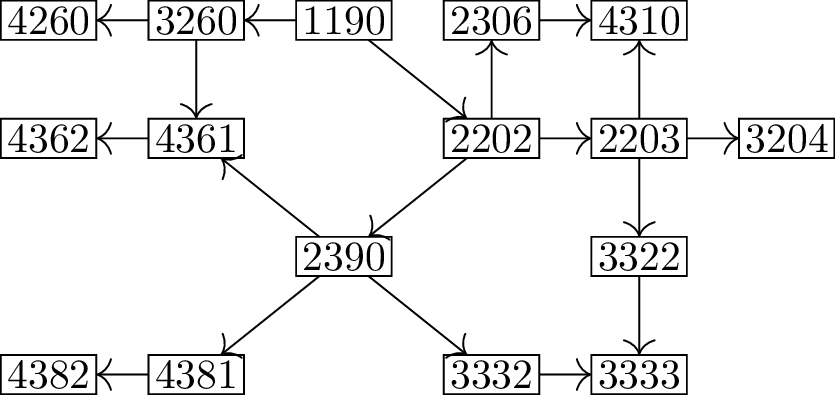
Figure 12.1(a) shows one example of the kind
of graph we will study in this chapter—loosely inspired by real life. It
represents the course prerequisite relationship between several math
courses offered at Kennesaw State University. It also includes one
fictional course: MATH 3333, which is what I imagine the course number
for a course on random graphs would be. (MATH 3333 doesn’t really exist,
but I have often thought that if it did, it would have been so fun to
teach.)
With or without this fictional innovation, there is one important
property that the digraph in Figure 12.1(a)
should have, from the point of view of graph theory. Unless something is
very wrong, it should not have a cycle!
What would go wrong if we had a cycle? For
example, what would go wrong if we added an arc \((3322, 2202)\)?
There would be no way to take the courses
in the cycle while obeying the prerequisites. Each course in the set
\(\{2202, 2203, 3322\}\) has a
prerequisite in that set, giving no starting point.
This is such a common restriction (equally applicable to course
offerings, baking recipes, or assembly lines) that the directed graphs
obeying it have their own name.
Definition 12.1. An directed acyclic
graph, or sometimes “dag” for short, is a directed graph that
contains no cycles.
Do not use as academic adviceAn example of a research tree
Two examples of directed acyclic graphs
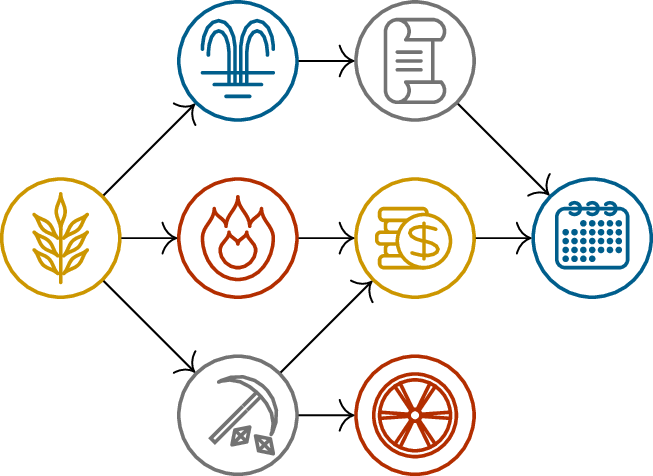
Figure 12.1(b) shows another example of a
directed acyclic graph: my own simplified representation of a research
tree from a game like Civilization. This one also represents
prerequisites: this time, for acquiring new technologies in the game. We
imagine that, for example, until a civilization masters the use of
writing, it cannot possibly hope to invent the calendar: hence the arc
from the “writing” node to the “calendar” node.
Although this structure is called a research tree, it doesn’t exactly
resemble the undirected graphs we call trees in every way. For one, we
don’t require the digraph to be connected. (If we also
included all the German classes at KSU in Figure 12.1(a), we would probably not see any
arcs between the two types of classes.) This means that there is no
lower bound on the number of arcs; we should be comparing directed
acyclic graphs to forests, not trees. However, the upper bound on the
number of arcs is much weaker as well.
Suppose you can alter the course of
history and change the relationships between the \(8\) technologies in Figure 12.1(b) to any directed acyclic graph you
like. What is the maximum number of arcs you can make?
If the only requirement is to avoid
cycles, we can have up to \(28\) arcs,
by arranging the \(8\) technologies in
a line and drawing arcs from each technology to all those that come
after it.
This \(28\)-arc solution has some
redundant arcs: if arcs \((x,y)\) and
\((y,z)\) exist, then as far as
modeling prerequisites goes, there is no need for arc \((x,z)\). But redundancy can’t take all the
blame.
What is the maximum number of arcs if we
never include arc \((x,z)\) as long as
both \((x,y)\) and \((y,z)\) exist?
We can still get up to \(16\) arcs by dividing the technologies into
four “basic” and four “advanced” ones, and adding an arc from each basic
technology to each advanced technology.
There are some parallels between directed acyclic graphs and trees,
though. In trees, we have learned to look for leaves: vertices of degree
\(1\). In directed acyclic graphs, we
instead look for sources (vertices of indegree \(0\), as defined in Chapter 7) and
sinks (vertices of outdegree \(0\)).
Lemma 12.1. Every directed acyclic graph has at
least one source and at least one sink.
Proof. As far as the existence of a source goes, this is
exactly the contrapositive of Theorem 7.2, and the
existence of a sink is the contrapositive of a “mirror version” of that
theorem. But we can also prove this result from scratch.
Let \(D\) be a directed acyclic
graph, and let the walk \((x_0, x_1, \dots,
x_l)\) represent the longest path in \(D\). There cannot be an arc \((y,x_0)\) for any \(y \in V(D)\): if \(y\) is a vertex on the path, then a cycle
is created, and if not, then the walk \((y,
x_0, x_1, \dots, x_l)\) represents a longer path. Therefore \(x_0\) is a source.
Similarly, there cannot be an arc \((x_l,
z)\) for any \(z \in V(D)\): if
\(z\) is a vertex on the path, then a
cycle is created, and if not, then the walk \((x_0, x_1, \dots, x_l, z)\) represents a
longer path. Therefore \(x_l\) is a
sink. ◻
The parallel is not only in the proof technique (which, by the way,
could be directly adapted to a proof of Lemma 10.5 on the existence of
leaves in a tree). Just like leaves, sources and sinks are the best
choice when writing a proof by induction on directed acyclic graphs, or
when coming up with a recursive algorithm. Although it’s true that for
every vertex \(x\) in a directed
acyclic graph \(D\), the digraph \(D-x\) also has no cycles, it is still best
to remove a source or sink, because they’re often easiest to put
back.
To give an example, suppose we are given a directed acyclic graph
\(D\), and want to compute the length
of a longest path in \(D\). To do so,
we’ll set ourselves a slightly harder task: for every vertex \(x \in V(D)\), we will compute the value
\(f(x)\) equal to the length of the
longest path in \(D\) ending at \(x\). (If we want the absolute longest path,
simply find the largest value of \(f\)
over all vertices.)
If the directed acyclic graph \(D\)
has only one vertex, we will assign that vertex a value of \(0\), because \(D\) cannot have a path of any positive
length. If \(D\) has more vertices,
then we compute \(f\) recursively: let
\(x\) be any sink in \(D\), and apply our algorithm to \(D-x\).
In \(D\), for any vertex \(y \ne x\), the value \(f(y)\) should be the same as in \(D-x\). There cannot be any path ending at
\(y\) that goes through \(x\), because it’s impossible for a path to
leave \(x\). So we only need to
evaluate \(f(x)\). To do this, let
\(y_1, y_2, \dots, y_k\) be the
vertices with an arc to \(x\): then
every path to \(x\) is either the
length-\(0\) path that starts at \(x\), or enters \(x\) via some \(y_i\), so we define \[f(x) := \max\{0, f(y_1), f(y_2), \dots,
f(y_k)\}.\] Now we have computed \(f\) for every vertex of \(D\).
If all we needed was a longest path in
\(D\), and we did not care where it
ended, why did we decide to compute \(f(x)\)?
If we want to work recursively, but only
compute longest paths, we might miss the longest path in \(D\) if it didn’t extend a longest path in a
subgraph of \(D\).
Why is it necessary for the removed vertex
\(x\) to be a sink?
If \(x\)
is not a sink, then in going from \(D-x\) to \(D\), we might have to change many other
\(f\)-values in addition to \(f(x)\).
Topological orders
Suppose you buy a piece of furniture which comes disassembled with a
set of instructions for how to put it together. In principle, the
necessary steps could form an arbitrary directed acyclic graph, and
there is some freedom in deciding which steps to perform before which
others. However, the instructions probably list the steps in order, to
avoid confusion.
Given a directed acyclic graph \(D\), a topological order
of \(D\) is a generalization of this
idea. It is a sequence \(x_1, x_2, \dots,
x_n\) listing all the vertices of \(D\) such that for every arc \((x_i, x_j) \in E(D)\), vertex \(x_i\) comes before vertex \(x_j\) in the topological order: \(i < j\). For example, given the class
prerequisites shown in Figure 12.1(a), one
possible topological order is \[1190, 2202,
2203, 2306, 2390, 3260, 3204, 3322, 3332, 3333, 4260, 4310, 4361, 4362,
4381, 4382\] which puts the courses in numerical order. (I assume
that most departments in most universities make sure that the numerical
order on their courses is also a topological order, though it is not
always the only order or the best order in which to take the
courses.)
Proposition 12.2. Every directed acyclic graph
\(D\) has a topological order.
Proof. We induct on the vertices of \(D\). If \(D\) has only one vertex, then there is only
way to list the vertices in a sequence, and it is vacuously a
topological order.
Let \(n>1\); suppose \(D\) has \(n\) vertices, and that every \((n-1)\)-vertex directed acyclic graph has a
topological order. By Lemma 12.1, \(D\) has a sink \(x\). By the inductive hypothesis, \(D-x\) has a topological order \(x_1, x_2, \dots, x_{n-1}\). Let \(x_n = x\). Then for every arc \((x_i, x_j)\), we consider three cases:
If \(i<n\) and \(j<n\), then \((x_i, x_j)\) is an arc of \(D-x\), and since we chose \(x_1, x_2, \dots, x_{n-1}\) to be a
topological order of \(D-x\), we must
have \(i<j\).
If \(i<n\) and \(j=n\), then \(i<j\) by substitution, with no need for
graph theory.
The case \(i=n\) and \(j<n\) is impossible, because \(x_n = x\) is a sink, and there are no arcs
out of it.
In all possible cases, \(i<j\),
and so \(x_1, x_2, \dots, x_n\) is a
topological order of \(D\). By
induction, topological orders exist for directed acyclic graphs with any
number of vertices. ◻
Can a directed graph \(D\) have a topological order if it has a
cycle?
No: if \(D\) has a topological order \(x_1, x_2, \dots, x_n\), then no path that
leaves \(x_i\) can return it, because
all arcs only take you forward in the topological order. Therefore \(D\) cannot contain any cycles.
Proposition 12.2 is a good illustration of how we
can use Lemma 12.1 to prove properties of
directed acyclic graphs by induction. However, in many cases, it also
makes induction (and recursive algorithms) unnecessary. For example, the
algorithm in our previous section for computing the longest directed
graph can now be rephrased more directly. First, choose a topological
order \(x_1, x_2, \dots, x_n\). Then,
for each \(i=1,2,\dots,n\), compute
\(f(x_i)\) by using the values of some
of the previous vertices \(f(x_1), f(x_2),
\dots, f(x_{i-1})\).
Strongly connected
We will now abandon directed acyclic graphs for a moment and turn to
a seemingly unrelated topic: the question of what it means for a
directed graph to be connected.
In Chapter 8, we had to develop one
definition of connectedness for directed graphs. We defined a weakly
connected digraph to be a digraph whose underlying graph is
connected. This is not always the wrong definition, and in fact, we
developed it with the best intentions possible: it was the definition we
needed! However, I also find it vaguely unsatisfying, because it doesn’t
tell us anything about directed walks at all.
The opposite approach is to directly copy the definition of
connectedness. We will say that a directed graph \(D\) is strongly connected if, for
every \(x \in V(D)\) and every \(y\in V(D)\), there is a directed \(x-y\) walk. Because we could have chosen
\(y,x\) instead of \(x,y\), there must also be a directed \(y-x\) walk. (For directed graphs that are
not strongly connected, this is not guaranteed to be true.)
Is a directed path graph \(\overrightarrow{P_n}\) strongly connected?
What about a directed cycle graph \(\overrightarrow{C_n}\)?
The directed path graph is not strongly
connected for \(n>1\): in fact, it’s
a directed acyclic graph! You can never get to an earlier vertex from a
later vertex.
Meanwhile, \(\overrightarrow{C_n}\)
is strongly connected: for any \(x\)
and any \(y\), if you follow the cycle
starting at \(x\), you will eventually
reach \(y\).
It’s useful to observe that Theorem 3.1 (and its proof)
continue to work for directed graphs: whenever there is an \(x-y\) walk, there is also a \(x-y\) path.
We used connectedness in undirected graphs to define connected
components, and we could use strong connectedness to define strongly
connected components in the same way: using equivalence relations. Since
we have a second chance to look at such a problem, though, let’s take
that chance to arrive at our destination differently.
We will define a strongly connected component of a digraph
\(D\) to be a maximal strongly
connected subgraph of \(D\): a subgraph
\(D'\) which is strongly connected,
and which is not a subgraph of any other strongly connected subgraph of
\(D\). In other words, we cannot add
any more vertices or arcs of \(D\) to
\(D'\) and still get a strongly
connected result.
A numerical mazeA strongly connected component
Strongly connected components in a numerical
maze
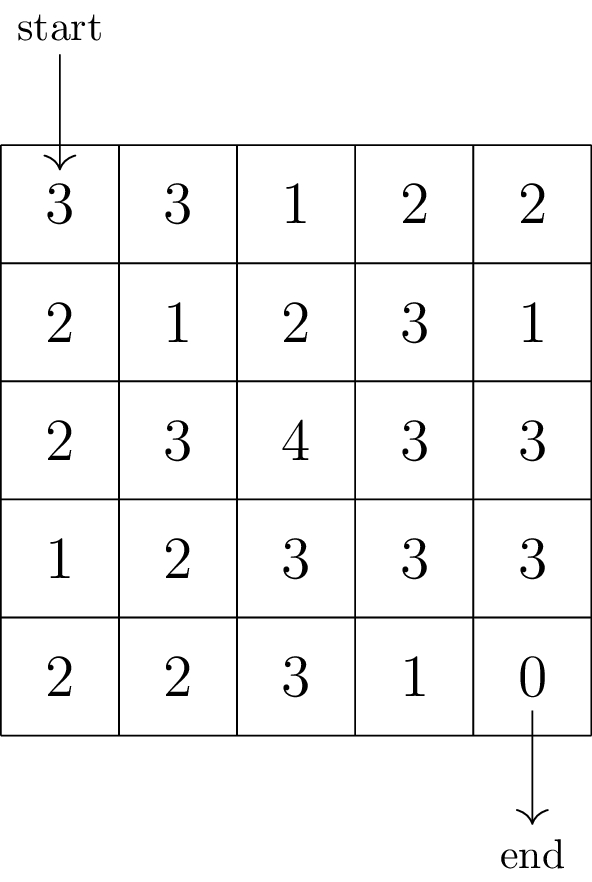
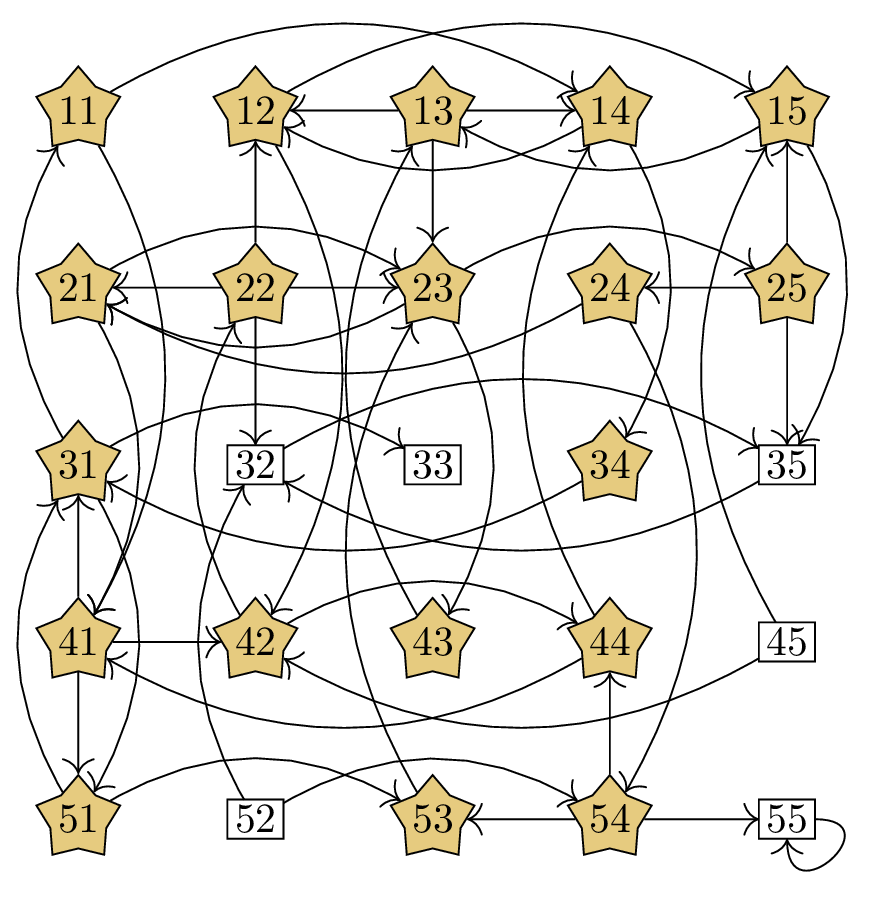
Figure 12.2 shows an example
of a strongly connected component in the same numerical maze that we
used as an example in Chapter 7. The subgraph
induced by the marked vertices in Figure 12.2(b) is a large strongly
connected component in the directed graph. From any marked vertex, it is
possible to reach any other; the other vertices either cannot be reached
from the marked vertices, or cannot reach any marked vertex.
I found the strongly connected component by starting with just vertex
\(11\) and looking for cycles. Whenever
I found a cycle that contained a marked vertex, I also marked every
other vertex of the cycle.
Why does this guarantee that the result is
a strongly connected component?
From every vertex on the cycle, we can
reach the marked vertex on the cycle, and from there, we already know we
can reach every previously-marked vertex. This strategy also works in
reverse.
Compared to what we did in Chapter 3,
we’ve definitely done less work to define what a strongly connected
component is. However, now we must do more work to ensure that the
definition behaves:
Theorem 12.3. If \(D_1,
D_2, \dots, D_k\) are the strongly connected components of a
directed graph \(D\), then \(V(D_1), V(D_2), \dots, V(D_k)\) are a
partition of \(V(D)\).
Proof. When we say that \(V(D_1),
V(D_2), \dots, V(D_k)\) are a partition of \(V(D)\), we say two things: first, that
every \(x \in V(D)\) is in \(V(D_i)\) for some \(i\), and second, that no \(x \in V(D)\) is in both \(V(D_i)\) and \(V(D_j)\) where \(i\ne j\).
For the first claim, to find a strongly connected component
containing a vertex \(x\), start with
the subgraph consisting of \(x\)
alone.
Why is this subgraph strongly
connected?
There is only one thing to check: that
there is an \(x-x\) walk. The sequence
\((x)\) is an \(x-x\) walk of length \(0\).
Either this subgraph is a strongly connected component, or else (by
the contrapositive of that definition) it must be contained in a bigger
strongly connected subgraph. That subgraph, in turn, is either a
strongly connected component, or contained in a bigger strongly
connected subgraph. We can skip to the end by applying the extremal
principle: take a strongly connected subgraph containing \(x\) which has as many vertices and arcs as
possible. From the way we chose it, we know that it cannot be contained
in a larger strongly connected subgraph, so it satisfies the definition
of a strongly connected component.
For the second claim, suppose for the sake of contradiction that
\(x \in V(D_i) \cap V(D_j)\) for some
\(i \ne j\). The contradiction is this:
the union of directed graphs \(D_i \cup
D_j\) is a bigger strongly connected subgraph of \(D\). To see this, take any \(y \in V(D_i \cup D_j)\) and \(z \in V(D_i \cup D_j)\). Then there is a
\(y-x\) walk: if \(y \in V(D_i)\), this is true because \(x \in V(D_i)\) and \(D_i\) is strongly connected, and if \(y \in V(D_j)\), this is true because \(x \in V(D_j)\) and \(D_j\) is strongly connected. There is also
an \(x-z\) walk, for the same
reason.
Joining these walks together, we get a \(y-z\) walk, proving that \(D_i \cup D_j\) is strongly connected. But
then \(D_i\) and \(D_j\) are both subgraphs of \(D_i \cup D_j\), which is a strongly
connected subgraph of \(D\), so they
cannot be strongly connected components. This contradiction tells us
that \(x\) cannot be in two different
strongly connected components, proving the theorem. ◻
The proof of Theorem 12.3
is a special case of the general proof that, given an equivalence
relation on a set \(S\), its
equivalence classes form a partition of \(S\). If you look closely, you can see where
elements of this proof rely on the three defining properties of an
equivalence relation.
Be careful, however: it is not true that \(D\) is equal to \(D_1 \cup D_2 \cup \dots \cup D_k\), the
union of its strongly connected components! As we are about to see,
there are other arcs \(D\) might
have.
Condensations
When we worked with undirected graphs, the connected components told
us the whole story of which vertices can reach which other vertices:
there is an \(x-y\) walk in \(G\) if and only if \(x\) and \(y\) are in the same connected component of
\(G\). With directed graphs and
strongly connected components, this is no longer true.
Why are strongly connected components
different?
If \(x\)
and \(y\) are in different strongly
connected components, there can still be either an \(x-y\) walk or a \(y-x\) walk; just not both.
We can, however, guarantee at least one thing: if we know the
relationship between two vertices \(x\)
and \(y\), then the same relationship
holds between every vertex \(x'\)
in \(x\)’s strongly connected component
and every vertex \(y'\) in \(y\)’s strongly connected component. For
example, if there is an \(x-y\) walk,
then there is also an \(x'-y'\)
walk: we go from \(x'\) to \(x\) to \(y\) to \(y'\).
For this reason, once we find the strongly connected components \(D_1, D_2, \dots, D_k\) of a digraph \(D\), we can summarize the relationship
between different strongly connected components much more concisely. We
define a new directed graph called the condensation of \(D\) to be the directed graph whose vertices
are \(D_1, D_2, \dots, D_k\), with an
arc \((D_i, D_j)\) if \(i\ne j\) and there is an \(x-y\) walk where \(x \in V(D_i)\) and \(y \in V(D_j)\).
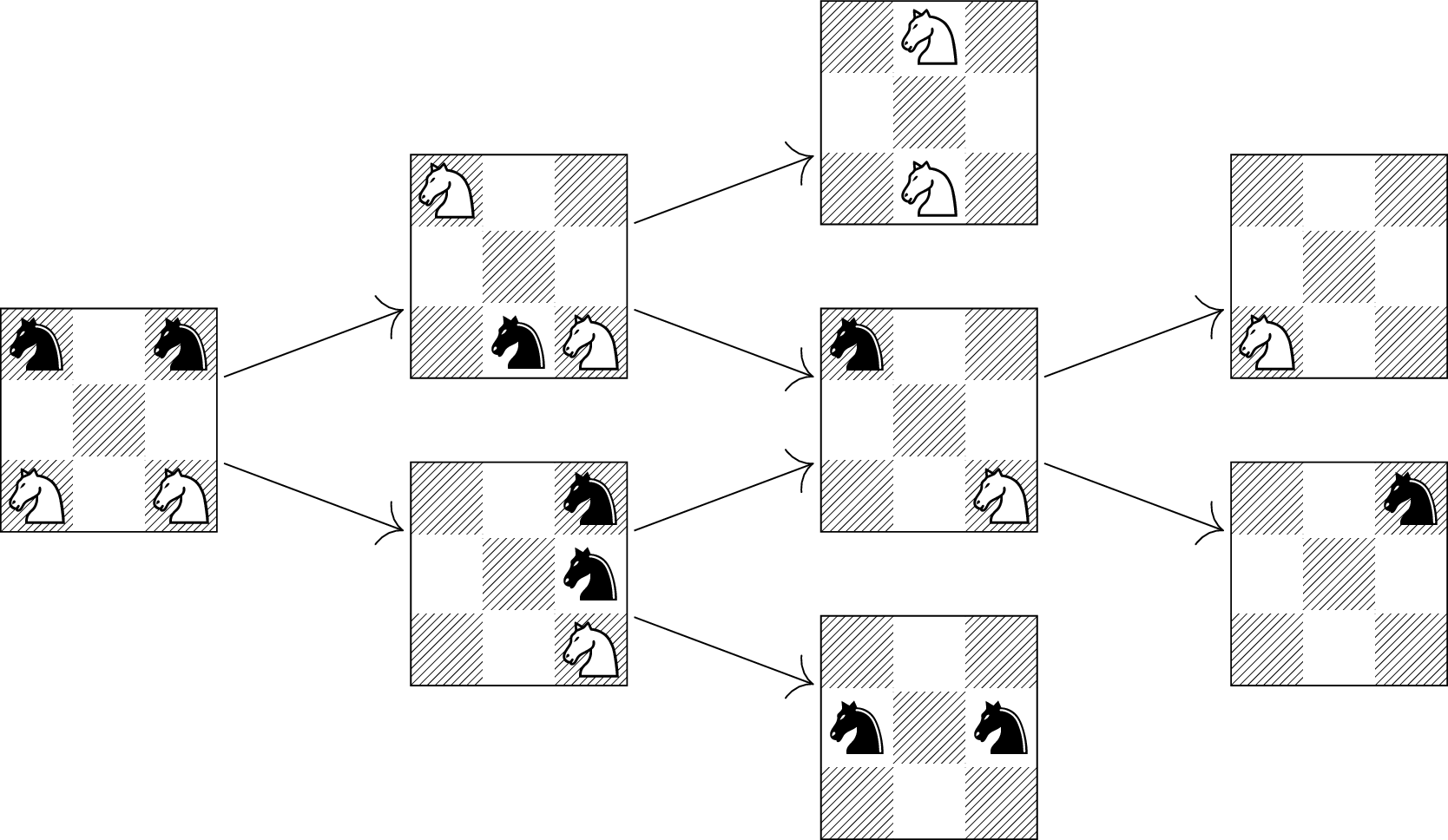
To give an example of this, I will add a frankly unnecessary twist to
a classic puzzle. In this puzzle, two white knights and two black
knights are placed on a \(3\times 3\)
chessboard, as shown in the leftmost vertex of Figure 12.3. The knights move as in
ordinary chess: two squares in one direction and one square in a
perpendicular direction. The objective of the puzzle is to switch the
positions of the black and white squares. The puzzle can be solved if
black and white must take turns, but for the purposes of this example, I
will not require this.
The condensation of the state digraph of the four knights
puzzle
My unnecessary twist is to allow moves where a knight captures a
knight of the opposite color. Obviously, once you do this, you have no
hope of solving the puzzle, since you can’t put back the captured piece.
It also means that if we want to define a graph whose vertices are the
possible states of the puzzle, it must be a directed graph: some moves
cannot be undone.
Figure 12.3 doesn’t show this state
digraph, but rather, its condensation. Each \(3\times 3\) board shows a single vertex of
its strongly connected component.
What are the strongly connected components
of this digraph, then?
For each possible collection of pieces we
can have, there is a strongly connected component. By making moves that
are not captures, we can rearrange the pieces however we like; a capture
takes us to a different strongly connected component. For example, each
of the rightmost \(3\times 3\) boards,
with only one knight on it, represents a strongly connected component
with \(8\) vertices, one for each
possible position of the remaining knight.
You might notice something else about Figure 12.3: it is a directed acyclic
graph. This is not an accident, but it is true in general.
Theorem 12.4. The condensation of any directed
graph is a directed acyclic graph.
Proof. Let \(D\) be a
directed graph, and suppose for the sake of contradiction that the
condensation of \(D\) contains a cycle.
Let \((D_0,D_1,\dots,D_{l-1},D_0)\)
represent one such cycle; each \(D_i\)
here is a vertex of the condensation, so it is a strongly connected
component of \(D\).
By definition of the condensation, for each \(i=0,1,\dots,l-1\), there is some \(x_i \in V(D_i)\) and some \(y_{i+1} \in V(D_{i+1})\) such that \((x_i, y_{i+1})\) is an arc of \(D\); when \(i=l-1\), there is some \(y_0 \in V(D_0)\) such that \((x_{l-1}, y_0)\) is an arc. Because each
\(D_i\) is strongly connected, it has a
\(y_i - x_i\) path. Using the arcs
\((x_i, y_{i+1})\) to join these paths
together, we obtain a cycle \(C\)
containing a vertex from multiple strongly connected components.
But then, the union \(D_0 \cup D_1 \cup
\dots \cup D_{l-1}\) is strongly connected: if \(z_i \in V(D_i)\) and \(z_j \in V(D_j)\), there is a \(z_i - x_i\) walk in \(D_i\), an \(x_i -
y_j\) walk that follows cycle \(C\), and a \(y_j
- z_j\) walk in \(V(D_j)\), so
there is a \(z_i - z_j\) walk. This
invalidates the assumption that the individual \(D_i\)’s are strongly connected components,
since they are contained in a bigger strongly connected subgraph. ◻
This result makes it easy to use the condensation as a reference to
see which vertices in the original digraph can reach which other
vertices. To see if there is an \(x-y\)
walk, look up the strongly connected components of \(x\) and \(y\), and see if there is an \(x-y\) walk between them in the
condensation. Not only are we potentially reducing the size of the
problem, we are also simplifying it, because now we are working with a
directed acyclic graph.
What is the condensation of a directed
acyclic graph \(D\)?
It is essentially \(D\) itself: each strongly connected
component of \(D\) is just a vertex.
Once we follow an arc out of a vertex \(x\), we can never return to \(x\), because that would imply the existence
of a cycle.
Practice problems
Draw the condensation of the graph in Figure 12.2.
Medieval alchemists valued above all the following seven
materials:
Alkahest: the universal solvent, made by adding crushed
Bluemyrtle to molten Firemetal.
Bluemyrtle: a plant that can only be harvested with tools made of
Firemetal.
Calomel: a dry powder left after dissolving Gold in
Alkahest.
Dreadwater: the infusion of Bluemyrtle in plain water.
Elixir: a potent potion obtained by adding Gold powder to
Dreadwater.
Firemetal: a mystical transformation of Gold.
Gold: could be transmuted from common dirt by adding Alkahest and
Dreadwater.
Let \(H\) be the directed graph
whose vertices are these compounds, with an arcs \((x,y)\) representing that \(x\) is needed to synthesize \(y\).
Find a cycle in \(H\), and
explain why this would have been a problem for medieval
alchemists.
Describe the strongly connected components of \(H\).
Suppose that you are a very rich medieval alchemist with an
unlimited supply of Gold. For you, the graph \(H\) must be modified to delete all arcs to
this vertex, since you don’t need anything else to synthesize it.
Find a topological order of the modified graph.
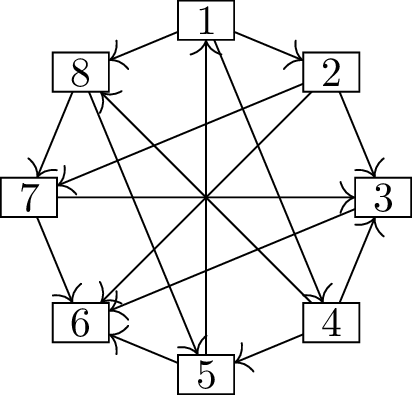
In the directed graph shown below, find an arc \((x,y)\) such that if it is reversed
(deleted and replaced by \((y,x)\)),
the result is a directed acyclic graph. Give a topological order of the
result.
If \(S\) is a set of integers,
let the divisibility digraph of \(S\)
be the directed acyclic graph with vertex set \(S\) and an arc \((x,y)\) whenever \(x \ne y\) and \(y\) is divisible by \(x\). For example, if \(S = \{2,3,6\}\), then the divisibility
digraph of \(S\) has arc set \(\{(2,6), (3,6)\}\).
Draw a diagram of the divisibility digraph of \(\{2,3,4,6,8,9,10,12\}\).
Prove that for every set \(S\),
the default order of the vertices (from smallest to largest) is a
topological order of the divisibility digraph.
For the divisibility digraph in (a), find a different topological
order: one in which \(3\) comes after
\(8\).
Let \(D\) be the divisibility
digraph of the set \(\{1,2,\dots,100\}\). Which vertex in this
graph has indegree \(1\) and outdegree
\(32\)?
A game is played with two piles of stones. On a turn, a player
picks a pile which is not empty, and takes one or more stones from it.
The game ends once both piles are empty.
We can represent this game by a digraph whose vertices are the
states, with arcs representing the valid moves. Let \(D_{n,m}\) be the digraph we get when the
game is played with a pile of size \(n\) and a pile of size \(m\).
Draw a diagram of \(D_{3,2}\).
(It should have \(12\)
vertices.)
Why is \(D_{n,m}\) always a
directed acyclic graph?
Find a topological order of \(D_{3,2}\). (There are many.)
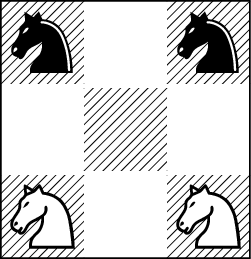
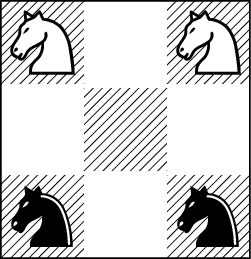
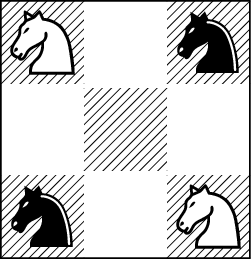
Prove that in the four knights puzzle, from the first position shown below, we can reach the second position (solving the classical puzzle) but not the third.
Call a vertex \(x\) in a
directed graph \(D\) “safe” if it is
impossible to leave \(x\) and get lost:
for every vertex \(y\) such that \(D\) has an \(x-y\) walk, \(D\) also has a \(y-x\) walk.
Prove that every directed graph has a safe vertex.
Let \(T\) be an \(n\)-vertex tree.
How many directed acyclic graphs are there whose underlying graph is \(T\)?
How many of these directed graphs have exactly one sink?
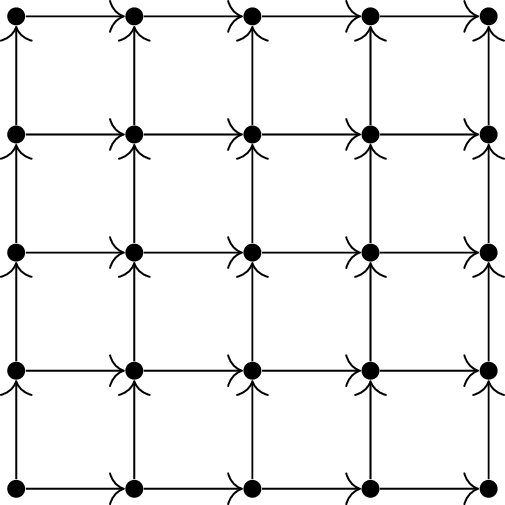
A well-known brainteaser asks the following question: given a
\(5\times 5\) grid, how many ways are
there to go from the bottom left vertex to the top right vertex while
only going up or to the right? We can phrase this in terms of directed
graphs: how many paths are there from the bottom left vertex to the top
right vertex of the first graph below?
Solve this brainteaser; see if you can generalize to \(n\times n\) grids with a combinatorial
formula.
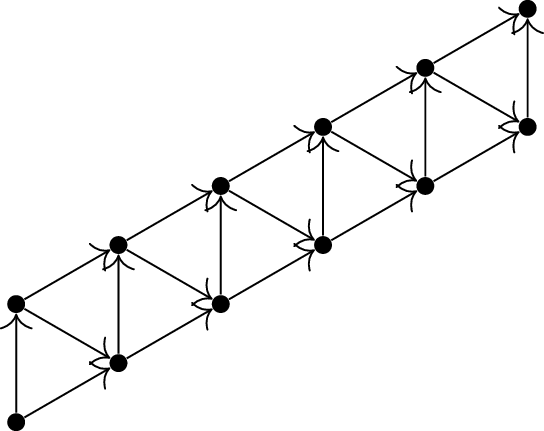
How many paths are there from the bottom left vertex to the top
right vertex in the second graph above? See if you can generalize this
problem, as well.
How can this problem be solved efficiently for arbitrary directed
acyclic graphs?
(AIME 2007) A frog is placed at the origin on the number line,
and moves according to the following rule: in a given move, the frog
advances to either the closest point with a greater integer coordinate
that is a multiple of \(3\), or to the
closest point with a greater integer coordinate that is a multiple of
\(13\). A “move sequence” is a sequence
of coordinates which correspond to valid moves, beginning with \(0\), and ending with \(39\). For example, \(0, 3, 6, 13, 15, 26, 39\) is a move
sequence. How many move sequences are possible for the frog?