I am including a chapter on Cayley’s formula for the number of
labeled \(n\)-vertex trees in this
book, first of all, because it is a beautiful piece of mathematics. It
comes with an introductory look at counting problems in graph theory,
which I think is especially important to include because I often tend to
overlook such problems when I think about what a graph theorist needs to
know. (The next chapter is also about counting problems in graph theory,
but from a very different perspective.) In short, even though Cayley’s
formula is not necessary as a prerequisite for any of the following
chapters, I think it is a worthwhile topic to study on its own.
I do not like including sections such as the last section of this
chapter, which is mainly about results too complicated to prove in this
book. However, I think that a textbook must say something about counting
trees up to isomorphism, even if it simply says that not very much is
known about the problem. When teaching this topic, I would not have
feelings that are nearly as strong; I think it is perfectly acceptable
to say that the textbook has a page on this version of the problem, and
leave it at that.
How to count graphs
Graph enumeration is a whole discipline of graph theory, but we have
a lot of ground to cover in this textbook. As a result, this is the
first and only chapter in which we will seriously look at problems about
counting graphs satisfying a given property.
When we count graphs, we must first choose between two options that
are typically described as “counting labeled graphs” and “counting
unlabeled graphs”. This is a bit misleading, because all graphs are
labeled, in the sense that all graphs have a vertex set with
distinguishable elements. Here is how to describe these options more
precisely.
Counting labeled graphs is typically the easier of the two problems.
To describe it more precisely, suppose that we being by choosing a set
\(V\) of size \(n\): it does not matter too much which set
\(V\), as long as we choose it, so
choosing \(V = \{1, 2, \dots, n\}\) is
a very reasonable and simple choice. Then we ask: how many graphs with
vertex set \(V\) have a certain
property?
The other option is to count graphs up to isomorphism, and this is
the problem typically called “counting unlabeled graphs”. Here, we start
with the set \(\mathcal S\) of all
labeled graphs of that type (again, with some fixed vertex set \(V\)). In most problems, some of the graphs
in \(\mathcal S\) will be isomorphic.
Graph isomorphism is an equivalence relation on \(\mathcal S\), so it can be used to
split \(\mathcal S\) into equivalence
classes. When we count graphs up to isomorphism, we ask: how many
equivalence classes are there?
In this chapter, we will count \(n\)-vertex trees. Most of the chapter is
devoted to the labeled counting problem, for which a clean and beautiful
formula exists. Much less is known about the unlabeled counting problem,
but I will summarize what is known about it at the end of the
chapter.
For either counting problem, one of the most important tools graph
theorists use is counting by bijection. If a function \(f\colon X \to Y\) is a bijection, then the
sets \(X\) and \(Y\) have the same size: to a set theorist,
this is actually how the size of a set is defined. Our bijections will
be bijections from a set of graphs to a set of sequences, and so we will
think of them somewhat differently: we will call them encoding
schemes.
An encoding scheme is a rule by which we can take a graph (or
whatever else) and write down a sequence of numbers to represent it.
This is a very natural idea in the modern day, when every piece of
information has an encoding scheme: after all, a computer must represent
all the data it works with as by sequences of zeroes and ones. That’s
exactly the way you should think about encoding schemes.
We will want to know two things about our encoding schemes. These
correspond to the definition of a bijection, though we won’t invoke that
definition directly.
We will want to make sure that the encoding scheme is a
unique encoding scheme: from the sequence it produces as an
output, we can uniquely determine which graph was the input. It’s nice
if we have a simple algorithm to find the graph, but all that’s strictly
necessary is to know that two different graphs never produce the same
sequence.
We will want to know which sequences of numbers are valid
encodings: which ones
An encoding scheme can be described as a function \(f\) from graphs to encodings, and both of
the properties above can be phrased in terms of \(f\).
If the encoding scheme is unique, what
does that say about \(f\)?
It says that \(f\) is an injective (one-to-one)
function.
If every element of some set \(S\) is a valid encoding, what does that say
about \(f\)?
It says that \(f\) is a surjective (onto) function, at
least if it is a function to the set \(S\).
So that’s the connection to bijections. For our purposes, the
consequence is this: once we verify that we have a unique encoding
scheme of a set of graphs, we can count the graphs in that set by
counting the valid encodings.
To avoid getting too abstract about it, here are two examples.
Problem 11.1. How many graphs with vertex set
\(\{1,2,\dots,n\}\) are there?
Answer to Problem 11.1. We will encode
these graphs as binary strings of length \(\binom n2\). Here, \(\binom n2 = \frac{n(n-1)}{2}\) is the
number of edges in the complete graph \(K_n\) (which we also consider to have
vertex set \(\{1,2,\dots,n\}\)). To
encode a graph \(G\) with \(V(G) = \{1,2,\dots,n\}\), we go through the
edges of \(K_n\) in a fixed order, such
as the dictionary order \[12, 13, \dots, 1n,
23, 24, \dots, 2n, \dots.\] For each edge, we ask: does \(G\) also contain that edge? If so, we write
down a \(1\); if not, we write down a
\(0\).
From the output of this procedure, we can look through the bits one
at a time and uniquely determine the edge set \(E(G)\), so this is a unique encoding
scheme. Starting from an arbitrary sequence of \(\binom n2\) zeroes and ones, we can
reconstruct a graph that will give that sequence, so every one of these
sequences is a valid encoding.
There are \(2^{\binom n2}\)
sequences of \(\binom n2\) zeroes and
ones (because we have \(2\) choices for
each bit in the sequence) and therefore there are \(2^{\binom n2}\) graphs with vertex set
\(\{1,2,\dots,n\}\). ◻
Problem 11.2. How many \(1\)-regular graphs with vertex set \(\{1,2,\dots,n\}\) are there?
Answer to Problem 11.2. As we know from
Chapter 5, such graphs only exist
when \(n\) is even. In the cases of
even \(n\), we could begin by listing
all \(n/2\) edges in the graph. This is
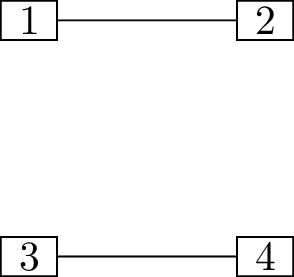
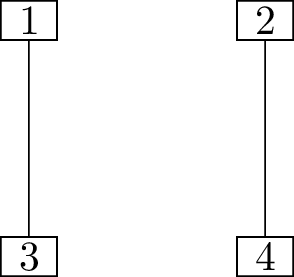
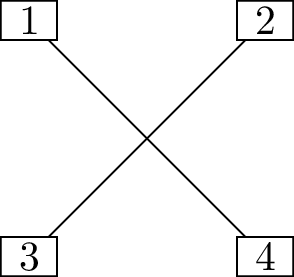
done in Figure 11.1 in the case \(n=4\).
\(12, 34\)\(13, 24\)\(14, 23\)
The \(1\)-regular graphs
with vertex set \(\{1,2,3,4\}\)Are there multiple ways to list the edges
in a graph in a sequence?
Yes: for each edge \(xy\), we can also write it as \(yx\), and we can also write the edges in
any order.
To make the encoding scheme unique, we should make a rule for how the
edges should be written, and in which order they should appear. A simple
option is to write a “sorted sequence of sorted edges”: to sort each
edge \(xy\) so that \(x<y\), and to sort the sequence of edges
by the first number in each pair. This is already done in Figure 11.1.
Are all “sorted sequences of \(n/2\) sorted edges” valid encodings?
No: some of them encode graphs with \(n/2\) edges that are not \(1\)-regular, by leaving out some vertices
and using others too many times. Each vertex must appear exactly
once.
If not all sequences are valid encodings, this complicates our life,
but we can still proceed. We just have to describe which encodings are
valid, and count only the valid ones.
Going from left to right, what are the
constraints on the vertices in the “sorted sequence of sorted
edges”?
The first vertex of each sorted edge is
uniquely determined: it is simply the smallest element of \(\{1,2,\dots,n\}\) that has not yet
appeared. The second vertex of each sorted edge can be any of the
vertices that have not yet appeared.
How many possibilities are there for each
vertices, given the vertices to its left?
There is only \(1\) option for the first vertex of each
sorted edge. For the second vertex in the \(k\)th sorted edge, there are
\(n-2k+1\) options, because \(2k-1\) vertices have already appeared.
In such a case, we can count by the product principle, multiplying
the numbers of possible vertices in each position. We can do so because
that number of options is always the same for a given position, no
matter which vertices came before. (Always make sure that this is true
before applying the product principle!)
Multiplying together the numbers of possible vertices in each
position, we get the product \[\underbrace{1
\cdot (2n-1) \cdot 1 \cdot (2n-3) \cdot 1 \cdot (2n-5) \cdots 1 \cdot 3
\cdot 1 \cdot 1}_{n \text{ factors}}\] in answer to the problem.
We can ignore the factors of \(1\) and
just say that this is the product of the first \(n/2\) odd positive integers. For example,
we get \(3 \cdot 1 = 3\) when \(n=4\) (as seen in Figure 11.1), \(5 \cdot 3 \cdot 1 = 15\) when \(n=6\), \(7\cdot 5
\cdot 3 \cdot 1 = 105\) when \(n=8\), and so on. This product is often
written with the double factorial symbol \((2n-1)!!\). ◻
Trees and deletion sequences
Having solved a few problems for practice, we can move on to the
question we’re really interested in: how many trees with vertex set
\(\{1,2,\dots,n\}\) are there?
The solution to Problem 11.2 gives us a good
starting point. An \(n\)-vertex tree,
as we know, is in particular an \((n-1)\)-vertex graph. So we can begin by
writing down the edges of that graph, in a convenient order.
The most convenient order to use here is not the dictionary order we
used before. We would like to make use of the structure of a tree! In
particular, we know from Lemma 10.6 in
the previous chapter that if we remove a leaf vertex (and its only edge)
from a tree, we get a smaller tree. We used this to great effect to
write inductive proofs of theorems about trees; it can be used to
equally great effect to write recursive algorithms for problems about
trees.
Given a tree \(T\) with vertex set
\(\{1,2,\dots,n\}\), here is an
algorithm to list all its edges in a uniquely defined order:
If \(n=1\), then there are no
edges, so the list of edges should be empty as well.
Otherwise, for \(n>1\), the
tree \(T\) will have some leaves. Let
\(x\) be the lowest numbered leaf, and
let \(y\) be its neighbor: write down
the pair \((x,y)\), in that
order.
Delete vertex \(x\) and edge
\(xy\) from \(T\) to get an \((n-1)\)-vertex tree \(T-x\). To write the rest of the sequence,
go back to step 1, but with tree \(T-x\) in place of \(T\).
We will call the result of this algorithm a deletion
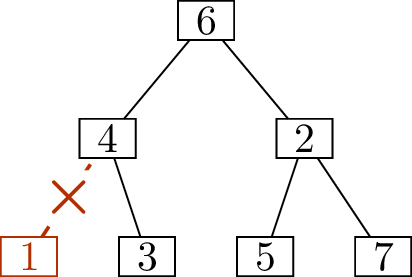
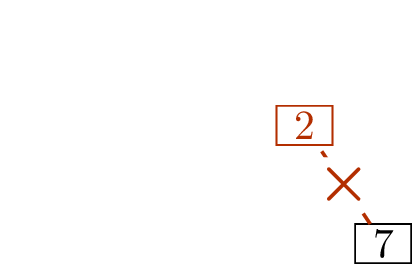
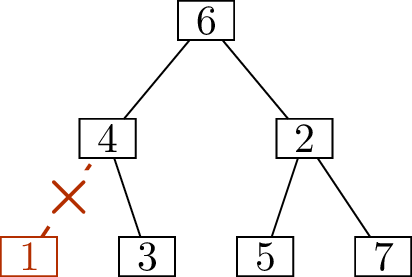
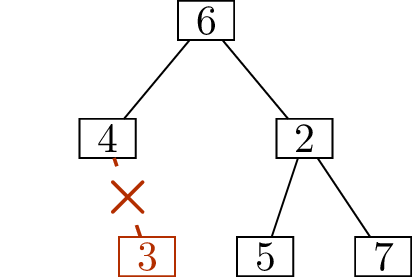
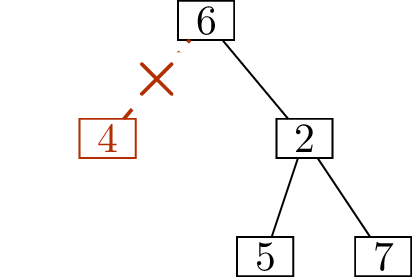
sequence1 for \(T\). As an illustration of the technique,
Figure 11.2 shows how, starting with
the tree in Figure 11.2(a), we determine that its
deletion sequence is \[(1,4),\; (3,4),\;
(4,6),\; (5,2),\; (6,2),\; (2,7).\]
Write down \((1,4)\)Write down \((3,4)\)Write down \((4,6)\)
Write down \((5,2)\)Write down \((6,2)\)Write down \((2,7)\)
Finding the deletion sequence of a treeIs this a unique encoding scheme?
Yes, it is. We can recover the tree from
its deletion sequence, because the deletion sequence is after all a list
of edges. Moreover, each tree only has one deletion sequence, because
the deletion sequence is computed by an algorithm with no freedom at any
step.
There is a great deal of redundancy in the deletion sequence of a
tree. Before proving a general result about it, let’s explore a few
examples. In all of these, I will erase some numbers from the deletion
sequence we just constructed and ask how they can be filled back in to
get a valid deletion sequence. Of course, one way to fill in the number
is to put back the number we erased, getting back the deletion sequence
we started with. However, we want to know if there are any other
deletion sequences that have a different value in that blank!
In the incomplete deletion sequence \[(1,4),\; (3,4),\; (4,6),\; (5,2),\; (6,2),\;
(2,\underline{\phantom{7}}),\] how many ways are there to fill in
the blank?
The number in the blank can only be
\(7\).
The reason is that vertex \(7\) will
never be deleted as the smallest leaf of the tree: there are always at
least two leaves, one of which is smaller than \(7\). Therefore it is the last vertex
remaining, and will always occupy the last position in the deletion
sequence.
In the incomplete deletion sequence \[(1,4),\; (3,4),\; (\underline{\phantom{4}},6),\;
(5,2),\; (6,2),\; (2,7),\] how many ways are there to fill in the
blank?
The number in the blank can only be
\(4\).
The reason is that vertices \(1, 2, 3, 4,
5, 6\) must all be eventually deleted. The five complete ordered
pairs tell us when we deleted vertices \(1\), \(2\), \(3\), \(5\), and \(6\), so the incomplete ordered pair must
tell us when we deleted vertex \(4\).
In the incomplete deletion sequence \[(1,4),\; (3,4),\; (\underline{\phantom{4}},6),\;
(\underline{\phantom{5}},2),\; (6,2),\; (2,7),\] how many ways
are there to fill in the two blanks?
Once again, the answer is uniquely
determined: the blanks must contain \(4\) and \(5\), in that order.
By the same reasoning as above, we know that \(4\) and \(5\) must go in those two blanks in some
order. Since neither number appears later in the deletion sequence, we
know that none of their neighbors are deleted later: after the first two
steps, both vertices \(4\) and \(5\) are leaves. Since \(4\) is a smaller number, it will be the
leaf deleted first.
But all of these questions are thinking too small: we can take the
incomplete sequence \[(\underline{\phantom{1}},4),\;
(\underline{\phantom{3}},4),\; (\underline{\phantom{4}},6),\;
(\underline{\phantom{5}},2),\; (\underline{\phantom{6}},2),\;
(\underline{\phantom{2}},\underline{\phantom{7}})\] and fill in
all \(7\) blanks in a unique way!
First of all, we know that the first six blanks are the numbers \(1\) through \(6\), while the last blank is \(7\). The order of the numbers \(1\) through \(6\) is not known yet, but even without
knowing the order, we know how many times each number appears in the
deletion sequence, in total: the number of times we see it in the
incomplete sequence, plus \(1\).
This tells us the degree of every vertex: \[\begin{array}{c|ccccccc}
x & 1 & 2 & 3 & 4 & 5 & 6 & 7 \\
\hline
\deg(x) & 1 & 3 & 1 & 3 & 1 & 2 & 1
\end{array}\] Why is this helpful? Because it tells us that at
the beginning of the algorithm to generate the deletion sequence, the
leaves were \(1\), \(3\), \(5\), and \(7\). Of these, \(1\) is the smallest, so it must be the
first leaf deleted: the first pair is \((1,4)\).
From there, we can deduce that after vertex \(1\) is deleted, the degrees of the vertices
were as follows: \[\begin{array}{c|cccccc}
x & 2 & 3 & 4 & 5 & 6 & 7 \\
\hline
\deg(x) & 3 & 1 & 2 & 1 & 2 & 1
\end{array}\] The leaves were \(3\), \(5\), and \(7\), of which \(3\) is the smallest. Therefore the second
pair must be \((3,4)\).
If we keep going in this manner, we can reconstruct the entire
deletion sequence, because we can determine the degree of each remaining
vertex at each step of the algorithm. Only \(5\) of the \(12\) numbers in the deletion sequence were
necessary!
Prüfer codes
Our strategy in the preceding section generalizes fully. We can
summarize the properties we use in the following two properties of a
deletion sequence \((a_1, b_1), (a_2, b_2),
\dots, (a_{n-1}, b_{n-1})\):
For every \(k\) from \(1\) to \(n-1\), the number \(a_k\) is the smallest positive number not contained in the set \(\{a_1,
a_2, \dots, a_{k-1}\} \cup \{b_k, b_{k+1}, \dots,
b_{n-2}\}\).
\(b_{n-1}=n\).
Lemma 11.1. If a sequence \((a_1, b_1), (a_2, b_2), \dots, (a_{n-1},
b_{n-1})\) is the deletion sequence of a tree with vertices \(1, 2, \dots, n\), then it satisfies
properties (1) and (2).
Proof. The tree at every stage of the algorithm that
generates the deletion sequence has at least two leaves, so the smallest
leaf will never be vertex \(n\).
Therefore vertex \(n\) will never be
the deleted leaf, so it will be the last vertex remaining: \(b_{n-1} = n\). This proves (2).
Meanwhile, \(a_1, \dots, a_{n-1}\)
are a permutation of \(1, 2, \dots,
n-1\), representing the order in which the other vertices are
deleted. After the first \(k-1\) stages
of the algorithm that generates the deletion sequence, the tree that
remains has edges \((a_k, b_k)\)
through \((a_{n-1}, b_{n-1})\).
Vertices in the set \(\{a_1, a_2, \dots,
a_{k-1}\}\) are not present in this tree; they have already been
deleted.
The remaining vertices of the tree appear once in the set \(\{a_k, a_{k+1}, \dots, a_{n-1},
b_{n-1}\}\). They have degree \(1\) if this is their only appearance: if
they do not appear in the set \(\{b_k,
b_{k+1}, \dots, b_{n-2}\}\). Vertex \(a_k\) is the smallest leaf remaining at
this stage, so it is the smallest positive number not contained in the
set \(\{a_1, a_2, \dots, a_{k-1}\} \cup \{b_k,
b_{k+1}, \dots, b_{n-2}\}\). This proves (1). ◻
Since the numbers determined by Lemma 11.1 can be deduced from the
others, they are not necessary to recover the tree. Therefore, instead
of recording the deletion sequence of a tree, it is enough to record the
sequence \((b_1, b_2, \dots,
b_{n-2})\). This sequence is called the Prüfer
code of the tree, named after Heinz Prüfer, who proposed Prüfer
codes as a method of counting labeled trees in 1918 [88].
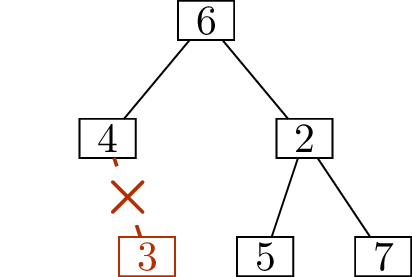
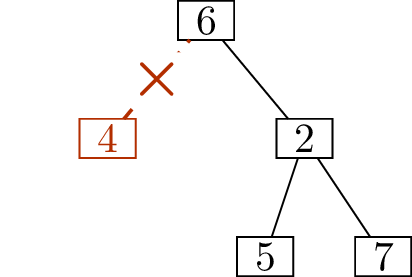
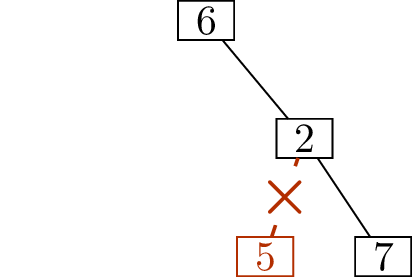
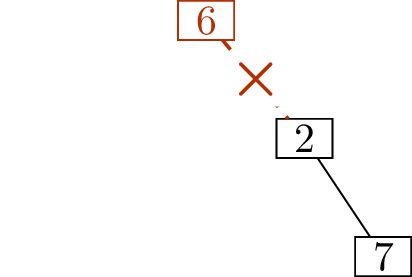
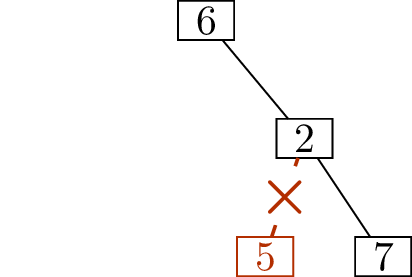
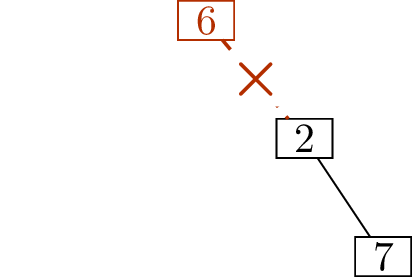
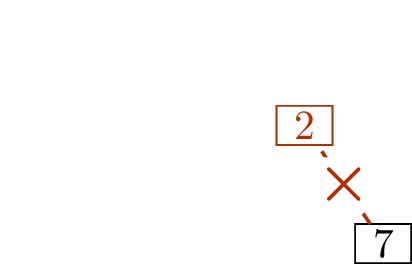
Write down \(4\)Write down \(4\)Write down \(6\)
Write down \(2\)Write down \(2\)Stop
Finding the Prüfer code of a tree
It is worth mentioning that the Prüfer code of a tree can be directly
computed using an abbreviated version of the algorithm that computed the
deletion sequence. The only two differences are that instead of writing
down the pair \((x,y)\), we only write
down the vertex \(y\), and that we stop
when there are \(2\) vertices and \(1\) edge left. Figure 11.3 illustrates this on an
example.
Are Prüfer codes a unique encoding
scheme?
Yes: from the Prüfer code, we can recover
the deletion sequence using properties (1) and (2), and the deletion
sequence simply tells us the edges of the tree.
Is this enough to count the with vertex
set \(\{1,2,\dots,n\}\)?
No: we need to know whether all possible
sequences \((b_1, b_2, \dots,
b_{n-2})\) are valid Prüfer codes, or whether there are some
constraints on these numbers.
In fact, there are no further constraints: every sequence \((b_1, b_2, \dots, b_{n-2})\), where each
term is an element of \(\{1,2,\dots,n\}\), is the Prüfer code of a
tree with vertex set \(\{1,2,\dots,n\}\). To prove this, the most
important claim we have not yet shown is that (1) and (2) are not just
properties every deletion sequence has: they are properties only a
deletion sequence can have.
Lemma 11.2. If a sequence \((a_1, b_1), (a_2, b_2), \dots, (a_{n-1},
b_{n-1})\) in which every term \((a_i,
b_i)\) is a pair of numbers from \(1\) to \(n\) satisfies properties (1) and (2), then it is the
deletion sequence of a tree with vertex set \(\{1,2,\dots,n\}\).
Proof. Let’s make some initial observations. First, since
\(a_k \notin \{a_1, a_2, \dots,
a_{k-1}\}\), the numbers \(a_1, a_2,
\dots, a_{n-1}\) are distinct. They are all smaller than \(n\), since each is the smallest positive
number not contained among at most \(n-2\) options; therefore, they are a
permutation of \(\{1,2,\dots,n-1\}\).
Second, consider \(b_k\) for \(1 \le k \le n-2\). Since none of \(a_1, a_2, \dots, a_k\) can equal \(b_k\), but \(b_k\) is an integer from \(1\) to \(n\), we know that it must be an element of
\(\{a_{k+1}, \dots, a_{n-1}, n\}\).
From this observation, it follows that we can define a graph \(T_k\) with \(V(T_k) = \{a_k, a_{k+1}, \dots, a_{n-1},
n\}\) and \(E(T_k) = \{a_k b_k,
a_{k+1}b_{k+1}, \dots, a_{n-1}b_{n-1}\}\): each edge in \(E(T_k)\) really does have both endpoints in
\(V(T_k)\).
We are now ready to proceed with the proof. The graph \(T_k\) is not just any graph: it is a tree
in which the leaf with the smallest number is \(a_k\). We will prove this by an induction
that starts with \(T_{n-1}\) and ends
with \(T_1\).
In the base case, \(T_{n-1}\) is the
graph with vertices \(\{a_{n-1}, n\}\)
and edge \(a_{n-1} b_{n-1}\); since
\(b_{n-1}=n\), this is an edge between
\(T_{n-1}\)’s two vertices, so \(T_{n-1}\) is a tree. Both \(a_{n-1}\) and \(b_{n-1}\) are leaves, but since \(b_{n-1}=n\) and \(a_{n-1} \ne b_{n-1}\), \(a_{n-1}\) must be the smaller leaf.
Next, for some positive \(k<n-1\), suppose \(T_{k+1}\) is a tree. The only difference
between \(T_k\) and \(T_{k+1}\) is that we add vertex \(a_k\) and edge \(a_k b_k\). By our first observation, \(a_k \notin V(T_{k+1})\), so \(a_k\) is a leaf of \(T_k\). Since \(T_{k+1}\) is a tree, it has no cycles, so
\(T_k\) cannot contain any cycles not
using vertex \(a_k\). It cannot have
any cycles using \(a_k\), either,
because \(a_k\) has degree \(1\). Therefore \(T_k\) still has no cycles; we know it has
\(n-k+1\) vertices and \(n-k\) edges, so it is a tree by condition 5
of Theorem 10.2.
Each \(a_i\) for \(i<k\) is not yet a vertex of \(T_k\), by our first observation. Each \(b_i\) for \(i\ge
k\) appears a second time as \(a_j\) for \(j>i\), by our second observation; so it
is the endpoint of at least two edges of \(T_k\), and is not a leaf. Among the
remaining positive integers, \(a_k\) is
the smallest; therefore in particular it is the smallest leaf of \(T_k\). This completes the induction.
From this claim, it follows that the deletion sequence algorithm,
when encountering tree \(T_k\), will
write down the pair \((a_k, b_k)\) and
delete \(a_k\), then either go on to
tree \(T_{k+1}\) or (if \(k=n-1\)) stop. In particular, if we start
with tree \(T_1\), the deletion
sequence algorithm will proceed through the trees \(T_2, T_3, \dots, T_{n-1}\) and write down
the sequence \[(a_1, b_1), (a_2, b_2), \dots,
(a_{n-1}, b_{n-1}),\] which is exactly what we wanted to
show. ◻
With this setup complete, we are ready to finish counting. This
theorem is known as Cayley’s formula after Arthur Cayley, whom we
already know as the mathematician that came up with the term “tree”.
(So, you see, Prüfer’s argument was not the first to be found. However,
as it sometimes happens, Cayley was not the first, either; the formula
was first proven by Carl Wilhelm Borchardt in 1860 [10].)
Theorem 11.3. There are \(n^{n-2}\) trees with vertex set \(\{1,2,\dots,n\}\).
Proof. Each tree with vertex set \(\{1,2,\dots,n\}\) has a Prüfer code \((b_1, b_2, \dots, b_{n-2})\) whose elements
are integers between \(1\) and \(n\), uniquely defined by the deletion
sequence algorithm. Therefore the number of trees with vertex set \(\{1,2,\dots,n\}\) is exactly the number of
possible Prüfer codes.
Moreover, for every such sequence \((b_1,
b_2, \dots, b_{n-2})\), we can apply (1) to determine \(a_1\), then \(a_2\), and so on through \(a_{n-1}\), as long as we go in that order:
each \(a_k\) will be the smallest
positive integer not contained in a set we’ve already entirely
determined. We can also set \(b_{n-1} =
n\). Now, the sequence \[(a_1, b_1),
(a_2, b_2), \dots, (a_{n-1}, b_{n-1})\] is a deletion sequence of
a tree with vertex set \(\{1,2,\dots,n\}\), by Lemma 11.2, and therefore \((b_1, b_2, \dots, b_{n-2})\) is the Prüfer
code of that tree. This shows that every sequence \(n-2\) integers from \(1\) to \(n\) is a valid Prüfer code. There are
exactly \(n^{n-2}\) such sequences,
since there are \(n\) options for each
of the numbers \(b_1\) through \(b_{n-2}\), so the number of trees with
vertex set \(\{1,2,\dots,n\}\) is also
\(n^{n-2}\). ◻
Working with Prüfer codes
There are a few more difficult questions to ask about Prüfer codes,
but let’s first pause to make sure that we can return from the abstract
results to concrete claims. Take a Prüfer code like \((2,1,2,5,4)\). How do we turn it back into
a tree?
Let’s write down what we know about the deletion sequence of that
tree, even if there’s still some blanks to be filled in: \[(\underline{\phantom{0}}, 2),
(\underline{\phantom{0}}, 1),
(\underline{\phantom{0}}, 2),
(\underline{\phantom{0}}, 5),
(\underline{\phantom{0}}, 4),
(\underline{\phantom{0}}, \underline{\phantom{0}}).\] A Prüfer
code is always a sequence of \(n-2\)
numbers from \(1\) to \(n\); since we started with \(5\) numbers, their values will range from
\(1\) to \(7\). We fill in the blanks from left to
right.
For the first blank, which is \(a_1\), we use (1). There are no \(a\)-terms before \(a_1\); however, \(a_1\) needs to be distinct from \(\{b_1, b_2, b_3, b_4, b_5\} = \{1, 2, 4,
5\}\). The smallest integer not on this list is \(3\), so we set \(a_1 = 3\): \[(3,
2),
(\underline{\phantom{0}}, 1),
(\underline{\phantom{0}}, 2),
(\underline{\phantom{0}}, 5),
(\underline{\phantom{0}}, 4),
(\underline{\phantom{0}}, \underline{\phantom{0}}).\] We continue
to use (1) for the next blank,
which is \(a_2\). Here, the excluded
values are \(a_1, b_2, b_3, b_4, b_5\)
or \(3, 1, 2, 5, 4\). We fill in the
blank with the first integer not on this list, which is \(6\): \[(3, 2),
(6, 1),
(\underline{\phantom{0}}, 2),
(\underline{\phantom{0}}, 5),
(\underline{\phantom{0}}, 4),
(\underline{\phantom{0}}, \underline{\phantom{0}}).\] We go on in
this way. Some people prefer to arrange the entries in a \(2 \times (n-1)\) table, where each \(a_i\) entry (in the first, initially empty
row) must be distinct from everything to its left, as well as everything
below it and to the right: \[\begin{array}{c|c|c|c|c|c}
a_1 & a_2 & a_3 & a_4 & a_5 & a_6 \\
\hline
b_1 & b_2 & b_3 & b_4 & b_5 & b_6
\end{array}
\quad
=
\quad
\begin{array}{c|c|c|c|c|c}
3 & 6 & ? & & & \\
\hline
2 & 1 & 2 & 5 & 4 &
\end{array}\] Regardless, we fill in \(a_3 = 1\) (the smallest value not among
\(3, 6, 2, 5, 4\)), then \(a_4 = 2\) (the smallest value not among
\(3, 6, 1, 5, 4\)), then \(a_5 = 5\) (the smallest value not among
\(3, 6, 1, 2, 4\)), then \(a_6 = 4\) (the smallest value not among
\(3, 6, 1, 2, 5\)). All this is done
using (1); then, the last blank
is \(b_6 = 7\) by (2). The completed
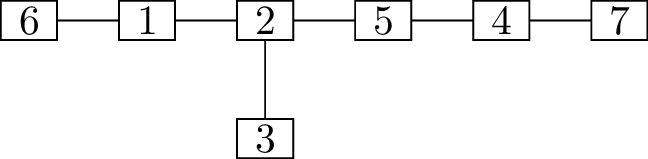
deletion sequence is \[(3, 2),
(6, 1),
(1, 2),
(2, 5),
(5, 4),
(4, 7).\] This sequence tells us the edges of the tree, and if we
like, we can draw a diagram such as the one in Figure 11.4.
The tree with Prüfer code \((2, 1,
2, 5, 4)\).
That being said, it is not too often that we find ourselves needing
to actually convert a Prüfer code back into a tree: it only matters for
the proof of Theorem 11.3 that we can, in principle, do
it.
This does not mean that Prüfer codes have no use beyond the proof of
Theorem 11.3. The Prüfer code of a tree actually
contains a bit of information about the tree, which we can use to solve
more complicated counting problems. For example:
Proposition 11.4. In the Prüfer code of a tree
where \(\deg(x) = k\), the number \(x\) appears \(k-1\) times.
Proof. When we fill in the blanks in the sequence \[(\underline{\phantom{a_1}}, b_1),
(\underline{\phantom{a_1}}, b_2), \dots, (\underline{\phantom{a_1}},
b_{n-2}), (\underline{\phantom{a_1}},
\underline{\phantom{a_1}})\] we use each of the numbers \(1, 2, \dots, n\) once. The number \(n\) is going to fill in the second blank of
the last pair, and the numbers in the first blanks are a permutation of
\(1, 2, \dots, n-1\).
Therefore if a number \(x\) appears
\(k-1\) times in the Prüfer code, it
appears \(k\) times in the deletion
sequence \[(a_1, b_1), (a_2, b_2), \dots,
(a_{n-1}, b_{n-1}).\] But the deletion sequence is just a
particular way to write down the edges of the tree, so if \(x\) appears in the deletion sequence \(k\) times, then it is the endpoint of \(k\) edges, which is just another way of
saying that \(\deg(x) = k\). ◻
For example, even before we turned the Prüfer code \((2,1,2,5,4)\) back into the tree shown in
Figure 11.4, we could have known
the rough structure of the tree:
Vertices \(3\), \(6\), and \(7\) are leaves, because they do not appear
in the Prüfer code at all.
Vertices \(1, 4, 5\) appear
once, and therefore have degree \(2\).
Vertex \(2\) appears twice, and
therefore has degree \(3\).
What can we say about the shape of such a
tree, knowing only the degrees of the vertices?
Such a tree must consist of three paths
starting at vertices \(3\), \(6\), \(7\)
and converging at vertex \(2\).
Here is a quick example of using Proposition 11.4 to solve a counting
problem:
Corollary 11.5. There are \((n-1)^{n-2}\) trees with vertex set \(\{1, 2, \dots, n\}\) in which vertex \(1\) is a leaf.
Proof. By Proposition 11.4,
vertex \(1\) is a leaf (has degree
\(1\)) if and only if the number \(1\) never appears in the Prüfer code. There
are \((n-1)^{n-2}\) such codes: the
code is a sequence with \(n-2\) terms,
each of which is now restricted to one of the \(n-1\) values in the set \(\{2, 3, \dots, n\}\). Therefore there are
\((n-1)^{n-2}\) such trees. ◻
Unlabeled trees
Now that we’ve counted labeled trees on \(n\) vertices, we can try to say something
about unlabeled trees. How many \(n\)-vertex trees are there, up to
isomorphism? As I mentioned earlier in this chapter, we can think of
this as counting equivalence classes of the \(n^{n-2}\) trees with vertex set \(\{1,2,\dots,n\}\). Each equivalence class
is a set of trees that are isomorphic (but not equal).
Sometimes, if we’re very lucky, the equivalence classes all have the
same size. In that case, to count the equivalence classes, we can
divided by the number of elements of one equivalence class. Let’s begin
by destroying all such hopes: when we count trees, the equivalence
classes are far from equal in size.
An \(n\)-vertex path
graphAn \(n\)-vertex star
graph
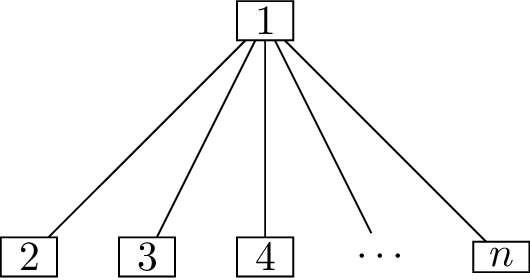
Two trees with very different structuresFigure 11.5(a) shows the path graph
\(P_n\). How many trees with vertex set
\(\{1,2,\dots,n\}\) are isomorphic to
it?
There are \(n!\) ways to put the vertices in order from
left to right along the path. However, the graph does not know a “left”
and a “right”: if you reverse the sequence, you get the same graph,
drawn in reverse. Therefore there are \(\frac
12 n!\) paths with vertex set \(\{1,2,\dots,n\}\).
Figure 11.5(b) shows the star graph
\(S_n\). How many trees with vertex set
\(\{1,2,\dots,n\}\) are isomorphic to
it?
As soon as we choose which vertex in the
set \(\{1,2,\dots,n\}\) is the vertex
of degree \(n-1\) at the center of the
star, the graph is completely determined. Therefore there are \(n\) stars with vertex set \(\{1,2,\dots,n\}\).
If all \(n\)-vertex trees were like
\(P_n\), then every equivalence class
would have \(\frac12 n!\) elements, and
the number of equivalence classes would be the quotient \(n^{n-2}/(\frac12 n!)\). If instead all
\(n\)-vertex trees were like \(S_n\), then every equivalence class would
have \(n\) elements, and the number of
equivalence classes would be \(\frac{n^{n-2}}{n}\) or \(n^{n-3}\).
In reality, neither of these extremes is the case. The truth is
somewhere in the middle; but it is more like the first answer than the
second. Why? Well, the reason that there are very few different trees
isomorphic to \(S_n\) is that the star
graph has a lot of symmetry. Most large trees are not nearly as
symmetric, so most equivalence classes are pretty large.
A result known as Stirling’s formula says that, very approximately,
\(n!\) grows like \((\frac ne)^n\), where \(e \approx 2.718\) is Euler’s number.2 If we plug this into the quotient
\(n^{n-2}/(\frac12 n!)\), we get an
estimate of \(2e^n/n^2\) for the number
of unlabeled trees. This is not the true growth rate, but it is the
right type of growth: the number of unlabeled trees really does grow
exponentially. That growth rate was first precisely analyzed in 1937 by
George Pólya [84], who
described it as an exponential \(c^n\)
with \(c \approx 2.9557\), divided by a
polynomial factor.
No exact formula is known. In the Online Encyclopedia of Integer
Sequences, the number of \(n\)-vertex
unlabeled trees can be found in one of the very first sequences:
sequence A000055 [79].
The first few terms are \[1, 1, 1, 1, 2, 3,
6, 11, 23, 47, 106, 235, \dots\] The initial \(1\)’s in this sequence correspond to \(n=0\)3 through \(n=3\), where only one \(n\)-vertex tree is possible. (For \(n=4\), we have two options: the \(4\)-vertex path, and the \(4\)-vertex star.)
Practice problems
Find the trees with the following Prüfer codes:
\((3, 3, 3, 3, 3)\).
\((2, 7, 1, 5, 4, 6)\).
\((3, 1, 4, 1, 5, 9,
2)\).
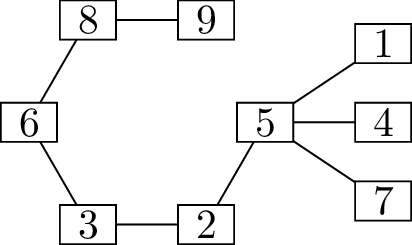
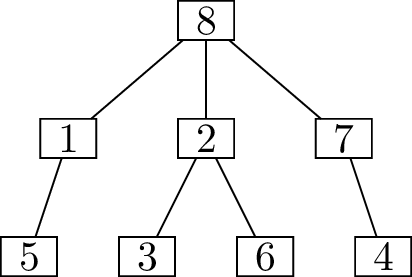
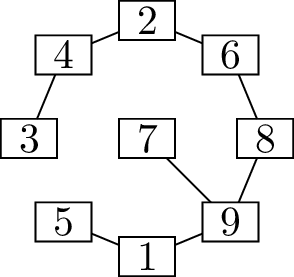
Find the Prüfer codes of the following trees:
(One of these Prüfer codes gives you my birth date. Another is the
first few digits of Euler’s number \(e\). Another tells you the phone number to
call to reach Ghostbusters.)
Find all \(16\) trees with
vertices \(\{1, 2, 3, 4\}\).
What is the Prüfer code of the path graph in Figure 11.5(a), and what is the general
form of a Prüfer code for a tree isomorphic to it?
What is the Prüfer code of the star graph in Figure 11.5(b), and what is the general
form of a Prüfer code for a tree isomorphic to it?
Is it true that if only one number is changed in a Prüfer code,
then this only changes the tree it corresponds to by one edge?
If so, prove it. If not, find (in terms of \(n\)) the maximum number of edges that can
change in the tree, if the Prüfer code changes in only one
position.
Let \(f(n)\) be the number of
trees with vertex set \(\{1,2,\dots,n\}\) that contain the edge
\(12\).
Prove that \(f(n)\) is also the
number of trees with vertex set \(\{1,2,\dots,n\}\) that contain the edge
\(xy\), for any other edge \(xy\) that such a tree could have.
Using part (a), find and prove a formula for \(f(n)\).
Let \(G\) be a graph with \(n\) vertices and \(\binom n2 - 1\) edges. In terms of \(n\), find the number of spanning trees
\(G\) has.
Footnotes
This is not a universally recognized term, but simply
the term I will use in this chapter to explain our counting strategy.↩︎
See the second problem at the end of this chapter if you
want to know more digits of this constant, but prepare to do some work,
first.↩︎
I actually disagree with the OEIS on the initial value;
I do not believe there is a \(0\)-vertex tree. Even if we allow \(0\)-vertex graphs to be exist, they would
surely have \(0\) edges, but an \(n\)-vertex tree should have \(n-1\) edges. My opinion, which does not
really affect anything but definitions and initial terms, is that the
\(0\)-vertex graph exists but is not
connected.↩︎